
Newsroom


Researchers revealed an ultralow-barrier collective sliding mechanism mediated by domain walls, as well as defect-induced pinning of the sliding motion. They found that twisted bilayer MoS2 moiré superlattices can undergo spontaneous long-range interlayer sliding at room temperature, while a sulfur-vacancy concentration of only about 0.1% can turn the motion into localized oscillations.
The study was conducted by a collaborative team involving Profs. ZHANG Jin and SHI Xinghua from the National Center for Nanoscience and Technology (NCNST) of the Chinese Academy of Sciences (CAS), and Prof. MENG Sheng from the Institute of Physics (IOP) of CAS.
The findings were published in the Journal of the American Chemical Society.
In recent years, two-dimensional moiré superlattices have become a major research focus in condensed matter physics and materials science because of their unique structural tunability and rich physical properties.
When two layers are stacked with a small twist angle, the interlayer stacking configurations vary periodically, and atomic relaxation gives rise to distinct stacking domains and interconnected domain-wall networks. Such complex structural reconstruction can give rise to unusual electronic and ferroelectric properties and may also induce collective dynamical behaviors distinct from those in conventional layered materials.
Using a high-accuracy machine-learning interatomic potential, the researchers performed molecular dynamics simulations of moiré superlattices containing more than 10,000 atoms. They found that, under ideal defect-free conditions, twisted bilayer MoS2 can undergo spontaneous interlayer sliding at a speed of approximately 1 m/s at room temperature, accompanied by an overall drift of the moiré pattern.
The conventional rigid-sliding model cannot readily explain this phenomenon. When domain-wall motion and local atomic reconstruction are allowed, however, the sliding barrier is reduced by nearly two orders of magnitude, revealing an almost barrierless collective sliding mechanism mediated by domain walls.
In realistic materials, however, atomic defects are ubiquitous. The researchers further found that a sulfur-vacancy concentration of only about 0.1% is sufficient to convert long-range sliding into localized oscillations, demonstrating the significant influence of atomic defects on interlayer dynamics.
Further analysis showed that sulfur vacancies have the lowest relative energy in SP stacking regions at the junctions of the domain-wall network, making these regions preferential pinning centers. As the moiré pattern drifts, SP junctions can become trapped by the local potential wells associated with sulfur vacancies. The competition between sliding and pinning is determined by the relative magnitudes of the defect-pinning energy and the energy required to deform the moiré structure.
The findings reveal a collective sliding mechanism in ferroelectric moiré superlattices that differs from conventional rigid interlayer translation. They clarify the key roles of domain-wall motion and atomic defects in interlayer dynamics, deepen understanding of two-dimensional sliding ferroelectrics and collective dynamics in moiré superlattices, and provide a theoretical basis for controlling moiré superlattice dynamics through defect engineering.
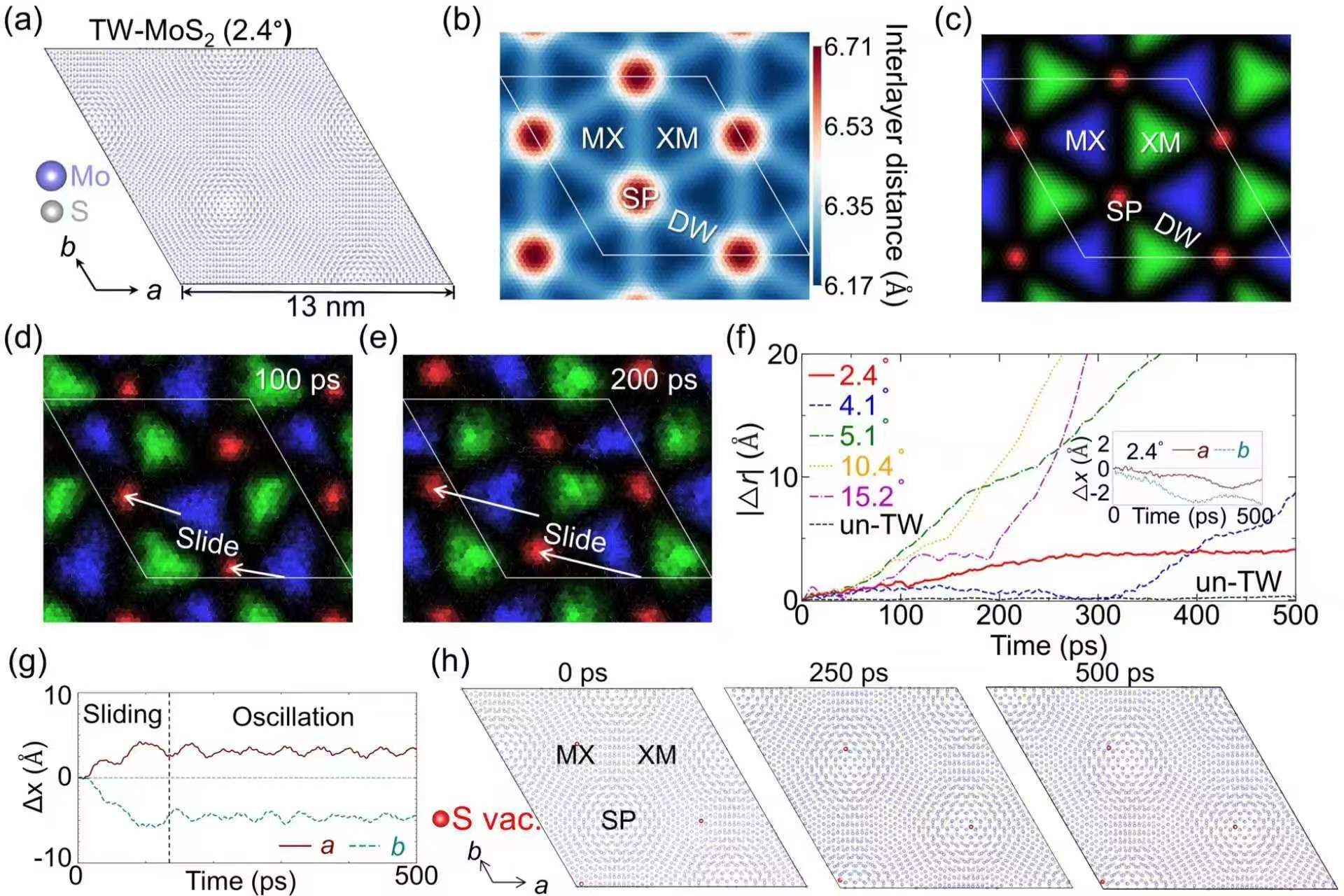
Room-temperature spontaneous sliding and sulfur-vacancy-induced pinning in moiré superlattices (Image by ZHANG Jin et al.)
