
Newsroom


Researchers from the Hefei Institutes of Physical Science (HFIPS) of the Chinese Academy of Sciences (CAS) have developed a carbon dioxide (CO2) sensor that combines high sensitivity with a wider measurement range.
The sensor uses dual-polarization, single-triangular-cavity cavity ring-down spectroscopy (DPS-CRDS). It measures two types of polarized light in the same optical cavity to detect CO2 at both low and high concentrations.
Led by ZHANG Zhirong from HFIPS, the work was published in Sensors and Actuators B: Chemical.
CO2 monitoring is important for studying the atmosphere and assessing indoor air quality. Cavity ring-down spectroscopy (CRDS) is widely used to detect gases at very low concentrations. However, conventional systems often struggle to maintain high sensitivity while measuring across a wide range of concentrations.
In this study, the researchers used two types of polarized light, S and P, in the same optical cavity. The two types of light respond differently inside the cavity. S-polarized light is more sensitive to low CO2 concentrations, while P-polarized light can measure higher concentrations. By combining the two, the sensor can cover a much wider range of CO2 levels.
Tests showed that the sensor could measure CO2 concentrations from 50 to 10,000 parts per million (ppm), expanding the measurement range by more than ten times compared with using S-polarized light alone.
The researchers also tested the sensor in real-world settings. Indoors, it tracked changes in CO2 levels as room occupancy and ventilation varied. In outdoor tests, it continuously monitored atmospheric CO2, capturing daily fluctuations in concentration.
The same technique could also be adapted to detect other gases by adjusting the measurement wavelength and optical cavity, potentially expanding the use of CRDS sensors in indoor air quality monitoring and atmospheric studies, according to the researchers.
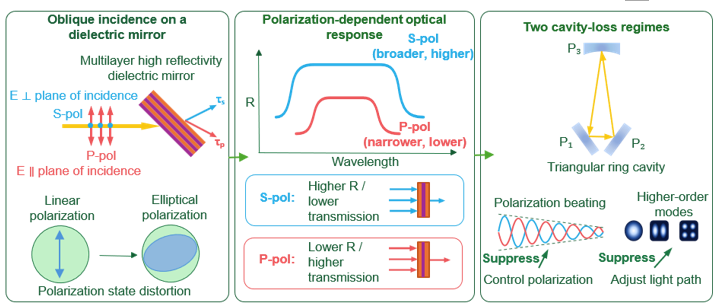
DPS-CRDS system high-sensitivity wide-range CO2 monitoring. (Image by LIN Yuqing)
