
Newsroom


Gastrointestinal fistulas are abnormal passages between the digestive tract and another organ or tissue. They are a common complication of surgery, trauma, inflammatory diseases, and malignant tumors and can be life-threatening in severe cases.
Current endoscopic fistula treatments have limitations, though: Stents migrate, fistulas closed with titanium clips recur, and endoscopic suturing is technically challenging. Postoperative tissue adhesion further complicates clinical treatment. As a result, safer, more effective repair strategies are needed.
Now researchers have developed a thermoresponsive hydrogel sealant—inspired by slugs—that has proved effective at sealing gastrointestinal fistulas in animal models. The sealant, which is injected through a standard endoscope, rapidly solidifies upon entering the body, thus offering a new, minimally invasive way to treat gastrointestinal fistulas.
The study was led by Prof. BAI Shuo from the Institute of Process Engineering of the Chinese Academy of Sciences, in collaboration with Dr. LI Jingtao's team from the China–Japan Friendship Hospital. Their findings were published in Nature Biomedical Engineering on October 30.
Slugs living in humid jungles can secrete a defensive mucus that firmly attaches tree frogs to branches. This mucus is rich in positively charged proteins that adhere to wet tissue through electrostatic interactions and physical entanglement. The proteins transform from a solution into a gel under the action of metal ions and environmental factors.
Inspired by this substance, the researchers combined linear poly(N-isopropylacrylamide) (PNIPAM) with Ga3+ to prepare a PGaIII sealant. At 25 °C, the sealant is a transparent, flowing "mucus" that passes smoothly through a 27-gauge needle and a standard endoscopic channel. However, once delivered into the body, where the temperature is approximately 37 °C, the sealant transforms into a gel within about 30 seconds.
The tissue-facing surface adheres firmly to negatively charged tissue through electrostatic interactions and topological entanglement, while its lumen-facing surface remains non-adhesive. The sealant's injection, adhesion, and contraction are completed in a single step—achieving double-sided asymmetric (Janus-type) adhesion that is "sticky on one side and non-sticky on the other." The researchers termed this mechanism "slug-inspired electrostatically assisted topological (SET) Janus adhesion."
This design resolves a previous limitation of injectable hydrogels by not requiring that the gel maintain asymmetric adhesion before or during the injection process.
In vitro experiments showed that the adhesive side of PGaIII has a shear strength of approximately 10.46 kPa, compared to just 0.11 kPa on the non-adhesive side—a difference of nearly 100-fold. In an ex vivo porcine stomach model, the hydrogel sealed a 10-mm perforation without leakage.
At body temperature, PGaIII undergoes a hydrophobic transition and actively expels water. Consequently, its adhesion strength and burst pressure increase rather than decrease after immersion in simulated gastric acid at pH 1.0, whereas those of commercial fibrin glue drop markedly. Meanwhile, the researchers observed that the surface area of the hydrogel shrank by about 51.6%, generating a centripetal traction force that avoids the problem of widening the fistula opening due to swelling.
In addition, Ga3+ interferes with bacterial iron metabolism, providing an inhibition efficiency of about 98.6% against Escherichia coli and Staphylococcus aureus. Cytotoxicity, hemolysis, and long-term in vivo safety evaluations were all favorable.
In a rat gastric fistula model, the postoperative mortality of the PGaIII group was only 3.3%, lower than that of the suture group (6.7%) and the fibrin glue group (56.7%), with almost no postoperative adhesion and near-complete recovery of the gastric wall structure on day 21, whereas the other groups both developed severe adhesions.
In a Bama pig model, the researchers endoscopically applied PGaIII to a 20-mm gastric fistula. After 14 days, the fistula had closed completely, the mucosa was smooth, and the repair quality was superior to that of the titanium clip group. In addition, no foreign-body residue was observed.
This study provides a ready-to-use biosealant with a simple workflow for the endoscopic, minimally invasive treatment of gastrointestinal fistulas. It also offers ideas for repairing fistulas in other organs and designing next-generation medical sealing materials for minimally invasive surgery.
"We will further study the metabolism and clearance of Ga³⁺ in large animals and the influence of gastrointestinal pH fluctuations on the degradation rate," said Prof. BAI, who also noted that the researchers plan to optimize the catheter delivery system and manufacturing process to promote clinical translation.
Since the findings are based on preclinical studies in animal models, further research is needed to establish the material's safety and efficacy in human patients.
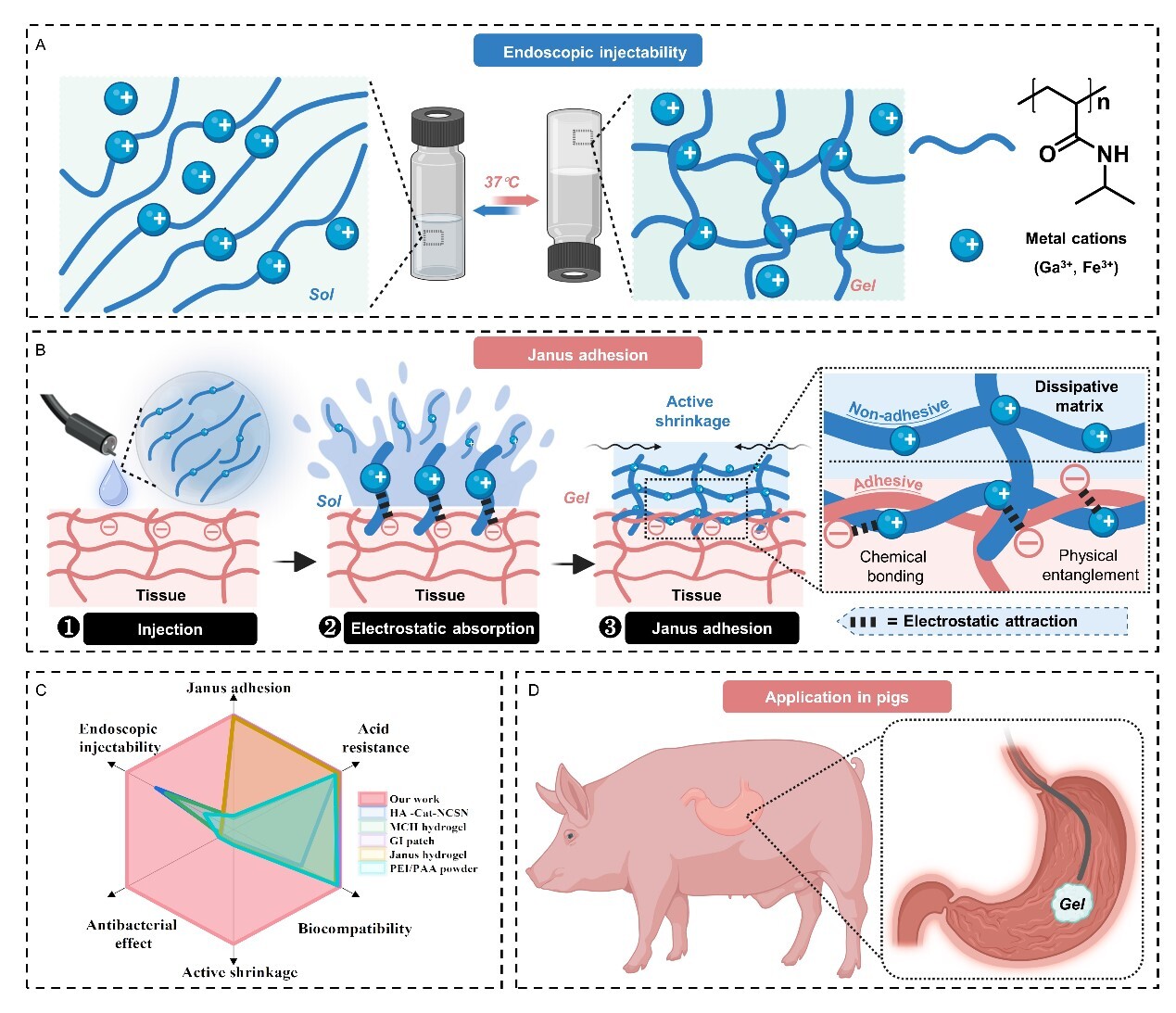
Schematic illustration of the mechanism and in vivo application of the injectable Janus adhesive hydrogel (Image by LIANG Sen)
