
Newsroom


Passive daytime radiative cooling (PDRC) offers a zero-energy route to personal thermal management by reflecting sunlight and dissipating heat through the atmospheric transparency window. Electrospun thermoplastic polyurethane (TPU) is an attractive cooling-textile substrate because of its flexibility, breathability and high infrared emissivity, but its intrinsic ultraviolet (UV) absorption introduces photothermal heating and photoaging. Existing cooling fabrics also remain white or silvery, lacking both color and adaptive moisture control.
Recently, a research group led by Profs. WU Lixin and WENG Zixiang from the Fujian Institute of Research on the Structure of Matter (FJIRSM) of the Chinese Academy of Sciences has addressed these limitations by fabricating a hierarchical bilayer nanofibrous membrane (denoted as FTPT-5) that integrates fluorescent photon management, multi-scale optical scattering and a temperature-responsive wettability layer.
The findings were published in Small.
In the study, the researchers introduced fluorescent microspheres (FMs), whose excitation spectrum fully covers the UV absorption band of TPU. Acting as UV competitors, the FMs harvest UV photons that would otherwise be absorbed by urethane linkages and re-emit them as bright orange-red visible light.
The resulting membrane reaches a photoluminescence quantum yield of 63.3% and converts 53.2% of the UV photothermal load into fluorescence, simultaneously reducing heat accumulation, suppressing photodegradation and endowing the textile with vivid color.
To boost broadband solar reflection, the researchers constructed a highly reflective TPU underlayer via high-concentration electrospinning, producing a hierarchical fiber-diameter distribution that scatters sunlight across the solar spectrum.
The composite membrane achieves an effective solar reflectance (ESRsol) of 96.7%, which remains as high as 95.2% after 200 minutes of accelerated UV aging. A Monte Carlo simulation confirmed that the bimodal fiber architecture maximizes scattering in the FM excitation band while minimizing it in the emission band, favoring bright, stable color.
On one side of the membrane, the team grafted a poly(N-isopropylacrylamide) (PNIPAM) network with a lower critical solution temperature (LCST) near 32 °C, close to the human thermal discomfort threshold. Below this temperature, the layer keeps sweat evaporation moderate (262.9 W·m-2 at 25 °C) for dry comfort; above it, the PNIPAM layer switches wettability and accelerates sweat transport, raising the evaporative cooling power to 392.4 W·m-2 at 38 °C. The radiative and evaporative pathways together compensate for the intrinsic power shortfall of standalone radiative coolers.
According to the researchers, the study turns the UV weakness of polymer cooling textiles into a colored, durable advantage and provides a scalable electrospinning strategy for zero-energy, all-day personal thermal management. The researchers also estimated that the technology has nationwide cooling-power potential on the order of 10 GW.
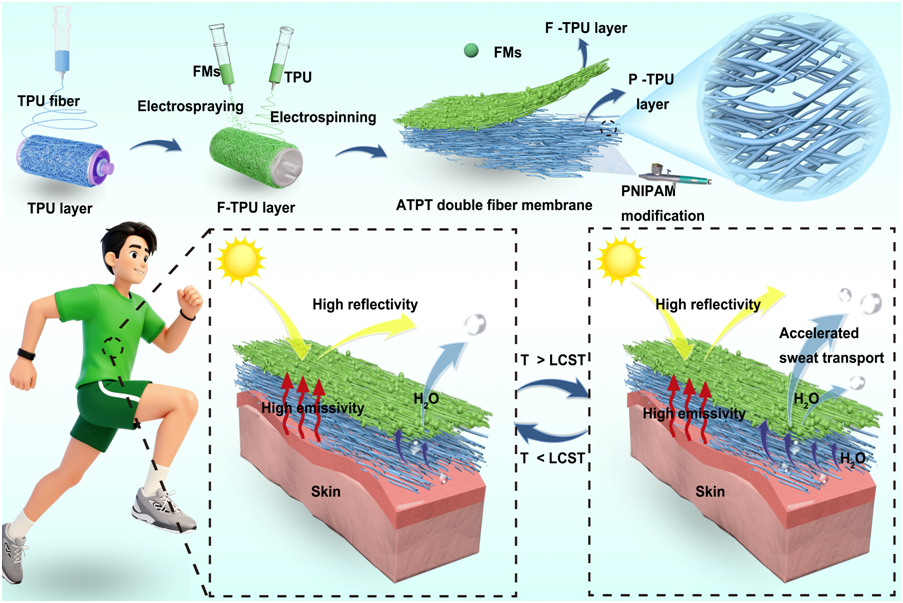
Schematic of the electrospun/electrosprayed FTPT membrane fabrication (top) and its self-adaptive thermal-wet regulation: high solar reflectance and infrared emission cool the skin, while the PNIPAM layer switches sweat transport below and above the LCST. (Image by Prof. WU's group)

