
Newsroom


Researchers have developed a new strategy to enhance charge transport in organic–inorganic hybrid perovskites by introducing an electrostatic buffer between radical-containing molecules. Despite a larger molecular separation, the buffered material showed approximately 100-fold increases in conductivity and photocurrent.
The study, published in Angewandte Chemie International Edition, was led by Prof. LIN Shujuan and Prof. GUO Guocong from the Fujian Institute of Research on the Structure of Matter of the Chinese Academy of Sciences. The researchers proposed a strategy called electrostatically buffered radical coupling (EBRC), which uses an electrostatic buffering medium between radicals to spread local charge density, reduce potential buildup and the on-site Coulomb repulsion parameter U, and restore intermolecular electronic communication.
Organic–inorganic hybrid perovskites combine charge-transporting inorganic frameworks with chemically versatile organic sublattices, but their organic components are typically electronically inactive. Radicals could change that, although compact radical π-stacking also strengthens Coulomb repulsion and can localize carriers in Mott–Hubbard-type states.
To test the strategy, the researchers compared two photochromic, viologen-based hybrid perovskites. In compound 1, (BAeV)Cl8Pb2·2H2O, lattice water separates neighboring viologen cations at 3.48–4.11 Å and serves as the buffer; compound 2, (AeV)2Pb3Cl10, instead adopts compact radical π–π stacking at 3.47–3.69 Å.
Despite its larger molecular separation, the buffered system exhibited substantial improvements in electrical performance, with conductivity and photocurrent increasing by approximately 100-fold.
The difference in their electrical performance was substantial. Repeated measurements on four crystals of the buffered system gave a 185 ± 73-fold conductivity increase and a 93 ± 24-fold increase in electron mobility. The compact system produced only about a 30% conductivity increase and a weak photoresponse, even though its radical fraction, 2.48%, exceeded that of compound 1 (1.02%).
To understand the mechanism behind the improved performance, the researchers examined changes in the materials' electronic structure under light exposure. Spectroscopic and transient-absorption measurements indicated that the improvement was associated with a light-induced reconstruction of the electronic structure. EPR confirmed radical formation, UPS showed a 0.54 eV upward shift of the valence-band maximum, and the optical band gap narrowed from 2.70 to 2.61 eV. Femtosecond transient absorption further resolved electron transfer from the inorganic framework to the viologen radical within 127 fs.
Additional experiments highlighted the importance of the buffering environment. Dehydration suppressed the radical fraction and removed the conductivity gain; rehydration restored most of the coloration response but not long-range conduction. These results show that the enhancement depends on electrostatic coupling among radicals rather than on radical concentration alone.
According to the researchers, EBRC offers a design principle complementary to conventional orbital overlap: inserting dielectric or charge-buffering species can tune the local electrostatic environment and activate electronic function in perovskites and related radical semiconductors.
However, the strategy has so far been demonstrated in one-dimensional lead chloride single crystals and a relatively wide-gap system. Extending it to strongly light-absorbing materials and other mixed-valence frameworks remains an important direction for further research.
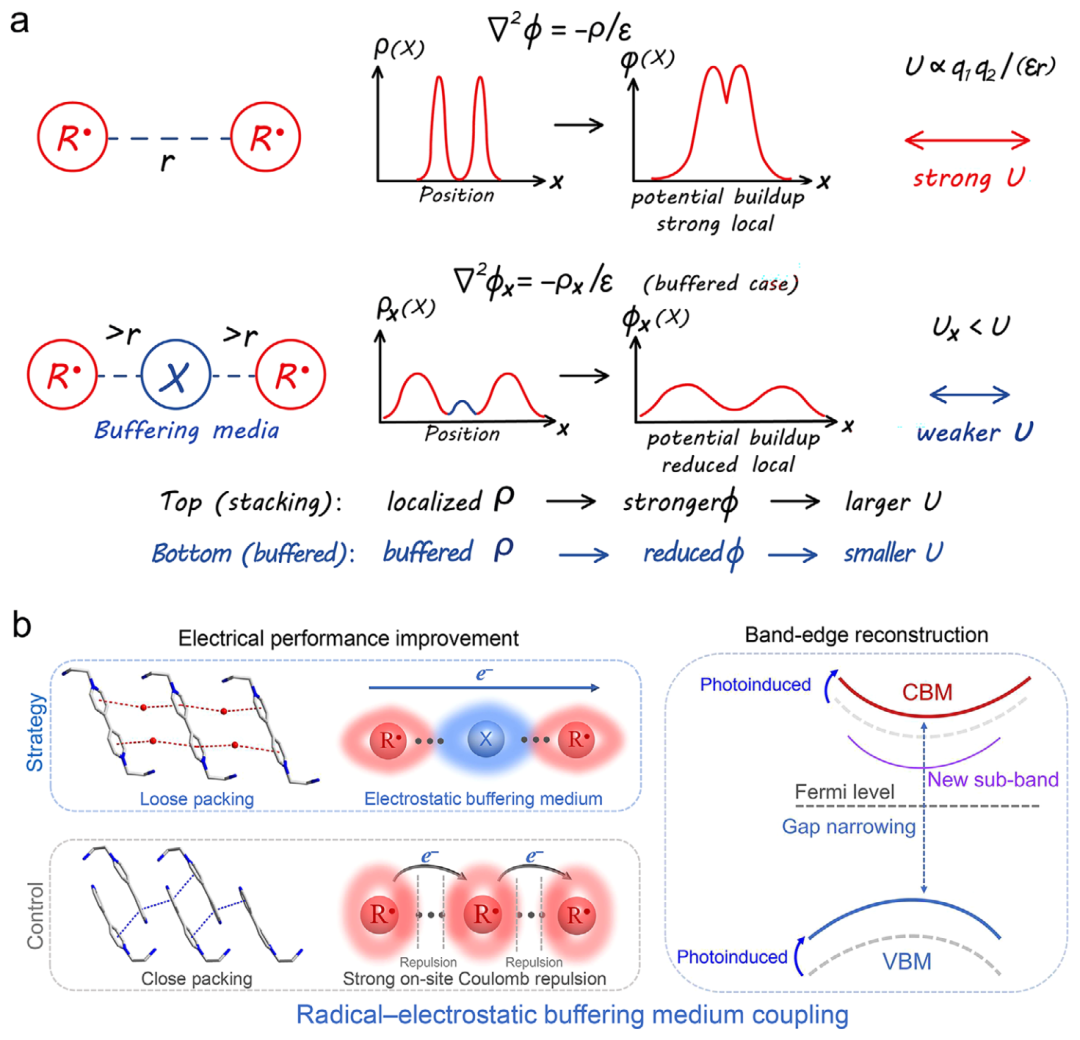
Illustration of the research (Image by Prof. LIN and Prof. GUO's group)
