
Newsroom


Researchers from the Shanghai Astronomical Observatory of the Chinese Academy of Sciences, in collaboration with the University of California, Berkeley, have conducted comprehensive studies to date of the intricate physical interplay between gas dynamics, turbulence and magnetic fields within filamentary molecular clouds.
Using high-resolution numerical simulations, the team mapped the complete evolutionary sequence: from the emergence of elongated, tenuous filamentary molecular clouds made up of numerous filamentary substructures, through the formation of dense cloud cores, and onward to the cores' subsequent evolution.
Their findings were recently published in The Astrophysical Journal.
Leveraging ORION2 — a multi-physics code with adaptive mesh refinement capabilities — the researchers ran a large-scale simulation of an environment featuring a moderately strong magnetic field and supersonic turbulence at Mach 10. The simulated domain extends 4.55 parsecs (pc) in length. Adaptive refinement delivers a peak resolution of 458 astronomical units (au), yielding a spatial dynamic range spanning three orders of magnitude. This setup enables the simulation to capture the formation of a 4.4-pc massive filamentary cloud, resolve filamentary substructures with a median full width at half maximum (FWHM) of 0.03–0.04 pc, and track core formation along these substructures.
Before gravitational effects are switched on, supersonic turbulence generates abundant low-density filaments shorter than one parsec across the simulation volume. Large-scale flows sweep these filaments toward convergence zones. Inside the primary filament, low-density subfilaments collide and coalesce, growing denser and more extended. Eventually, some highly compact subfilaments turn unstable and fragment into dense cores along their length or at intersection points.
The simulation offers evidence that filamentary substructures act as the fundamental building blocks of filamentary clouds. The team's model shows that filamentary substructures first arise in the interstellar medium from supersonic turbulence. These short, low-density filaments are then gathered by large-scale turbulent flows to assemble into extended filamentary clouds. Throughout this assembly phase, the low-density features — which become filamentary substructures embedded within the larger cloud — merge to grow longer and more massive. Magnetic support keeps them stable until they cross the supercritical threshold. Dense cores preferentially emerge at sites of subfilament collision and merger. Cores may also coalesce over time, creating an efficient pathway for rapid mass accretion. In denser, crowded regions, such mergers may represent the dominant mechanism for building massive cores and spawning massive stars.
One core evolves within a relatively sparse region of the simulation. Interactions and mergers with attached subfilaments and neighbouring gas structures impart angular momentum, setting the core into rotation. The spinning core then experiences rapid gravitational collapse and flattens, while its rotation winds the embedded magnetic field into a helical configuration.
This work demonstrates that supersonic turbulence and magnetic fields are critical to the early formation of thin, low-density filamentary structures. Magnetic fields stabilise growing large-scale filaments. Once mergers push subfilaments into the supercritical regime, gravity takes over and drives core formation. Merging cores generate rapid rotation and create favourable conditions for binary star formation.
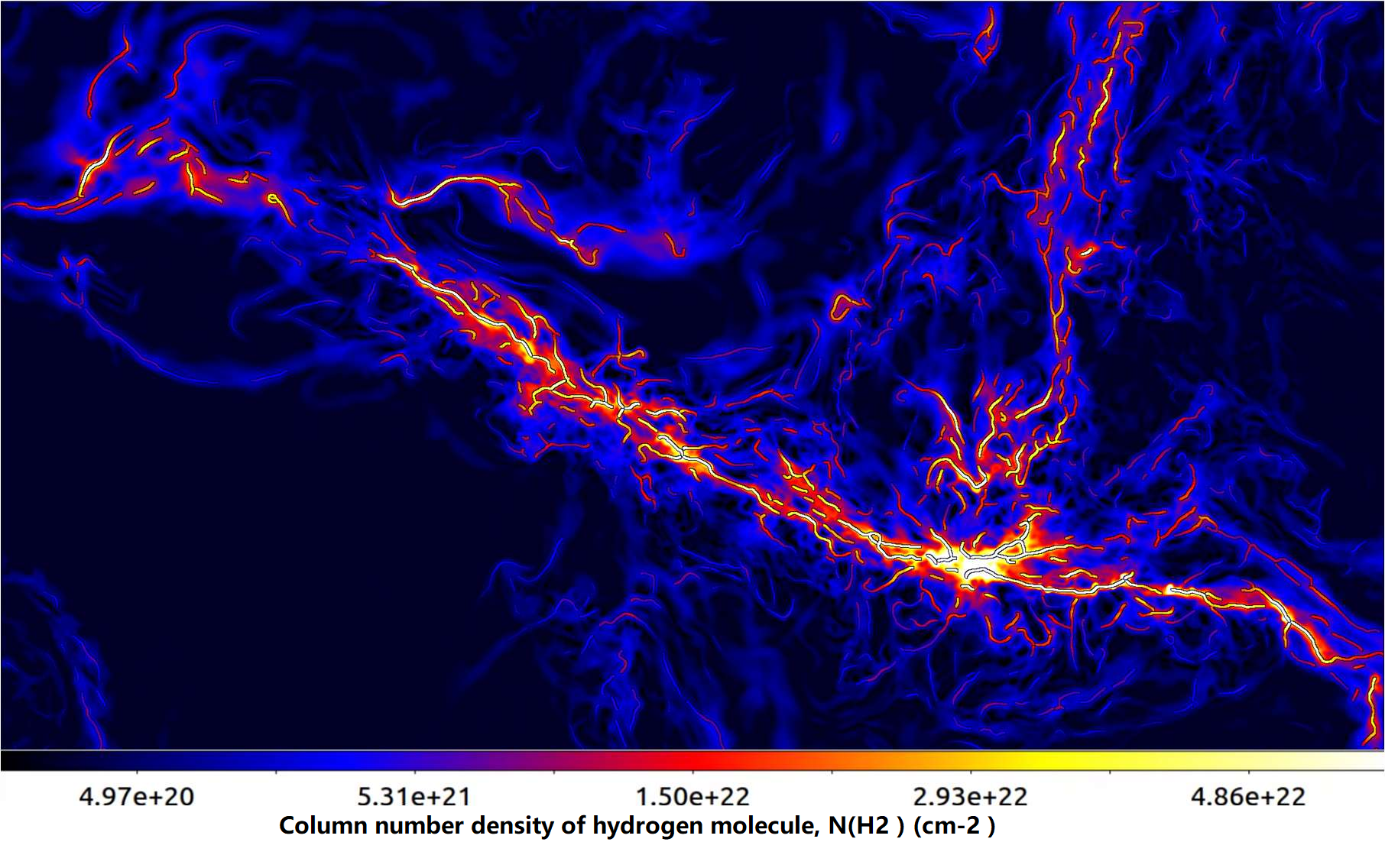
Column density map of a 4.4 pc-long filamentary cloud composed of many filamentary substructures from the simulation. The mean magnetic field is perpendicular to the image. (Image by LI Pak-Shing)
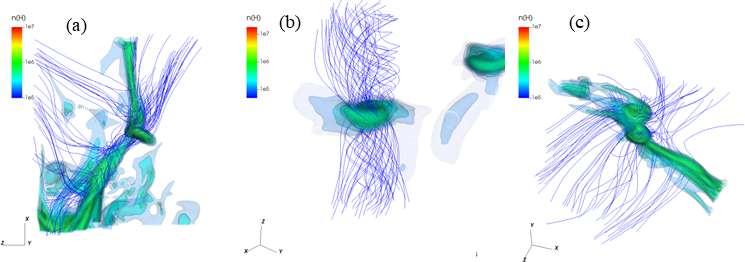
Volume number density, n(H) (cm-3), showing (a) a dense core forming after the collision of two subfilaments; (b) helical magnetic field structures of a rotating core; (c) the merger of two dense cores. Blue lines are magnetic fields. (Image by LI Pak-Shing)
