
Newsroom


Artificial intelligence (AI) is becoming a powerful tool in infectious disease research — yet where this research is concentrated does not always match where the need is greatest. A new study by researchers from the Aerospace Information Research Institute of the Chinese Academy of Sciences (AIRCAS), working with the Chinese Center for Disease Control and Prevention, has documented a persistent mismatch between the geographic focus of AI research and the global burden of infectious disease. Recently published in npj Digital Medicine, the study traces three decades of evolution in the field.
Advances in machine learning, deep learning and large language models are shifting infectious disease research from parameter-driven methods toward data-driven applications. These tools are helping scientists forecast outbreaks, support diagnosis and track disease spread. But how such research is distributed across regions and diseases — and whether it reflects global public-health priorities — has remained unclear.
To tackle this issue, the researchers analyzed 9,026 publications spanning 1995 to 2026, tracking publication trends, international collaboration and shifting research themes. Using GPT-4o-mini alongside rule-based methods, they identified the locations and disease categories studied in each paper. They then compared this research attention with disability-adjusted life years (DALYs), a standard measure of healthy life lost to illness and premature death.
The analysis reveals three phases in AI-driven infectious disease research: early exploration, methodological expansion and rapid growth. China and the United States stand out as the two main hubs of international collaboration, while India, South Korea and Saudi Arabia are emerging as increasingly active participants. New collaboration clusters are also taking shape in Africa.
Research themes have evolved from monitoring, classifying and predicting disease toward using deep learning for diagnosis and for understanding pandemics. The COVID-19 pandemic accelerated work on natural language processing and on analyzing social-media posts and public sentiment. These approaches extend AI's role to tracking public concern, shaping crisis communication and evaluating policy.
Geographically, however, the picture is uneven. Research attention clusters in countries with strong research systems and computing infrastructure, while the heaviest disease burdens remain concentrated in sub-Saharan Africa and parts of South and Southeast Asia.
The mismatch is not a verdict on the value of research done elsewhere. Tools for diagnosis, outbreak forecasting and decision support can benefit high-burden regions when shared, adapted to local capacity and actually deployed. The real challenge lies in building the partnerships and local expertise needed to deliver those benefits to the communities that need them most.
The study goes beyond counting publications and mapping authors' affiliations. It offers a new way to gauge how closely AI research aligns with global public-health priorities.
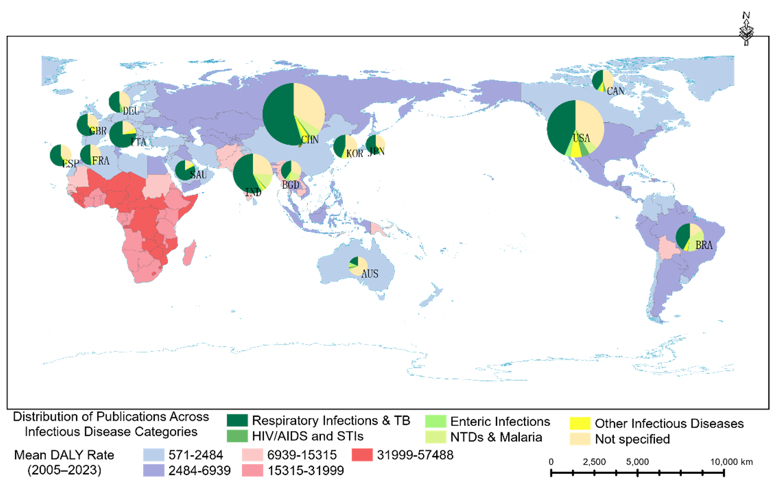
Global distribution of infectious disease burden and research attention by disease category. (Image by AIRCAS)
