
Newsroom


Researchers from the Ningbo Institute of Materials Technology and Engineering (NIMTE) of the Chinese Academy of Sciences have developed a 4-inch atomic-scale magnetron sputtering epitaxy (AMSE) system, enabling the wafer-scale epitaxy of high-quality single-crystalline films.
The study was published in Moore and More.
Large-scale, single-crystalline, thin-film epitaxy systems are essential for integrated circuits, quantum technologies, and advanced materials. However, conventional epitaxial techniques, such as molecular beam epitaxy (MBE) and chemical vapor deposition (CVD), face significant challenges when growing large-area, single-crystalline transition-metal nitride films. These challenges include low nitrogen generation efficiency and a lack of suitable chemical precursors.
To address these challenges, Prof. CAO Yanwei and his colleagues at NIMTE have devoted eight years to sustained research. To overcome the conventional limitations of magnetron sputtering in producing large-scale single-crystalline thin films, the researchers proposed and developed the AMSE technique.
Based on this concept, they developed a 4-inch AMSE system, with which they synthesized a series of high-quality 4-inch epitaxial AlScN films and single-crystalline AlScN/TiN heterostructures.
The AlScN films grown directly on sapphire substrates exhibited an exceptionally narrow full width at half maximum (FWHM) of only 0.02° in their X-ray rocking curves, demonstrating outstanding crystalline quality.
Furthermore, introducing a TiN buffer layer enabled the epitaxial growth of AlScN films at temperatures as low as 100 °C, which is the lowest epitaxy temperature reported to date. This highlights the system's capabilities for wafer-scale, high-quality, and low-temperature epitaxial growth.
The AMSE system combines the scalability and versatility of magnetron sputtering with the capability for high-quality, single-crystalline epitaxial growth. This makes it a promising tool for fabricating functional thin films and heterostructures. It opens new opportunities for advanced materials research and the development of next-generation electronic and quantum devices.
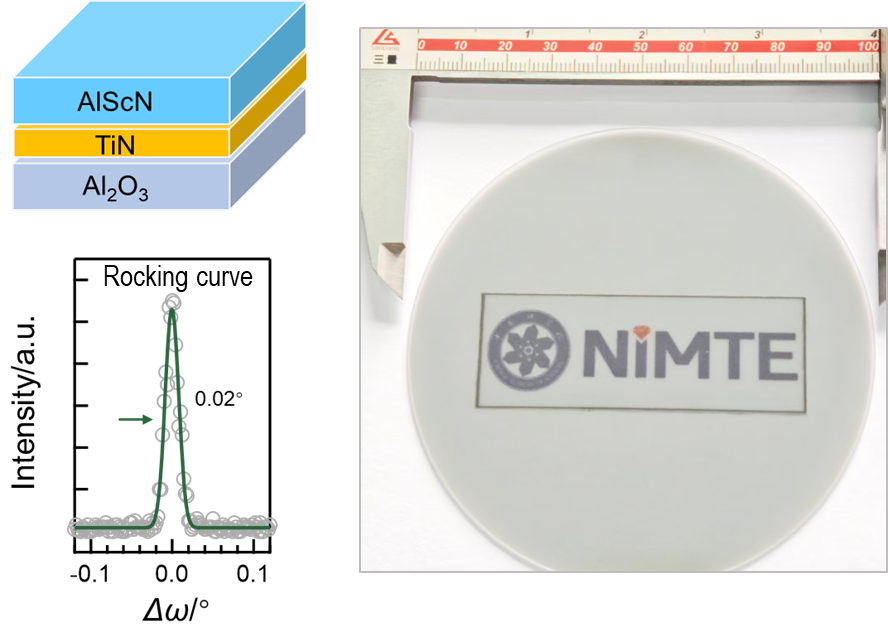
The 4-inch AlScN single-crystalline films grown on TiN-buffered α-Al2O3 substrates (Image by NIMTE)
XIANG Shuling
Ningbo Institute of Materials Technology and Engineering
E-mail: xiangshuling@nimte.ac.cn
