
Newsroom


Detecting approaching threats is essential for survival. Previous studies have identified neurons and neural circuits involved in detecting looming objects in insects, fish, birds, rodents, and humans. However, whether and how these evolutionarily conserved neural mechanisms are influenced by higher cognitive functions, such as attention and conscious awareness, has remained unclear.
A research team led by Prof. ZHANG Peng from the Institute of Biophysics of the Chinese Academy of Sciences has investigated how attention and conscious awareness shape the detection of potential collisions in humans. By combining high-resolution functional magnetic resonance imaging (fMRI) with behavioral experiments in healthy adults and patients with cortical hemianopia, the researchers identified distinct patterns of activity and functional connectivity in subcortical pathways under different attentional and awareness.
The findings were published in Imaging Neuroscience on October 9.
The researchers found that healthy participants could accurately distinguish whether approaching objects were on a collision course when they attended to the stimuli, with greater collision sensitivity in the upper visual field than in the lower visual field.
The fMRI results showed that when participants focused on the approaching objects and judged whether they would collide with the body, the superficial layers of the superior colliculus (SC), the parabigeminal nucleus (PBGN), and the centromedial amygdala (CMA) were sensitive to collision trajectories presented in the upper visual field. Significant functional connectivity was also observed between the SC and the PBGN.
Under unattended conditions, this collision sensitivity disappeared. Significant functional connectivity was observed in the superior colliculus-pulvinar (SC-PBGN) and superior colliculus-ventral tegmental area (SC-VTA) pathways in patients with cortical hemianopia when collision stimuli were presented in their blind visual fields, which they could not consciously perceive. However, connectivity strength in the SC-PBGN pathway was significantly weaker than in healthy participants.
These findings suggest that different subcortical pathways in the human brain may serve distinct functions depending on attentional and awareness states. The SC-PBGN pathway appears to support the precise detection of collision trajectories under attentional modulation. In contrast, the SC-pulvinar and SC-VTA pathways may contribute to the automatic detection of looming threats without conscious awareness.
Overall, this study reveals how attention and conscious awareness differentially influence subcortical visual threat detection in humans. It also highlights the distinct roles of subcortical pathways in processing potential collision threats under different cognitive conditions.
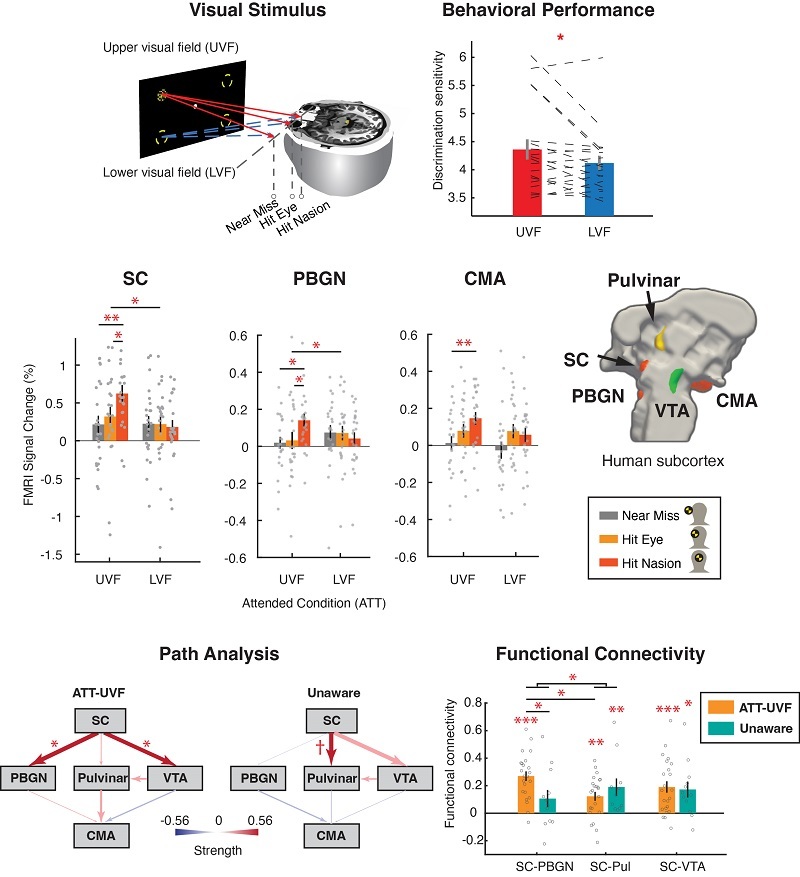
The SC-PBGN pathway detects collision trajectories under attended conditions in healthy participants, whereas the SC-pulvinar and SC-VTA pathways support the automatic detection of looming objects without conscious awareness in patients with cortical hemianopia. (Image by ZHANG Peng's group)

