Newsroom


A new study led by researchers at the Institute of Atmospheric Physics (IAP) of the Chinese Academy of Sciences (CAS) has found that combining irrigation technology upgrades with targeted expansion of irrigated farmland could help China conserve water, maintain cereal production under climate change, and improve investment returns.
As rising temperatures and droughts threaten food production, irrigation is becoming increasingly important for agricultural adaptation to climate change. However, expanding irrigated farmland could also intensify pressure on limited water resources, making it essential to balance water conservation, food security, and investment returns.
To address this challenge, a research team led by Dr. ZHANG Tianyi of IAP, in collaboration with researchers from several Chinese and international institutions, conducted a study published in Nature Food.
The study, entitled "Coupling irrigation technology upgrades with targeted expansion enables water-efficient and climate-resilient cereal production in China," involved researchers from Hohai University, Xiamen University, Peking University, Renmin University of China, China Agricultural University, the University of Maryland, and Yale University.
The study combined 42,190 county-level agricultural statistical records, 3,576 household socioeconomic survey responses, and 2,230 irrigation technology comparison trials. Focusing on China's three staple crops—maize, wheat, and rice—the researchers assessed trends in the adoption of different water-saving irrigation technologies.
They also developed an investment optimization framework that considers both irrigation technology upgrades and the expansion of irrigated areas, identifying crop-specific investment strategies to balance water conservation, food security, and investment returns.
Significant irrigation technology transition, but with notable regional disparities
Household survey data show that China's agricultural irrigation has undergone a marked technological transition between 2010 and 2022. In 2010, earthen-channel water delivery and flood irrigation were still widespread; by 2022, these inefficient practices had declined substantially, while the adoption of various water-saving technologies had increased. However, the pace of this transition varies significantly across crops and regions.
Professor WANG Jinxia of Hohai University said that upgrading irrigation and water-saving technologies has long been a key component of China's farmland water conservancy investment. Using large-scale household survey data, the researchers quantitatively assessed different irrigation technologies across crops and regions.
"At the current rate of technology adoption, irrigation water use per area for the three staple crops is projected to decrease by only 9.4%–16.0% by 2030, falling notably short of the 25.5% water-saving target set by the National Plan for Sustainable Agricultural Development (2015–2030)," WANG said.
The plan sets a cap of 373 km3 on national agricultural irrigation water use by 2030, representing a 25.5% reduction compared with the 2010s.
Further analysis showed that deploying the most efficient irrigation technologies across all existing irrigated areas could more than meet water-saving targets. However, even such widespread upgrades would not be sufficient to offset the potential crop yield losses caused by future climate change, posing risks to China's food security.
Improve efficiency first then expand, tailored by crop and region
Based on these findings, the research team proposed a new approach: first improve water-use efficiency in existing irrigated areas, and then, within water resource constraints, use the water saved to convert some rainfed farmland into irrigated farmland. This strategy aims to mitigate the adverse effects of future climate change.
Further investment portfolio analysis identified different optimal strategies for the three crops. For maize, the preferred approach is to adopt more advanced irrigation technologies while moderately expanding irrigated areas. For wheat and rice, less expansion is needed, and medium-efficiency water-saving technologies in newly developed irrigated areas could be sufficient to ensure food security under future climate conditions, meet water-saving policy targets, and maximize investment returns.
"The real question policymakers need to answer is: which crops need irrigation, where should irrigated area be expanded, by how much, what technologies should be adopted, and whether the investments are economically viable," said ZHANG from IAP.
ZHANG noted that previous studies had largely focused on projecting changes in irrigated areas, without fully accounting for interactions among irrigation technologies or between existing and newly developed irrigated areas.
"By integrating multi-source data and developing a new analytical framework, this study aims to provide more actionable scientific evidence for these specific investment decisions," ZHANG said.
Irrigation is not the only solution
The researchers also emphasized that irrigation is not the sole means of addressing future climate change and safeguarding food security. Agricultural production is also influenced by crop variety breeding, cultivation management, land management scale, and other factors.
Therefore, irrigation investment should be coordinated with the development of stress-tolerant crop varieties, climate-resilient cultivation practices, and the construction of high-standard farmland.
Dr. CHEN Huang of Xiamen University said that the study drew on three independent datasets collected through different survey and research approaches. Despite their different sources, the model was able to capture the decline in agricultural irrigation water use and the improvement in irrigation productivity in China over the past decade.
"Future research will further incorporate agricultural policy and economic factors such as farmland consolidation and changes in agricultural commodity prices, to refine the comprehensive assessment of irrigation investment," CHEN said.
The first author of the paper is ZHANG from IAP. The corresponding authors include ZHANG, WANG of Hohai University, and CHEN of Xiamen University. Co-authors include Professor ZHOU Feng of Peking University, Chinese Academy of Engineering Academician KANG Shaozhong of China Agricultural University, Dr. JIN Zhelong of Peking University, PhD candidate LIU Yuting of Renmin University of China, and PhD candidate CHAO Wei of Peking University, as well as Professor Weston Anderson of the University of Maryland and Professor Robert O. Mendelsohn of Yale University.
This research was supported by the National Key R&D Program of China, the National Natural Science Foundation of China, the Earth System Numerical Simulation Facility of CAS, and the CGIAR Initiative on Climate Resilience (ClimBeR).
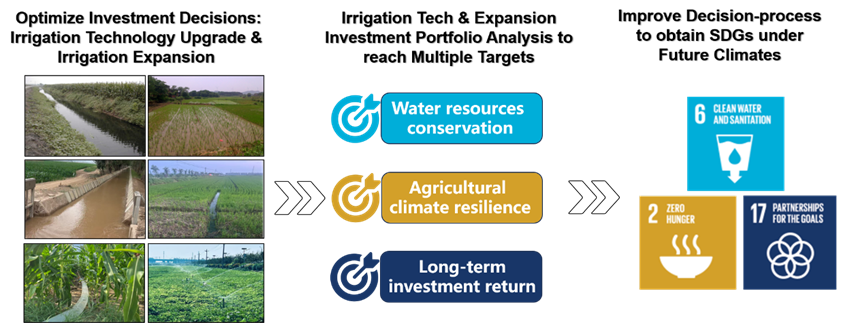
This conceptual graphical abstract illustrates that optimizing both irrigation technology upgrades and expansion is crucial to achieving multiple targets: water conservation, agricultural climate resilience, and long-term investment return. This study conducts an investment portfolio analysis to accelerate the government's progress toward SDGs within irrigation infrastructure and high-standard farmland construction plans. (Image by ZHANG Tianyi and WANG Jinxia)