
Newsroom


In the first few microseconds after the birth of the universe, the protons and neutrons that make up today's atomic nuclei had not yet formed. Matter existed instead as a hot "soup" of quarks and gluons — a state known as quark-gluon plasma (QGP). As the universe cooled, quarks became bound inside hadrons such as protons and neutrons. Understanding how quark matter forms and evolves at high temperatures and densities is therefore key to tracing the evolution of matter in the early universe and to exploring the nature of the strong interaction.
Now, a research team from the Institute of Modern Physics (IMP) of the Chinese Academy of Sciences (CAS) has shown that, in intermediate-energy gold–gold collisions, particles respond differently to QGP formation depending on how many strange quarks they contain: the more strange quarks a particle carries, the stronger its response to quark matter.
The findings were recently published in Physics Letters B.
Using the Parton-Hadron-String Dynamics transport model, which tracks the collision process and the subsequent evolution of particles, the researchers simulated gold–gold collisions at center-of-mass energies of 3.0–7.2 GeV. They compared two modes: one that allows quarks and gluons to evolve as independent particles (a quark phase), and one that includes only hadrons and their production processes. They found that even when the central collision region met the assumed conditions for hadron–quark conversion, the final collision products showed no clear signs of a phase transition.
The differences were most apparent in strange-particle yields. Beginning at a center-of-mass energy of 6.2 GeV, the response to quark matter started to grow in proportion to the number of strange quarks.
At 7.2 GeV, the model with a quark phase predicted an approximately linear increase in response with strange-quark number. Compared with the model without a quark phase, the yield of the Lambda hyperon (which contains one strange quark) rose by about 20–30%, that of the cascade hyperon (two strange quarks) by about 65%, and that of the Omega hyperon (three strange quarks) by about 93%.
These results show that the response of particle yields to a quark phase grows with the number of strange quarks the particles contain. "Multi-strange particles could be a promising probe of the hadron–quark phase transition in heavy-ion collisions," said Prof. YONG Gaochan, the study's corresponding author.
The study offers a new approach to experimentally searching for quark matter in baryon-rich environments and to exploring the phase diagram of nuclear matter.
This work was supported by the National Natural Science Foundation of China.
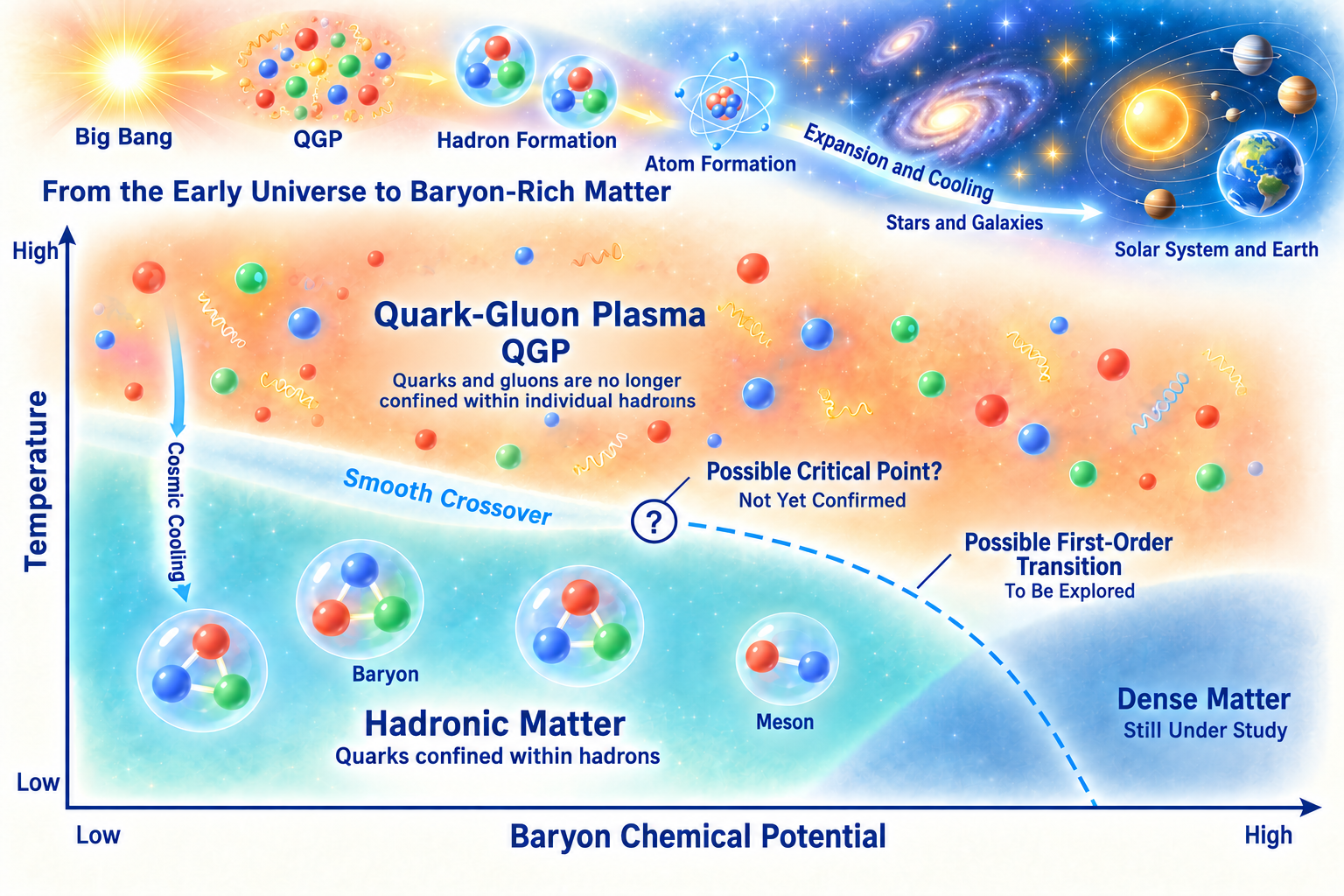
The phase diagram of nuclear matter and the evolution of the universe. (Image by YONG Gaochan)

