
Newsroom


The deep vadose zone serves as a critical interface connecting surface water processes and groundwater systems. Its water dynamics influence groundwater recharge, solute transport, and groundwater recovery. However, strong geological heterogeneity, long-term hydrological memory, and dynamic groundwater boundaries make regional-scale high-resolution simulations challenging.
Led by Prof. WANG Shiqin from the Center for Agricultural Resources Research (CARR), Institute of Genetics and Developmental Biology, Chinese Academy of Sciences, researchers developed the Parallel Regional Infiltration and Solute Model (PRISM), a regional one-dimensional model for simulating water and solute transport in deep vadose zones.
PRISM integrates parallel computing, database-based data management, and dynamic representation of groundwater boundaries, enabling long-term regional simulations of vadose-zone processes.
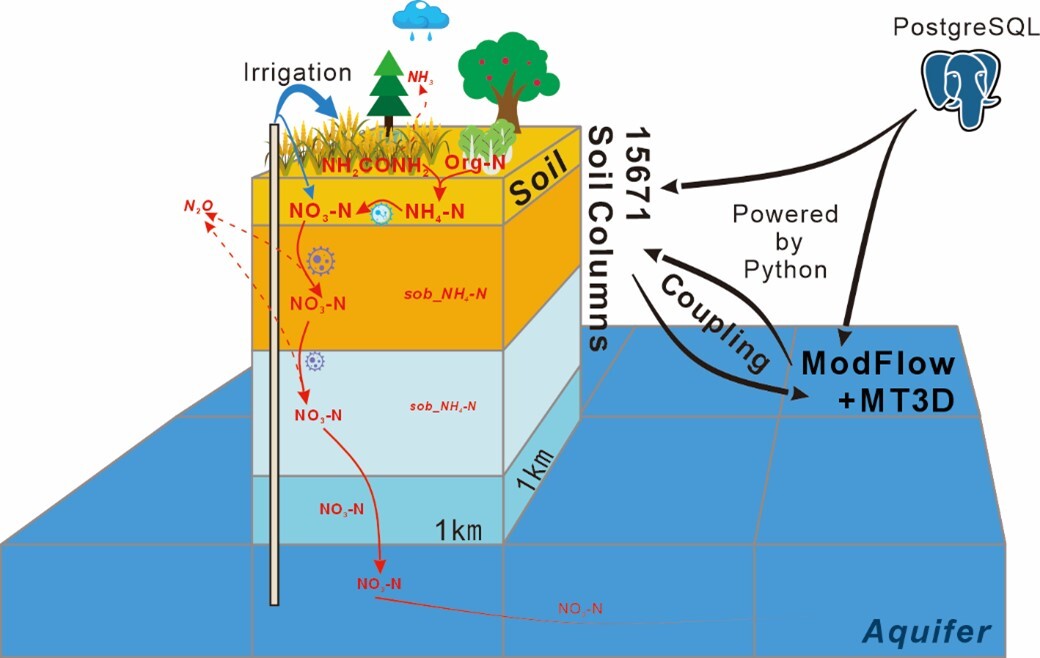
Parallel computing architecture of the PRISM model and physical simulation framework for the vadose zone. (Image by Prof. WANG Shiqin's team)
Using PRISM, the team reconstructed vadose-zone water dynamics across 15,671 spatial units in the plain area of the Baiyangdian Lake watershed over the period from 1980 to 2024, revealing hydraulic regulation mechanisms under changing groundwater conditions.
The results showed that increasing groundwater depth gradually shifts deep vadose-zone behavior from geological control toward dynamic water-state regulation. When groundwater depth exceeded approximately 11.9 m, surface hydrological signals were substantially attenuated before reaching groundwater.
Meanwhile, historical moisture conditions maintained hydrological memory, allowing surface–groundwater connectivity to persist at approximately 15 m depth.
The study further demonstrated that groundwater recovery does not necessarily restore vertical connectivity between surface infiltration and groundwater; instead, rising groundwater levels primarily modify lower-boundary conditions and reshape subsurface hydraulic states.
This study provides a new modeling framework for regional-scale deep vadose-zone simulations and offers a scientific basis for understanding groundwater responses under long-term environmental changes, evaluating groundwater recovery impacts, and assessing long-term risks associated with agricultural non-point source pollution.
The study, entitled "A mechanism-data-driven framework reveals hydraulic decoupling transitions and hydrological memory under transient phreatic boundaries", was published in Geoderma, with ZHANG Zhixiong from CARR as the first author and Prof. WANG as the corresponding author.
This work was supported by the National Key R&D Program of China, the National Natural Science Foundation of China, the Foundation for Innovative Research Groups of the Natural Science Foundation of Hebei Province, and the Hebei Provincial Science and Technology Program.
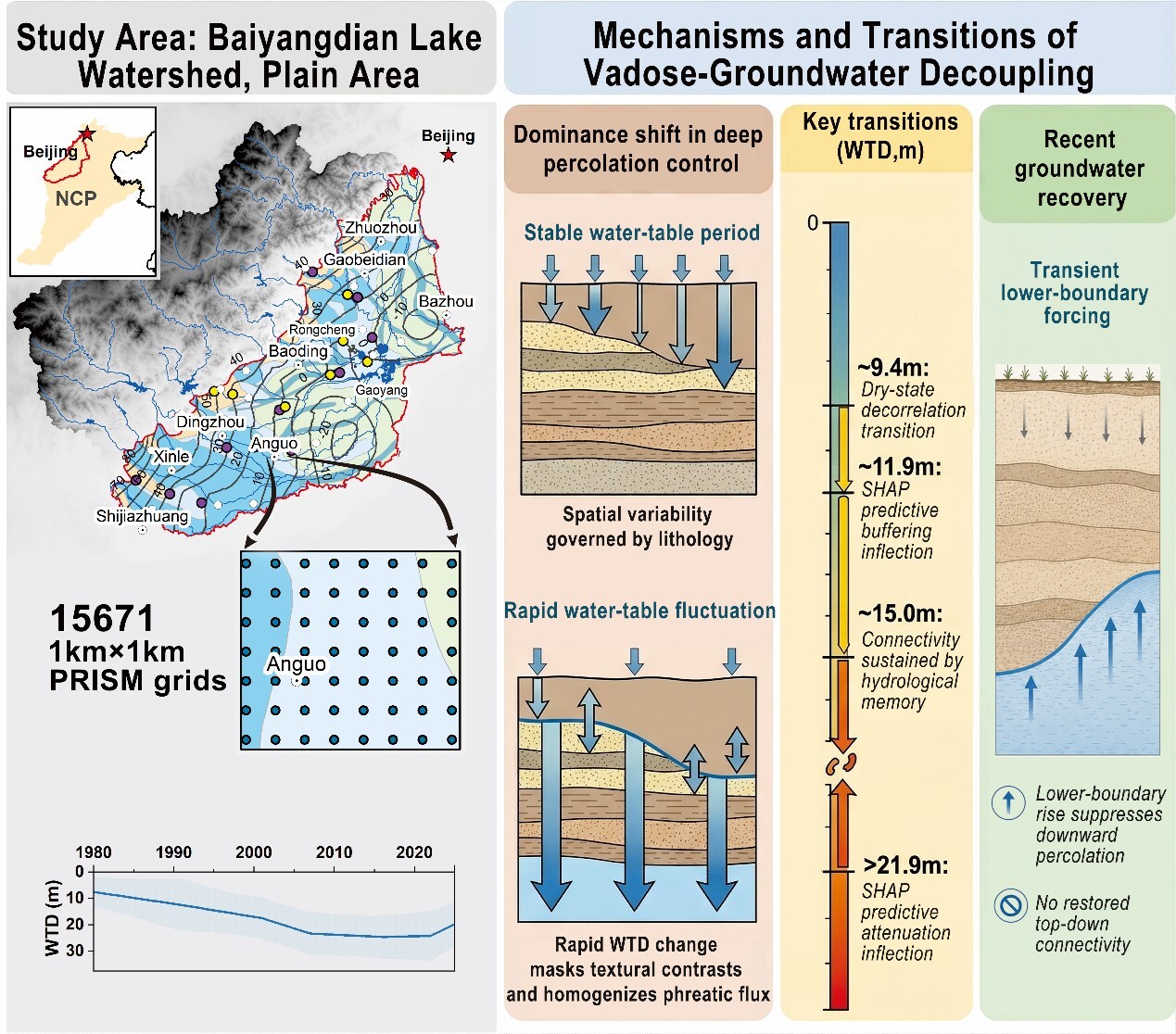
Hydraulic decoupling transitions, hydrological memory, and lower-boundary effects during groundwater recovery. (Image by Prof. WANG Shiqin's team)
