Newsroom


A recent study published in Molecular Plant has found that the plant hormone strigolactone (SL) acts as a key negative regulator of drought resistance in rice, revealing new targets for breeding drought-resistant, high-yield rice varieties.
Prof. WANG Bing from the Institute of Genetics and Developmental Biology (IGDB) of the Chinese Academy of Sciences (CAS) led the research in collaboration with CAS Member LI Jiayang's team at IGDB and Yazhouwan National Laboratory.
Global warming is increasing the frequency and severity of droughts, posing a major threat to crop production. As the staple food for nearly half the world's population, rice requires significant water and is highly vulnerable to drought-related yield losses. Understanding the molecular mechanisms of drought acclimation is crucial for developing drought-resistant, high-yield rice varieties.
SL is a key plant hormone that regulates rice tillering and yield. However, the role of SL signaling in rice drought acclimation is not well understood, limiting its use in breeding for drought resistance.
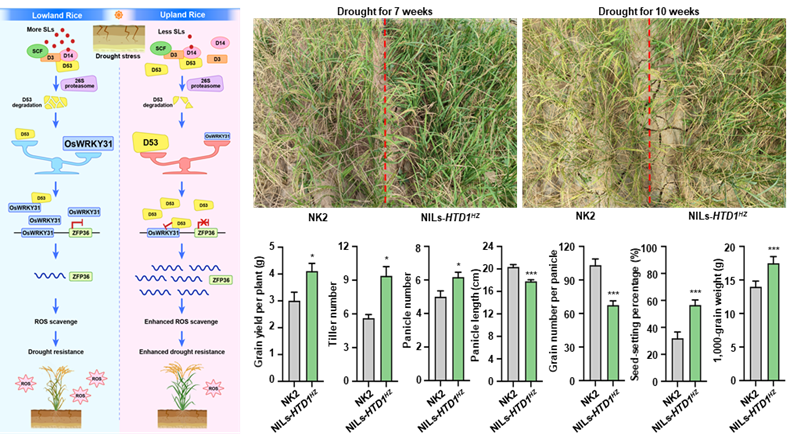
This study used physiological, biochemical, and genetic methods to clarify how SL regulates rice drought acclimation. The findings show that short-term drought reduces SL synthesis in rice roots, leading to D53 accumulation, which inhibits SL signaling.
D53 interacts with the transcription factor OsWRKY31 via its N-terminal domain and decreases OsWRKY31 protein abundance. OsWRKY31 binds directly to the promoter of the zinc finger protein gene ZFP36 and represses its transcription. ZFP36 contributes to hydrogen peroxide scavenging and the maintenance of reactive oxygen species (ROS) homeostasis. Thus, short-term drought suppresses SL synthesis and increases D53 levels, which enhances ROS scavenging and improves rice drought tolerance, defining the SL-D53-OsWRKY31-ZFP36 regulatory pathway.
The researchers further found that the roots of the drought-tolerant upland rice variety IRAT109 contain significantly less SL than those of Nipponbare, with this difference becoming even more pronounced under drought stress. Lower SL levels weaken SL signaling and enhance ROS scavenging, which is closely linked to drought resistance in upland rice.
Notably, OsWRKY31 haplotype 2 (hap2), enriched in upland rice, has been selected for and shows a positive correlation with drought resistance. Two single nucleotide polymorphisms (SNPs) in hap2 reduce the transcription and translation efficiency of OsWRKY31, further enhancing drought resistance. These results suggest that hap2 is an important target for molecular breeding to improve drought resistance.
The researchers used gene editing to disrupt key genes in the SL biosynthesis pathway, enhancing rice drought resistance.
To evaluate yield potential in the field, they tested a near-isogenic line with moderately reduced SL content (NILs-HTD1HZ), which produced 36.7% higher grain yield under drought stress. This line also outperformed controls under normal conditions, supporting its "green revolution" potential. The study demonstrates that the elite SL-biosynthesis allele HTD1HZ provides both drought resistance and stable yields, making it a valuable resource for breeding drought-resilient, high-yield rice varieties.
"Our findings reveal a new mechanism by which SL negatively regulates rice drought acclimation and identify a new pattern in how plant hormones coordinate drought resistance and plant architecture," WANG said.
"The identified genes, haplotypes, and elite alleles offer effective targets and strategies for breeding drought-resistant, water-saving, high-yield rice."