Newsroom


A research team led by Prof. ZOU Liangjian from the Hefei Institutes of Physical Science of the Chinese Academy of Sciences has recently found that high pressure can turn the single-layer nickelate La2NiO4 from an insulator into a metal without destroying its magnetic order.
The researchers also found that strontium (Sr) doping can change how the material's magnetic moments are arranged.
The findings were published in Physical Review B.
Nickelates have attracted growing interest since superconductivity was discovered in multilayer nickelates under high pressure. However, materials with different numbers of nickel-oxygen (Ni–O) layers may respond differently to pressure and chemical doping. La2NiO4, which contains a single Ni–O layer, provides a useful system for studying these effects.
In this research, using first-principles calculations, the researchers examined how pressure and Sr doping affect the electronic structure and magnetic order of La2NiO4.
They found that as pressure increases, the material's insulating energy gap gradually narrows and closes at around 50 gigapascals (GPa), turning it metallic. Yet its G-type antiferromagnetic order remains stable even at 75 GPa.
The researchers attribute this unusual combination to the material's layered structure. Magnetic coupling between neighboring NiO layers is relatively weak, allowing pressure to alter electron movement within the layers without destroying the overall magnetic order.
Sr doping has a different effect. Replacing lanthanum atoms with strontium introduces holes into the material and changes its magnetic order. The calculations predict several magnetic transitions as the Sr concentration increases, eventually leading to ferromagnetism at high doping levels. Interestingly, at (x = 1), the material remains insulating despite the change in magnetic order.
The findings show how pressure and Sr doping affect the electrical and magnetic properties of single-layer nickelates, according to the team.
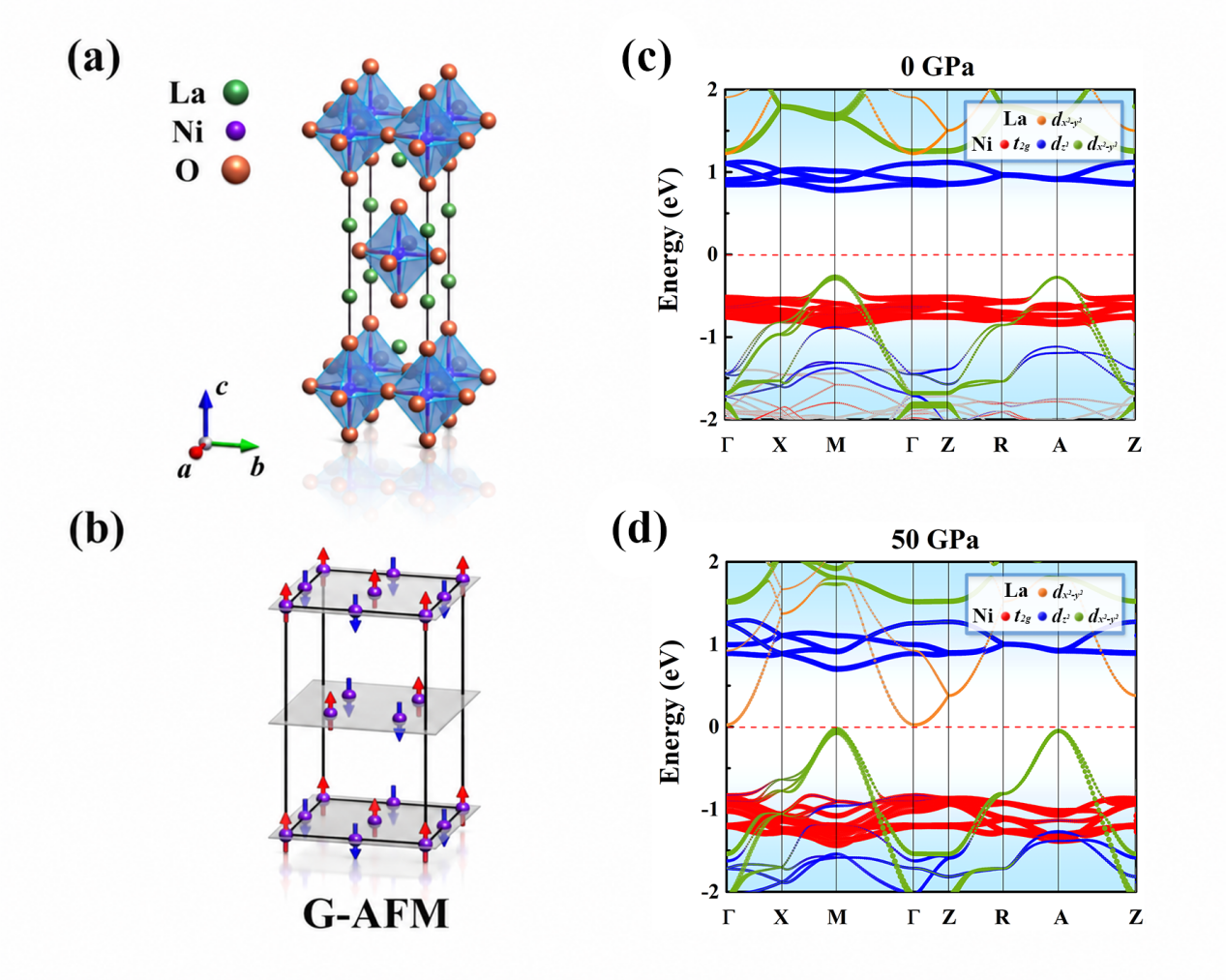
(a) Crystal structure of La2NiO4, with blue polyhedra representing NiO6 octahedra. (b) G-type AFM arrangement; arrows indicate the Ni spin directions. (c, d) Orbital-projected band structures at 0 and 50 GPa, respectively. The red dashed line marks the Fermi level. The band gap closes near 50 GPa. (Image by WANG Hanyu)