
Newsroom


Northwest China's Xinjiang Uygur autonomous region is a core part of the Silk Road Economic Belt. Launched in 2021, the five-year Third Comprehensive Scientific Expedition to Xinjiang received 657 million yuan in funding. It covered 30 projects, over 6,400 fieldwork person-trips and 91,232 survey sites.
Focused on water-soil balance and water resource security, the expedition conducted cross-regional surveys across five themes: water resources, ecology, land and agriculture, biodiversity, and mineral & energy resources.
The research team established regional resource and ecological baselines, assessed resource-environment carrying capacity and high-quality development potential, proposed green development pathways, and trained sci-tech talent for frontier regions.
Over five years, the expedition yielded ten major achievements.
Achievement 1: Xinjiang's Warming-Wetting Trend and Expanded Water Resources Create Opportunities for High-Quality Sustainable Development
Xinjiang's temperature has risen 0.34°C per decade — 1.7 times the global average and 1.13 times China's national level. Precipitation increased by 9.32 mm per decade, 4.3 times the global rate. Total glacial shrinkage reached 2,167 km2 (8.4%); northern Xinjiang recorded 16% glacier loss, showing accelerated melting. Usable water resources grew: annual river runoff rose by ~10 billion m3, and lake and wetland areas expanded by one-third. Southern Xinjiang's major rivers are expected to see continued inflow growth until around 2065. Still, compound natural hazard risks are rising; more frequent heatwaves and heavy rainfall will destabilize water availability.
These findings informed major water conservancy projects on the upper Tarim River, guided Xinjiang's water network planning, and supported a 1-million-mu Apocynum venetum sand-control industrial plan in Yuli County, Bayingolin Mongol Autonomous Prefecture.
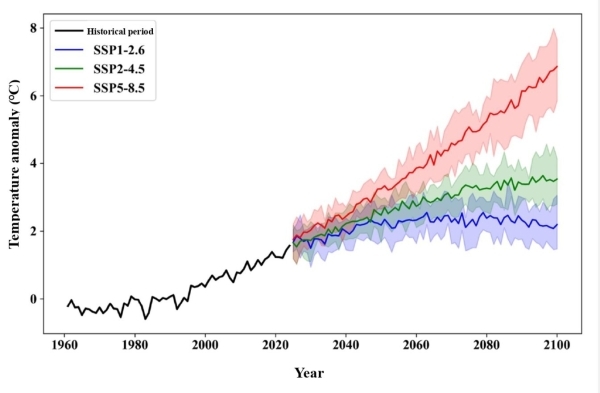
Annual average temperature variation trends in Xinjiang under different climate scenarios from 1961-2100. (Image by the Xinjiang Institute of Ecology and Geography, XIEG)
Achievement 2: Xinjiang's Major Ecological Projects Deliver Gains and Higher Carbon Sink Potential, Reinforcing Northwest China's Ecological Barrier
Degraded basin ecosystems show vegetation recovery: coverage rose by over 30%, desert forest regeneration improved. Wind-sand disaster risks have fallen, and Populus euphratica forests are recovering.
In 35 years, Xinjiang's oases expanded by a net 45,500 km2, 98.7% from artificial oases, with expansion continuing. Total ecosystem service value rose 17% and vegetation carbon sink capacity increased 20%. Its forest carbon-sink research featured in 100 Climate Actions from Cities in Asia and the Pacific and Xinjiang's ecosystem restoration master plan, supporting mountains-rivers-forests-farmlands-lakes-grasslands-deserts integrated restoration in the Irtysh and Aksu River basins.
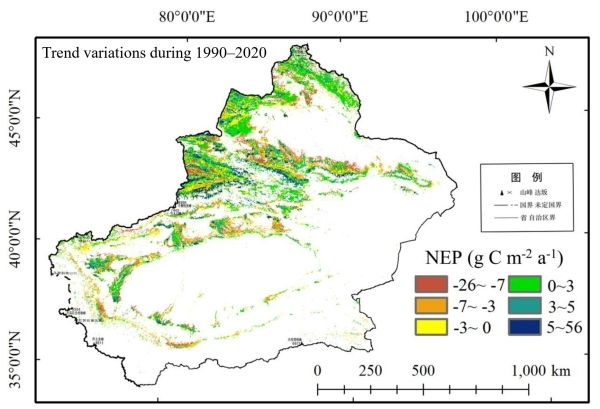
Changes in net ecosystem productivity of vegetation in Xinjiang. (Image by XIEG)
Achievement 3: Biodiversity Baselines and Novel Stress-Resistant Genes Support Seed Innovation and Ecological Restoration
The expedition built Xinjiang's full biodiversity baseline. The region hosts 4,828 wild higher plant species (1,259 more than previously recorded), plus 810 vertebrate species. Researchers found 33 new species and 243 newly recorded species for China/Xinjiang. Across Central Asia, the team documented 9,643 vascular plant species (3,409 endemic, 35% endemism), 982 vertebrate and over 20,000 invertebrate species.
For the first time, 1.32 million Central Asian plant specimens were digitized, filling a data gap in the Global Biodiversity Information Facility (GBIF). The study also demonstrated for the first time that Syntrichia caninervis, one of the most stress-resistant plants on Earth, can survive simulated extreme Martian conditions. Researchers screened 266 multi-stress-tolerant plants and identified over 300 stress-resistant genes, developing transgenic cotton varieties cutting water use by 25–40%.
Kalamaili ungulate conservation work aided the reserve's inclusion in the national park system. Tianshan wild fruit forest conservation findings were written into Ili Prefecture legislation, and the Ili-Turpan Botanical Garden joined the national botanical garden layout plan.
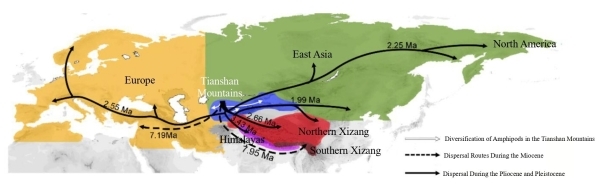
Amphipod dispersal routes. (Image by XIEG)
Achievement 4: Abundant Reserved Cultivated Land and Specialty Agriculture Advantages Support a National High-Quality Agricultural and Livestock Supply Base
The expedition produced Xinjiang's first 1:250,000 grassland vegetation formation map covering 786 million mu. Medium- and high-quality yet low-productivity grasslands account for 78%, showing grass-livestock balance is largely achieved. Xinjiang has 106 million mu of cultivated land; nearly 70 million mu use film-mulched drip irrigation, which has not caused salt buildup in cotton root zones over 30 years and stands as Xinjiang's optimal water-saving agricultural technology.
Xinjiang holds 116 million mu of saline-alkali land, a key reserve of potential cropland, with 315 halophyte species (56.7% of China's total) suitable for saline land agricultural development. A 1,000-km selenium-rich belt covering 22 million mu was discovered along the northern Tarim Basin margin, opening new specialty agriculture prospects.
The ANSO report Eurasian Grassland Change and Sustainable Development, launched at UNCCD COP17, was incorporated into saline-alkali land improvement plans for Xinjiang and the Xinjiang Production and Construction Corps (XPCC), covering 135,000 mu. A precision irrigation technology system developed by the expedition was listed in the Ministry of Water Resources' 2024 catalogue of promoted technologies.
Achievement 5: Accretionary-Orogenic Metallogenic Theory and Intelligent Prospecting Boost Xinjiang's Mineral Exploration Breakthroughs
The expedition reconstructed the Central Asian Orogenic Belt's tectonic framework and established continental accretion-metallogeny theory. It explained why giant deposits rarely cross national borders, guiding Xinjiang mineral exploration. This supported major discoveries: the super-large Dahongliutan lithium deposit, Huoshaoyun lead-zinc deposit, Eastern Tianshan vanadium-titanium magnetite belt and Lop Nur West potassium salt deposit.
Hyperspectral ore-identification technologies accelerated mineral discovery. Recommendations on vanadium-titanium magnetite resources backed a planned 100-million-ton resource base and a full-chain green industrial cluster.
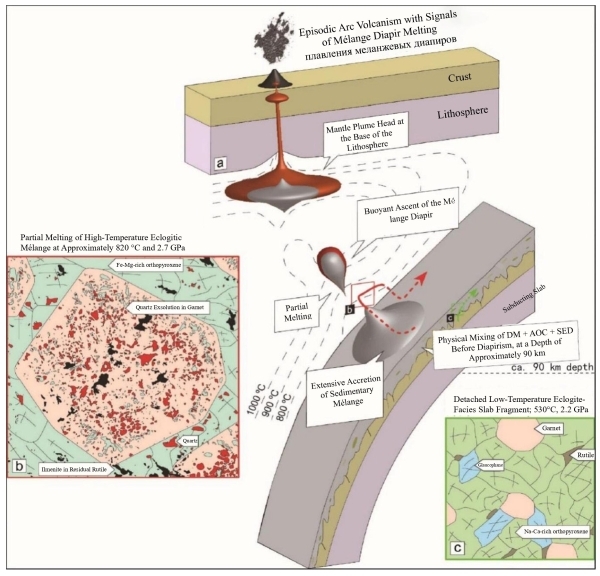
Coupling law of partial melting of deeply subducted slabs and porphyry mineralization in the Western Tianshan. (Image by XIEG)
Achievement 6: Oil-Rich Coal Resources Confirmed in Turpan-Hami Basin to Boost Reserves, Output and a National Modern Coal-Chemical Base
High-quality, concentrated oil-rich coal was confirmed in the Turpan-Hami Basin: 64 billion tons proven in Hami and 13.5 billion tons in Turpan, with an average tar yield of 12%. Each 100 million tons yields oil/gas equivalent to 34.5 million tons.
Proposals for coal-to-oil/gas bases in Hami entered the National Development and Reform Commission (NDRC)'s 15th Five-Year Plan for oil and gas, while the Hami comprehensive energy demonstration zone was included in Xinjiang's 2024 development plan.
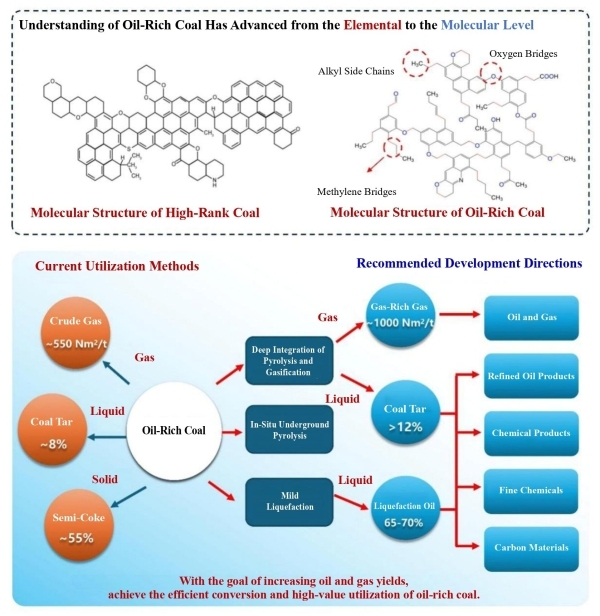
Efficient and comprehensive utilization of oil-rich coal. (Image by XIEG)
Achievement 7: Aeolian-Sand Mechanisms Uncovered and a Full-Factor Sand-Control Model Developed for the Taklamakan Desert-Edge Protection Campaign
The expedition defined the Taklamakan Desert's evolution and sand transport pathways, dating its modern landscape to ~300,000 years ago. It mapped high-altitude dust transport and identified degraded high-risk zones around the desert.
A full-factor sand-control model and "wind prevention — sand blocking — dust suppression" strategy were adopted by the National Forestry and Grassland Administration. Researchers led national and regional expert panels for desert boundary protection.
These results underpinned the 3,046-km Taklamakan perimeter enclosure project. The Taklamakan Desert Boundary-Locking Project was named one of 2025's Global Top Ten Engineering Advances and cited in Xinjiang's 2025 government work report.
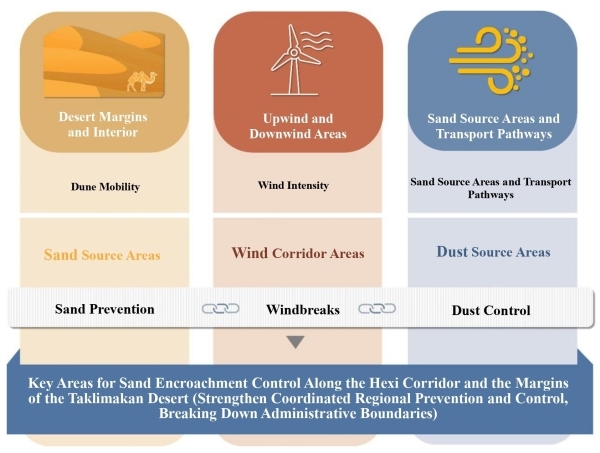
Overall concepts of the desert edge blocking battle scheme. (Image by XIEG)
Achievement 8: Cross-Border Ecological Proposals Help Build China's Geo-Ecological Security Barrier
The expedition assessed transboundary ecosystem changes. Habitat quality remained stable on China's side of the Ili and Irtysh river basins, with improvements in neighboring countries. Upstream water use in transboundary rivers has not harmed downstream water, ecosystems or biodiversity.
A cross-border biodiversity conservation plan and multinational conservation responsibility assessment framework helped launch the "Beijing Consensus" of the China-Russia-Kazakhstan-Mongolia Altai Mountains Cross-Border Protection Alliance. The initiative was incorporated into the State Council's General Plan for Establishing China (Xinjiang) Pilot Free Trade Zone and regional tourism 15th Five-Year Plan, supporting joint cross-border park planning and regional ecological defense.
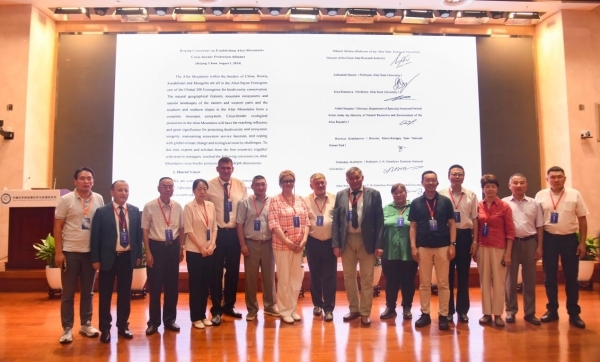
Organized and released the "Beijing Consensus" of the Altai Mountain Cross-Border Protection Alliance. (Image by XIEG)
Achievement 9: Space-Air-Ground Integrated Observation and Data System Improves Xinjiang's Intelligent Decision-Making
The expedition built Xinjiang's networked ecological monitoring system by integrating 42 existing ground stations and adding eight new stations, enabling continuous monitoring of 12 land-surface indicators and shifting from static description to dynamic assessment. It standardized ~180 TB of historical and survey data, released over 2,800 public datasets and facilitated 293 TB of data sharing, and secured approval for Xinjiang's first ecological and resources scientific data center.
The team developed an intelligent Tarim River irrigation regulation system, lifting ecological water efficiency by over 10%. It also built reservoir safety monitoring and avalanche early-warning systems. The avalanche system has been deployed in Xinjiang and promoted overseas; its developers received Tajikistan's National Medal.
Achievement 10: Expedition Results Shared with Belt and Road Partners to Promote Chinese Solutions Globally
The expedition produced the Atlas of Land Cover in Five Central Asian Countries and the Atlas of Glaciers in Tajikistan, launched at international forums. It built ecological shelterbelt demonstration zones in Kazakhstan and saline land restoration sites around Uzbekistan's Aral Sea.
These outputs featured among 2023 Belt and Road Forum deliverables and the UN Science Decade's 2025 initial batch of initiatives. The team established the Arid Lands Biodiversity Conservation Alliance and China-Tajikistan Belt and Road Joint Laboratory. The work benefits Belt and Road nations and spreads China's ecological and environmental governance practices internationally.
