Newsroom


Bacteria and eukaryotic algae living in the same biofilms in glacier-fed streams exhibit contrasting spatial and temporal patterns of diversity in response to environmental variability, according to a new study.
The study, published in Environmental Research, was conducted by a research team led by Prof. WU Chenxi from the Institute of Hydrobiology (IHB) of the Chinese Academy of Sciences. The findings highlight the importance of considering multiple biological domains when assessing biodiversity responses to environmental change.
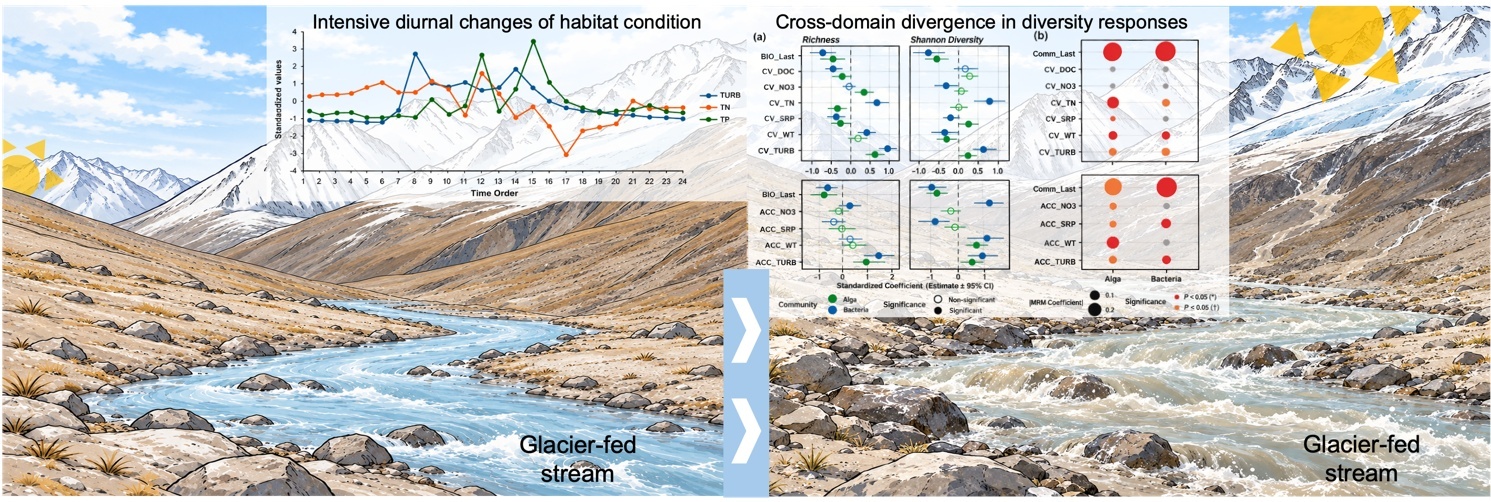
The intensive diurnal changes of habitat conditions in the glacier-fed stream and the divergent cross-domain diversity responses of the epilithic biofilm community. (Image by IHB)
Glacier-fed streams are characterized by highly variable environmental conditions driven by glacier and snowmelt processes. These fluctuations influence water temperature, turbidity, and nutrient availability, creating challenging habitats for aquatic organisms. Biofilms attached to streambed stones harbor diverse microbial communities that play essential roles in primary production and nutrient cycling. However, whether co-occurring bacteria and algae respond similarly to environmental variability remains poorly understood.
In this study, the researchers conducted field investigations in the Laohugou Stream located in the Qilian Mountains on the northern margin of the Qinghai-Tibet Plateau. From May to September 2023, they collected 106 epilithic biofilm samples and 504 stream-water samples across three sites along the stream.
By combining high-frequency environmental monitoring with 16S and 18S rRNA gene amplicon sequencing, the researchers examined how microbial diversity was associated with cumulative environmental conditions, sub-daily environmental variability, and preceding community states.
They found that bacterial community composition exhibited stronger temporal variation across the melt season, whereas eukaryotic algal communities showed more pronounced spatial differences along the stream. After excluding the dominant alga Hydrurus, the remaining algal community exhibited a stronger temporal signal, resembling the bacterial pattern.
Further analyses identified both shared and contrasting environmental associations across the two microbial groups. Turbidity was consistently and positively associated with bacterial and algal alpha diversity, while temperature and nutrient variables showed different associations depending on the microbial group and the temporal characteristics of environmental variation. Notably, preceding community dissimilarity exhibited the strongest association with beta diversity across all models, indicating substantial temporal dependence in microbial community composition.
The researchers also identified a potential role of Hydrurus, a dominant mat-forming alga in glacier-fed streams. Its relative abundance was associated with diversity metrics and with compositional changes in the remaining algal community under sub-daily environmental variability. These findings suggest that Hydrurus may influence microbial community organization by modifying the physical structure and local environmental conditions of biofilms, although the underlying mechanisms require further investigation.
According to the researchers, the study provides new insights into how bacteria and algae inhabiting the same biofilm respond differently to environmental variability. It also highlights the importance of cross-domain approaches for understanding biodiversity responses in glacier-fed ecosystems under ongoing climate change.