Newsroom


A new study has proposed a framework for "Third-generation metabolomics" that integrates standardization, streamlined workflow, automation, and intelligence.
The study, published in TrAC-Trends in Analytical Chemistry on October 10, was led by Profs. XU Guowang and LIU Xinyu from the Dalian Institute of Chemical Physics (DICP) of the Chinese Academy of Sciences (CAS).
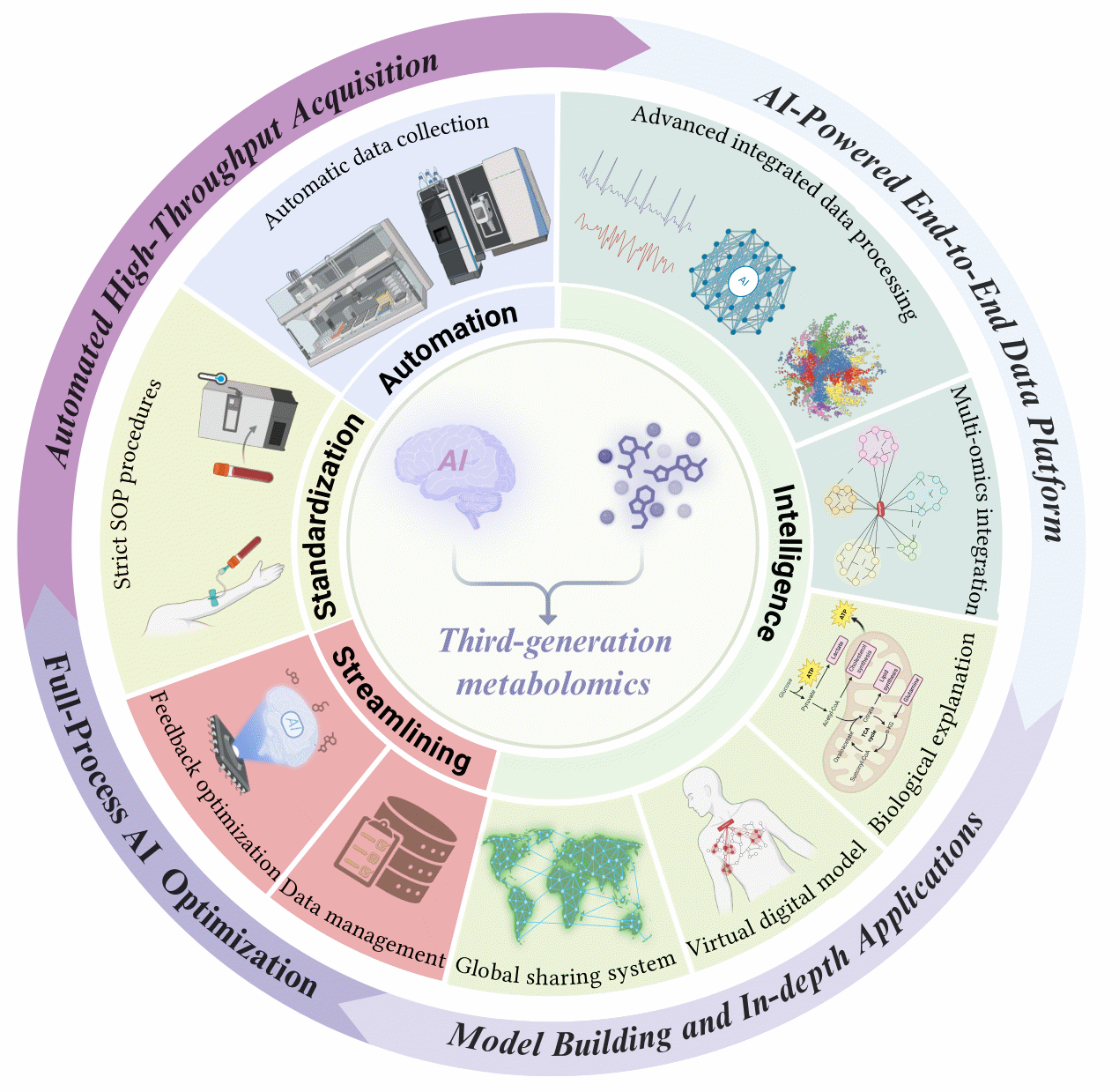
Agent-driven third-generation metabolomics unifies standardization, automation, intelligence, and streamlining to enable closed-loop automation and systems biology integration. (Image by JING Fengyang)
For decades, mass spectrometry-based metabolomics has largely relied on two main approaches: untargeted and targeted metabolomics. Untargeted metabolomics can detect a wide range of metabolites but faces challenges in reproducibility and data processing. Targeted metabolomics, by contrast, offers more reliable quantitative results but typically measures fewer metabolites.
In 2012, Prof. XU's team sought to bridge this gap by introducing pseudotargeted metabolomics, a hybrid approach that combines the strengths of both strategies. The approach was later described by Prof. Oliver Fiehn as "Second-generation metabolomics" and has since been applied in biomedical, agricultural, and environmental research.
However, as metabolomics increasingly supports high-throughput, large-scale, and multicenter studies, challenges remain in ensuring analytical reproducibility, comparability, and effective data mining.
To address these challenges, the researchers proposed a "Third-generation metabolomics" framework built around four interconnected principles: standardization, streamlined workflow, automation, and intelligence. Standardization ensures consistency in sample collection and analysis, while streamlined workflow connects different stages of the analytical process. Automation reduces manual intervention, and AI-driven intelligence enhances data interpretation and knowledge discovery.
Going beyond the automation of individual tasks, the framework envisions AI agents coordinating the entire workflow, from experimental design and instrument operation to data processing and interpretation. Through feedback-driven optimization and adaptive decision-making, these agents could enable more integrated and autonomous metabolomics workflows.
The researchers also outlined two potential directions for the development of "Third-generation metabolomics".
First, the integration of automated sample preparation, mass spectrometric analysis, real-time quality control, and intelligent data processing could pave the way for "Lights-out" laboratories, where experiments and analyses could be conducted with minimal human intervention, potentially improving analytical efficiency and data quality.
Second, combining high-quality metabolomics data with multi-omics information, knowledge graphs, and AI models could lead to "Metabolome-centered digital twins". These models could simulate metabolic states and track how they change over time across different tissues and organs, helping researchers better understand complex biological systems.
Overall, the proposed framework could help transform metabolomics from fragmented, expert-dependent procedures into a more reproducible and intelligent research process. It could also shift the focus from static descriptions of metabolic phenotypes to dynamic modeling and prediction, with potential applications in precision medicine.