Newsroom


A research team led by Profs. GAO Caixia and CHEN Yuhang from the Institute of Genetics and Developmental Biology (IGDB) of the Chinese Academy of Sciences (CAS) has developed a "dual-layer" allele engineering strategy to improve herbicide tolerance in crops.
By coordinating structure-guided protein design with precise cis-regulatory tuning, the researchers generated rice and wheat with improved herbicide tolerance.
The study was published in Nature Plants on October 12.
Weeds are among the greatest constraints on crop yield, and prolonged reliance on herbicides that target only a limited set of enzymes has driven the worldwide emergence of resistant weeds. Developing crops that tolerate new herbicides is therefore an important route to more effective weed control.
Conventional genome editing, however, typically modifies either a gene's protein-coding sequence or its regulatory region alone, making it difficult to improve a target trait without compromising the gene's normal function.
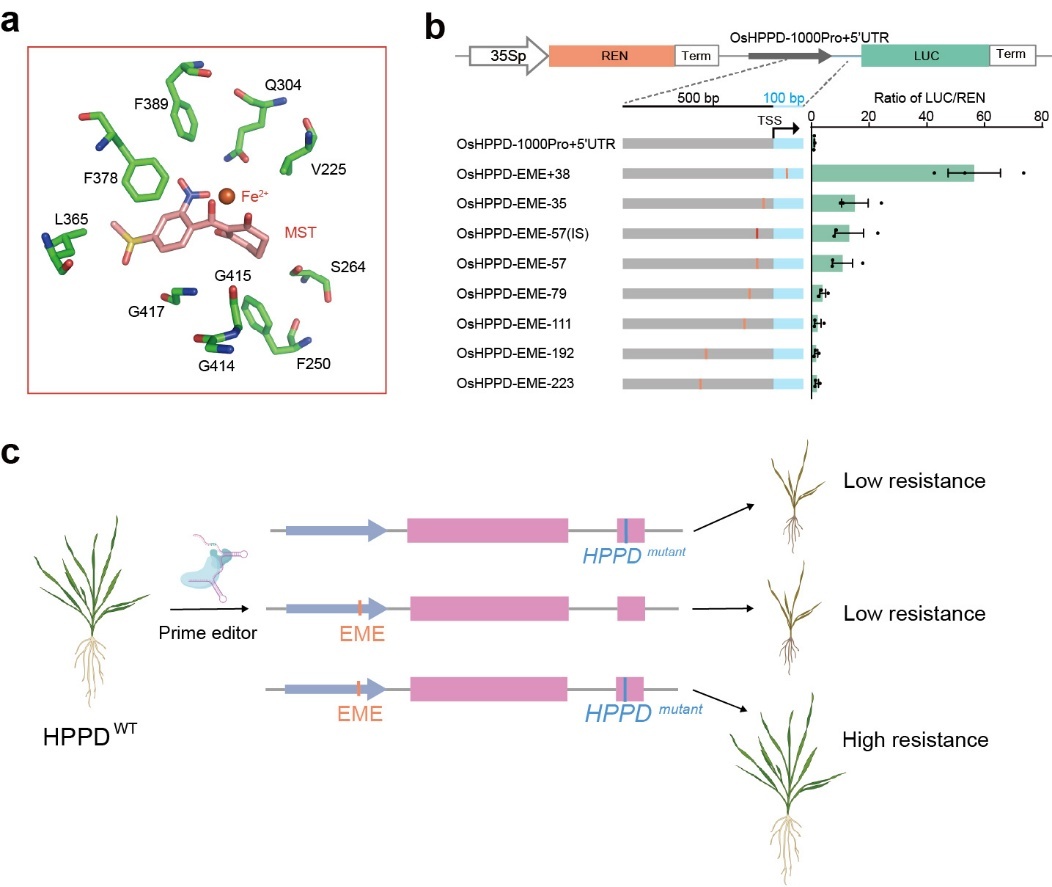
In this new study, the researchers used rice 4-hydroxyphenylpyruvate dioxygenase (HPPD), an essential enzyme in tyrosine metabolism and a target of β-triketone herbicides, as a model. They determined the crystal structure of HPPD bound to the herbicide mesotrione and, guided by the architecture of its binding pocket, designed and screened amino-acid substitutions that reduced herbicide sensitivity.
Several of these coding-sequence variants increased herbicide resistance but also impaired the enzyme's normal function and plant growth, revealing a trade-off between resistance and enzyme activity.
To resolve this trade-off, the researchers identified a 22 bp expression-modulating element (EME) and used prime editing to precisely integrate it into the regulatory region of the endogenous HPPD gene. Combining the EME with the coding-sequence variants synergistically enhanced herbicide tolerance. Some rice lines withstood mesotrione at four times the recommended field application rate, as well as other HPPD-inhibiting herbicides.
Field trials further showed that the balance between herbicide tolerance and agronomic performance depended on the allelic configuration. Some combinations reduced seed setting and yield, whereas retaining one wild-type allele preserved high tolerance while balancing it with agronomic traits.
The researchers then extended the strategy to allohexaploid wheat, simultaneously editing the coding and regulatory regions of wheat HPPD to obtain lines carrying both a coding variant and the EME. These lines showed elevated HPPD expression and stronger tolerance to mesotrione than wild-type plants, demonstrating that the approach is effective even in crops with complex genomes.
By optimizing protein function and gene dosage together, the dual-layer strategy can generate beneficial alleles that natural variation, conventional mutagenesis, or single-layer editing rarely deliver. Because the EME is compact, introduces no foreign gene cassette, and relies on sequence motifs already common in crop genomes, it combines a minimal regulatory modification with predictable control of expression.
According to the researchers, the work provides a general framework for engineering dosage-sensitive agronomic traits, in which a gain in one function must be balanced against an essential biological role. It also offers a strategy for the precise improvement of complex crop traits and for sustainable weed management.