Newsroom


Researchers have developed a copper-based nanozyme that inactivates influenza viruses by breaking down lipids in their viral envelopes. Unlike many antiviral nanozymes that rely on reactive oxygen species (ROS) to damage viral structures, the material, known as Cu-ImCar, mimics natural esterases and exhibits high esterase-like activity and potent antiviral performance.
The study, led by Prof. GAO Lizeng from the Institute of Biophysics of the Chinese Academy of Sciences, was published in ACS Nano on September 28.
According to the researchers, in this material, copper ions (Cu2+) serve as the key catalytic center, while imidazole-carboxylate ligands participate in metal coordination and help build a catalytic microenvironment favorable for ester bond hydrolysis.
Using enzyme activity assays, structural characterization, and theoretical calculations, the researchers systematically analyzed the nanozyme's structural features, catalytic performance, and mechanism.
They confirmed that Cu-ImCar efficiently inactivates H1N1 and H5N1 influenza viruses. Mechanistic analysis revealed that the nanozyme catalyzes the hydrolysis of lipid components in the viral envelope, disrupting the structural integrity of the envelope and thereby blocking viral infectivity.
Unlike oxidative nanozymes that rely on reactive oxygen species (ROS)-mediated damage, Cu-ImCar primarily destroys viral structures through ester bond hydrolysis, representing a non-oxidative catalytic mechanism for virus inactivation.
In addition, Cu-ImCar exhibited good storage stability and strong environmental tolerance, maintaining its catalytic activity at temperatures ranging from -20°C to 37°C. As a proof of concept for its application as an antiviral protective material, the nanozyme was incorporated into fabrics, endowing them with virus-inactivating capability and highlighting its potential value in antiviral protective materials and public health protection.
This work offers a new approach to developing antiviral nanozymes and may support broad-adaptive protection against enveloped viruses.
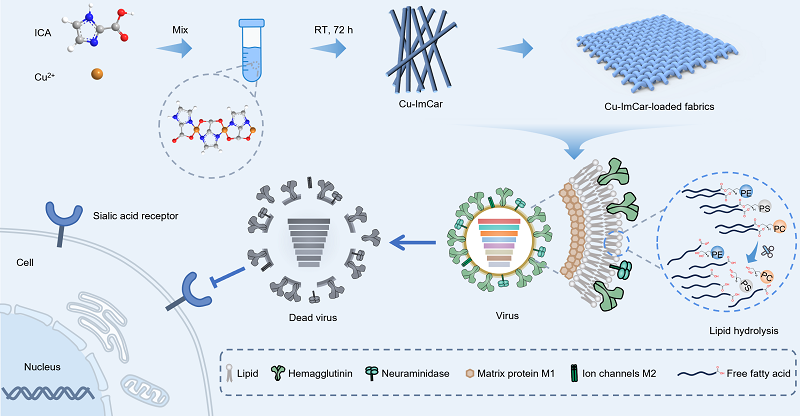
Preparation and antiviral application of the Cu-ImCar hydrolytic nanozyme (Image by GAO Lizeng's group)