
Newsroom


Covalent organic frameworks (COFs) are crystalline porous materials with designable structures, tunable bandgaps, and excellent light-harvesting capabilities, making them promising materials for optoelectronic devices. In conventional COF films, however, photogenerated carriers often migrate randomly and recombine rapidly due to structural disorder and poor interfacial contact. This severely limits macroscopic charge transport and device performance, especially in chemiresistive gas sensing.
A research team led by Prof. XU Gang from the Fujian Institute of Research on the Structure of Matter (FJIRSM) of the Chinese Academy of Sciences has developed sequence-controlled Janus COF films built from two isoreticular COFs, COF-366 and COF-366-OH, with nearly perfect lattice matching.
The study was published in Angewandte Chemie International Edition.
The researchers first grew highly oriented COF-366 and COF-366-OH layers on sapphire substrates using solvothermal methods, and then used secondary growth to fabricate bilayer films with opposite stacking orders: COF-366-on-COF-366-OH and COF-366-OH-on-COF-366. Powder X-ray diffraction (PXRD), scanning electron microscopy (SEM), and transmission electron microscopy (TEM) confirmed high crystallinity, continuous surfaces, and controlled thicknesses. Ultraviolet-visible (UV-vis) spectra and Mott-Schottky measurements revealed staggered energy levels, indicating the formation of type-II heterojunctions. Photocurrent tests further showed enhanced charge separation.
More importantly, in-situ X-ray photoelectron spectroscopy (XPS) demonstrated that light irradiation drives electrons and holes toward opposite sides of the film, creating an asymmetric charge distribution across the entire device. This Janus architecture generates a continuous built-in electric field and directional transport channels, enabling macroscopic carrier migration.
Under visible-light and room temperature, the bilayer COF films exhibited p-type gas-sensing behavior. Simply flipping the film reversed its selectivity between oxidizing and reducing gases.
In the COF-366-on-COF-366-OH film, the electron-rich top layer produced a response of 1263% to 100 ppm nitrogen dioxide (NO2), about 5.2 times higher than that of single-component films, with a limit of detection (LOD) of 0.48 ppm and response/recovery times of 2.2/1.0 min.
In the reversed COF-366-OH-on-COF-366 film, the hole-rich top layer showed a response of 132% to 100 ppm ammonia (NH3), about 5.3 times higher than the single-component counterparts, with an LOD of 5.6 ppm and response/recovery times of 1.4/12.4 min. XPS analysis and density functional theory (DFT) calculations further revealed that imine bonds serve as the key adsorption sites for both NO2 and NH3.
According to the researchers, this study provides a general strategy for constructing Janus COF films with macroscopic directional carrier migration. It not only deepens the understanding of charge transport in porous crystalline films but also opens a new route for advanced gas sensors and high-performance optoelectronic devices.
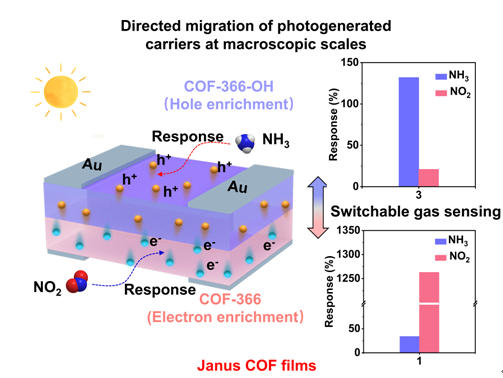
Directed migration of photogenerated carriers at macroscopic scales (Image by Prof. XU Gang's group)
