Newsroom


Scientists have used a tethered balloon to measure cloud droplets, aerosols, and electric fields over the Qinghai-Tibet Plateau, revealing links between aerosol abundance and droplet properties while also documenting weak electrical activity in clouds without lightning.
The study was published in Advances in Atmospheric Sciences.
Led by Prof. HUSI Letu at the Aerospace Information Research Institute of the Chinese Academy of Sciences (AIRCAS), the study involved collaborators from the Institute of Tibetan Plateau Research, the Institute of Atmospheric Physics, Xi'an University of Technology, the National University of Defense Technology, the National Satellite Meteorological Center, Peking University, and Tsinghua University.
The study reports a comprehensive tethered-balloon campaign specifically designed to investigate these properties simultaneously over the plateau, the researchers said.
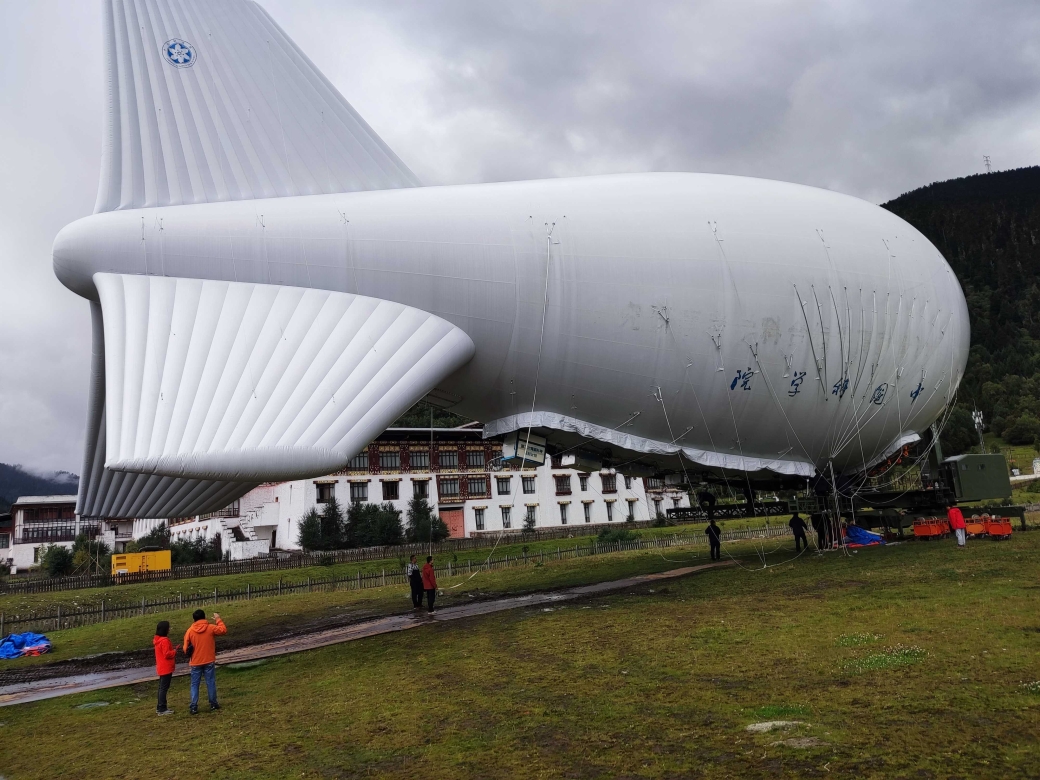
A tethered balloon prepares for launch over the Qinghai-Tibet Plateau. (Image by WANG Hengqi)
Clouds play an important role in Earth's climate and water cycle, yet their internal processes are difficult to observe. Unlike aircraft, which must keep moving, a tethered balloon can slowly ascend, descend, or remain within a cloud, allowing detailed measurements at different heights.
During the campaign in Lulang in the southeastern part of the plateau, the researchers combined measurements of cloud droplets, aerosols, meteorological conditions, and electric fields collected by the balloon with ground observations and satellite data.
"With the tethered balloon, we can stay in the cloud and observe how its microphysical and electrical properties change with height," said Assoc. Prof. SHANG Huazhe, who helped design and coordinate the campaign.
Higher aerosol abundance near cloud base was associated with more numerous, smaller droplets above, as well as increased cloud water. This relationship was particularly clear under the relatively clean conditions of the plateau, where the availability of particles on which droplets form may help control cloud development.
Asst. Prof. WANG Hengqi, who studies aerosol-cloud interactions and participated in the campaign, noted that more observations are needed to establish whether clouds elsewhere on the plateau show a similar sensitivity to aerosol abundance.
Droplets generally grew larger and cloud water increased with height, consistent with growth through condensation. Droplet numbers decreased in some cloud profiles, possibly because surrounding air mixed into the clouds and diluted the droplet population.
Previous studies of cloud electrification have focused largely on thunderstorms, where charge separation can generate strong electric fields and lightning. This study, however, focused on warm clouds that produced no lightning. Electric fields were generally weak, and their variations showed no clear linear relationship with droplet number or size. The researchers also found little difference in electric field strength between the inside and outside of the clouds.
These observations suggest that the surrounding atmospheric electrical environment, as well as the clouds themselves, may influence local electric fields. However, the researchers still observed some variations in electric field strength, and whether warm clouds influence atmospheric electrical activity on larger scales remains an open question.
Answering this question will require observations under a wider range of atmospheric conditions. The campaign demonstrates how tethered balloons can help investigate cloud processes over the plateau's complex terrain, providing a basis for further research.
"This campaign is only a beginning," HUSI said. To build on these initial findings, the researchers plan to extend their observations to different seasons and compare the properties of warm, mixed-phase, and ice clouds. Combining balloon measurements with aircraft, satellite, and ground-based radar observations could help improve understanding of the interactions among aerosols, clouds, precipitation, and electrical processes.