Newsroom


Researchers have identified a hidden Zeeman field (HZF) in the band structures of odd-parity magnets (OPMs). The finding reveals a previously overlooked feature of these magnetic systems and suggests a potential route to robust topological superconductivity without external magnetic fields.
The study, conducted by researchers from the High Magnetic Field Laboratory of the Hefei Institutes of Physical Science of the Chinese Academy of Sciences, in collaboration with the Hong Kong University of Science and Technology, was recently published in Physical Review Letters and selected as an Editors' Suggestion.
Topological superconductors are promising candidates for fault-tolerant quantum computing. However, conventional approaches often rely on external magnetic fields, which can suppress superconductivity and make topological phases more sensitive to disorder. Odd-parity magnets (OPMs), which exhibit momentum-dependent spin splitting despite having no net magnetic moment, offer a potential alternative. However, previous studies have largely overlooked the effects of the intrinsic time-reversal-symmetry breaking associated with their magnetic order.
Using an analytical model of an f-wave magnet on a triangular lattice, the researchers showed that the band structure of OPMs is shaped by two distinct mechanisms. The non-relativistic spin splitting (NSS) arises from a gauge field induced by magnetic order, which corresponds to a real-space spin-current-loop pattern. The HZF, by contrast, originates directly from time-reversal-symmetry breaking and lifts Kramers degeneracy at time-reversal-invariant momenta.
Self-consistent mean-field calculations further showed that the two effects work together to stabilize superconductivity. The electron-volt-scale NSS locks the spin polarization in a direction perpendicular to the HZF, creating a protection mechanism similar to that in Ising superconductivity. This allows conventional s-wave superconductivity to coexist with a strong HZF over a wide parameter range, even beyond the Pauli limit. The corresponding Zeeman splitting can reach hundreds of millielectronvolts.
Building on this mechanism, the team constructed several topological superconducting phases by introducing s-wave pairing. These phases can host different types of Majorana boundary modes, including Majorana flat bands and unidirectional Majorana edge states, without requiring an external magnetic field.
According to the researchers, the findings provide a more complete understanding of OPM band structures and highlight the potential of these materials as a platform for robust, magnetic-field-free topological superconductivity.
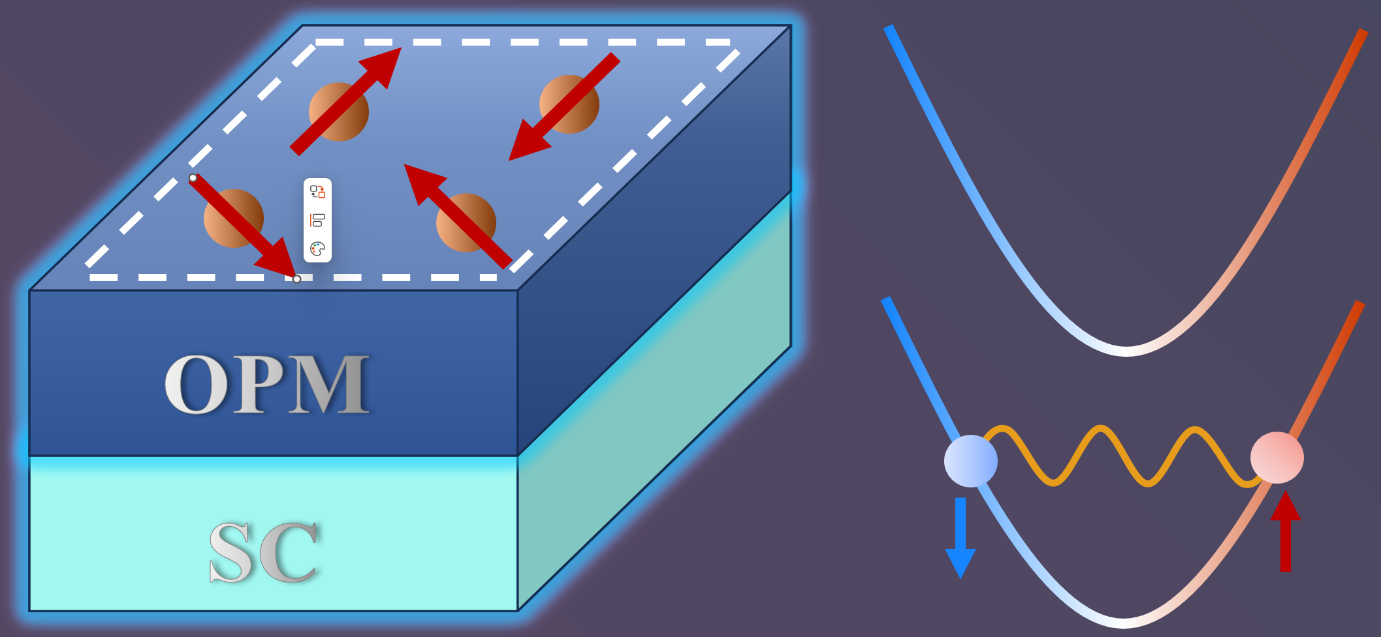
Schematic of the OPM/superconductor heterostructure and the mechanism of topological superconductivity: the unique band structure of odd-parity magnets, in which the NSS and the HZF coexist, makes them an ideal platform for realizing topological superconductors and Majorana boundary modes when coupled to a conventional superconductor. (Image by LUO Xunjiang)