Newsroom


A new study combining genomic analyses and fossil evidence sheds light on the century-old "Palaeoptera Problem," a longstanding debate over the evolutionary relationships among major groups of winged insects.
The findings, published in PNAS on October 13, support the hypothesis that mayflies (Ephemeroptera) and dragonflies and damselflies (Odonata) form a single evolutionary group, Palaeoptera, which is the sister group of Neoptera, the lineage comprising insects capable of folding their wings over their bodies.
The study, conducted by Professor CAI Chenyang's team from the Nanjing Institute of Geology and Palaeontology of the Chinese Academy of Sciences (NIGPAS) and Professor ZHOU Changfa's team from Nanjing Normal University, reconstructs the early evolutionary history of winged insects and provides new estimates for when their major lineages emerged.
Insects are the most species-rich group of animals on Earth, with more than one million formally described living species. The evolution of winged insects (Pterygota) stands among the most transformative events in terrestrial evolution. However, the timing of the origin of winged insects and the phylogenetic relationships among the three major pterygote lineages, Ephemeroptera (mayflies), Odonata (dragonflies and damselflies), and Neoptera (insects with foldable wings), have remained unresolved for over a century, making the Palaeoptera Problem a longstanding challenge in reconstructing the insect tree of life.
To address the problem, the researchers sequenced 16 new genomes from Chinese mayflies and integrated genomic and transcriptomic data from more than 100 insect species, achieving unprecedented coverage of this historically undersampled key lineage and substantially addressing gaps in taxon and gene sampling from previous studies.
The researchers first constructed two large amino-acid supermatrices using universal single-copy orthologous nuclear genes. They then systematically examined phylogenetic signals using concatenation and multispecies coalescent methods, multiple evolutionary models, topological tests, site-level signal dissection, and simulation analyses.
The results from these diverse phylogenomic approaches consistently support the monophyly of Palaeoptera. The genomic data also strongly indicate that Ephemeroptera and Odonata are sister groups—together forming Palaeoptera, the sister clade of Neoptera. These findings suggest that the non-foldable wings of Palaeoptera and the foldable wings of Neoptera are both novel traits independently acquired from ancestral winged insects, thereby largely resolving the long-standing Palaeoptera Problem.
The researchers found that during the rapid early radiation of winged insects, a combination of incomplete lineage sorting (ILS) and gene tree estimation error (GTEE) affected approximately 40% of gene trees, creating topological discordance between gene trees and the species tree. This phenomenon caused competing conclusions across different analytical frameworks and explains why earlier phylogenomic studies failed to fully resolve the phylogenetic relationships of basal winged insects. It also highlights the systematic rigor of the present study's analytical approach.
The researchers also used molecular-clock analyses calibrated with 13 carefully selected fossil reference points to estimate the timing of early winged-insect evolution. Their results indicate that crown-group Pterygota originated in the Early Devonian, while crown-group Palaeoptera arose in the Late Devonian. Insect wings evolved only once. The neopteran wing-folding mechanism, enabled by rotation of the independent third axillary sclerite to tuck hindwings over the abdomen, provided morphological and ecological foundations for the explosive radiation of Neoptera after the Carboniferous.
In contrast, both mayflies and dragonflies evolved highly specialized rigid wing-base complexes adapted for gliding or high-speed predatory flight. The reconstructed evolutionary scenario shows that after the initial divergence of winged insects, Palaeoptera and Neoptera rapidly diverged and evolved distinct wing structures, with Neoptera evolving its unique wing-folding apparatus and Palaeoptera developing rigid wing bases for high-performance direct flight.
Together, these innovations shaped the flight biomechanics and species diversity of winged insects observed in nature today.
This study was funded by the National Key R&D Program of China, the National Natural Science Foundation of China, and the China Postdoctoral Science Foundation.
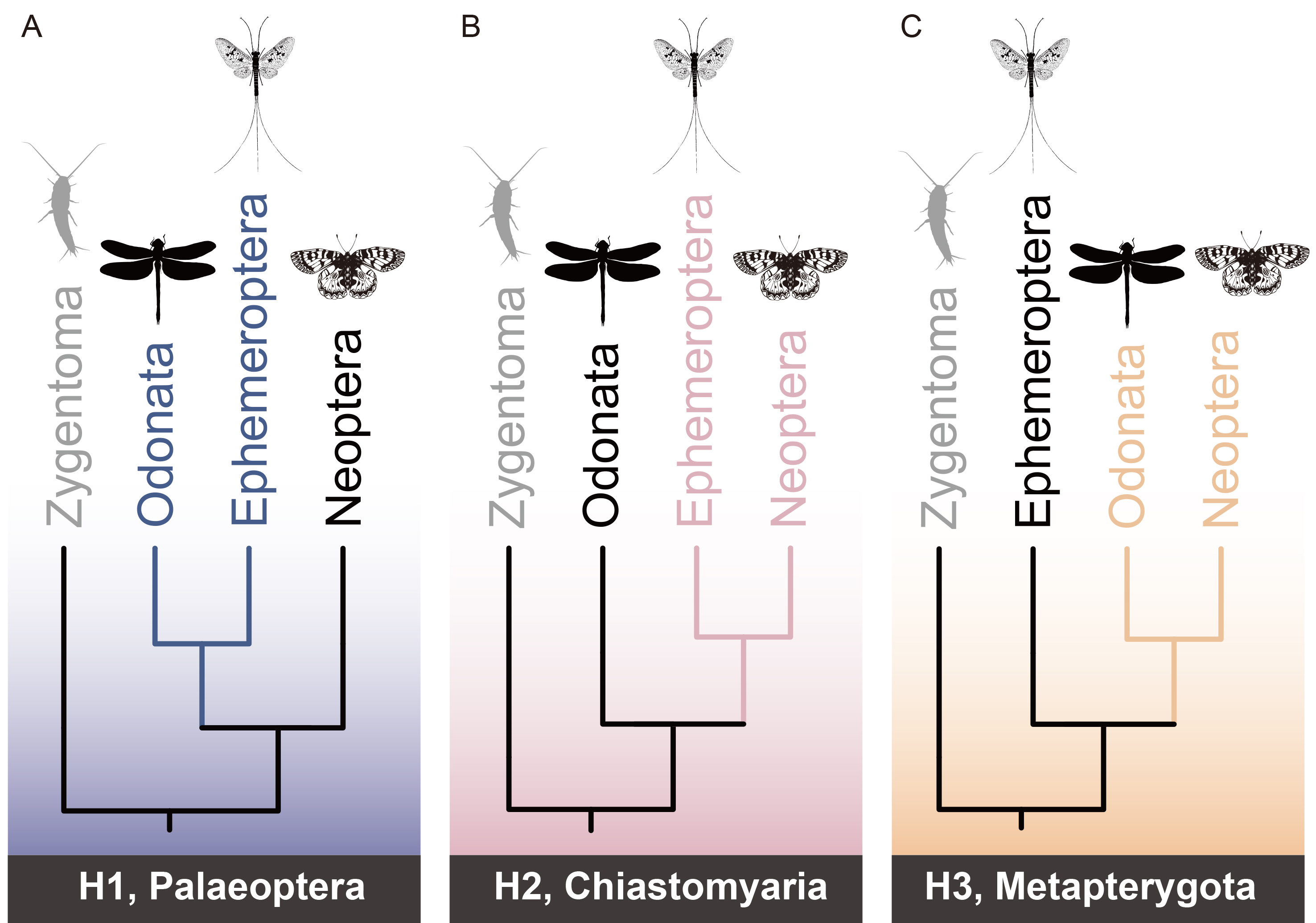
Three hypotheses for the early branching events within pterygote evolution. A. Palaeoptera hypothesis (H1): [[Ephemeroptera + Odonata] + Neoptera]; B. Chiastomyaria hypothesis (H2): [Odonata + [Ephemeroptera + Neoptera]]; C. Metapterygota hypothesis (H3): [Ephemeroptera + [Odonata + Neoptera]]. (Image by NIGPAS)