
Newsroom


Inhibiting hepatic forkhead box O1 (FoxO1) may lower blood glucose but also threaten pancreatic β cell survival, according to a new study that reveals how liver-derived ceramides contribute to β cell apoptosis.
Researchers found that hepatic FoxO1 loss triggers the overproduction of specific lipid messengers—C18/22/24 ceramides—that travel to the pancreatic islets and contribute to β cell apoptosis.
The study, published in Cell Chemical Biology, was conducted by a research team led by Prof. HAN Dong from the Institute of Hydrobiology of the Chinese Academy of Sciences, in collaboration with other researchers.
Hyperglycemia has become a prevalent hallmark of modern metabolic syndrome. Excessive hepatic glucose production (HGP) is the primary driver for hyperglycemia. FoxO1, a key transcription factor, fuels HGP by switching on gluconeogenic genes—making it an attractive target for blood glucose control.
However, FoxO1 also orchestrates hepatic lipogenesis. Blocking hepatic FoxO1 may drive excessive lipid production in the liver, leading to excessive lipid deposition and spillover of lipid metabolites that threaten metabolic balance. This dual role, controlling both HGP and lipid synthesis, represents a paradox with major implications for how we treat hyperglycemia with FoxO1-targeting strategies.
Inhibiting hepatic FoxO1 while keeping pancreatic β cells safe anchors the antihyperglycemic strategy, yet supraphysiological lipids, such as fatty acids and sphingolipids, are known to damage β cell function and homeostasis. So, the trade-off of enhanced lipogenesis upon hepatic FoxO1 loss deserves serious attention.
The liver is a metabolic hub, communicating with other organs by releasing specific metabolites. Previous studies have already raised concerns that FoxO1-targeting antihyperglycemic therapy could worsen liver lipogenesis and impair β cells. Therefore, a question remains to be addressed: do liver-derived lipids disturb β cell homeostasis upon hepatic FoxO1 loss, and if so, how?
To investigate this question, the researchers established liver-specific Foxo1-deficient mouse (AAV8-shRNA delivery) and β cell- or liver-specific transgenic rescue zebrafish models, combined with pharmacological approaches.
They found that hepatic FoxO1 loss inhibited gluconeogenesis and lowered blood glucose, but simultaneously reduced pancreatic β cell number and survival. Apoptosis marker detection, primary hepatocyte–β cell conditioned medium assays, and pharmacological interventions confirmed that liver-derived factor(s) mediated β cell apoptosis.
Lipidomic analysis further identified liver-derived C18/22/24 ceramides as key effectors, which inhibited the AKT–mTORC1 pathway via PP2A activation, thereby triggering β cell apoptosis.
Mechanistically, ChIP-qPCR, ChIP-seq, and dual-luciferase reporter assays demonstrated that FoxO1 acts as a transcriptional repressor of ceramide synthases genes Cers2/4. Hepatic FoxO1 loss derepresses Cers2/4 transcription, leading to excessive C18/22/24 ceramide production. The findings reveal a liver-to-β cell signaling axis mediated by FoxO1-regulated ceramide metabolism, cautioning that FoxO1-targeting antihyperglycemic strategies may compromise β cell integrity.
This study reports a new inter-organ signal from liver-derived ceramides to pancreatic β cell homeostasis upon hepatic FoxO1 loss. The disturbed β cell homeostasis underscores caution for FoxO1-targeting therapy.
Together, these findings reveal a previously unrecognized liver–β cell signaling axis mediated by FoxO1-regulated ceramide metabolism. The study also raises an important concern: therapies designed to inhibit hepatic FoxO1 may inadvertently harm pancreatic β cells.
According to the researchers, combining FoxO1 inhibition with strategies to curb ceramide production could be a potential approach to preserving β cell integrity while achieving glycemic control, although further investigation is needed.
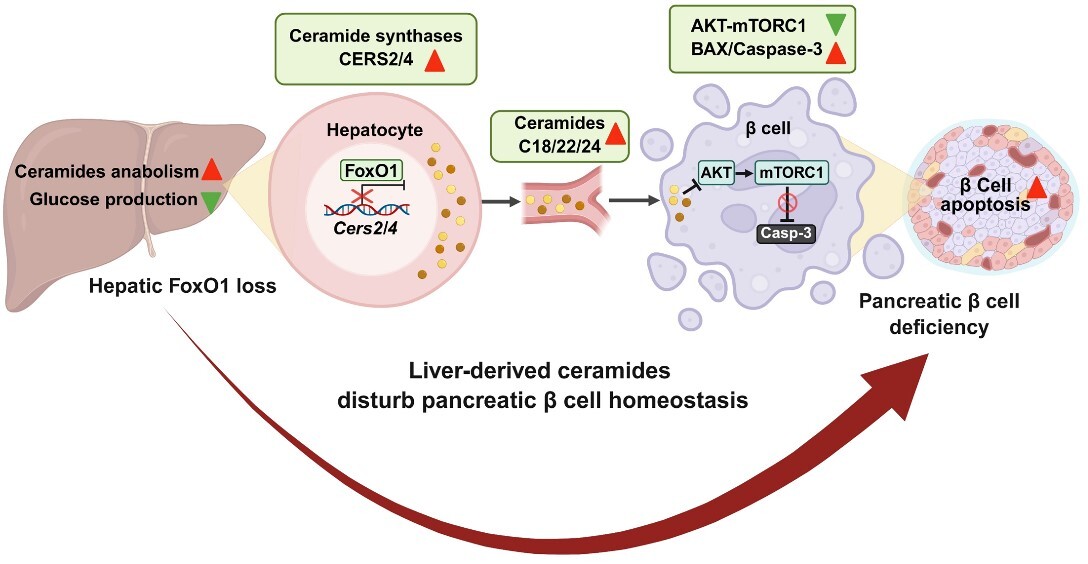
Hepatic FoxO1 loss induces pancreatic β cell deficiency mainly via liver-derived C18/22/24 ceramides. (Image by IHB)
