Newsroom


Reduced human mobility during the COVID-19 pandemic was associated with a 12.3% decline in global fire incidence, but fires increased in some countries. A study led by WANG Jianghao and GE Yong at the Institute of Geographic Sciences and Natural Resources Research of the Chinese Academy of Sciences helps explain this contrast: people can both ignite fires and keep them under control.
The study appears in Cell Reports Sustainability on October 9, 2026.
The pandemic offered a natural experiment for examining human influences on fires separately from weather. The researchers combined satellite fire observations, meteorological records, lockdown policies, and mobility data. They compared the first half of 2020 with corresponding periods in 2013–2019, accounting for weather conditions and seasonal and interannual variations.
The estimated changes differed sharply among countries. Fire incidence fell by 22.8% in the United States but rose by 31.4% in Colombia and 70.7% in Honduras. Forests experienced a particularly large decline, at 27.7%, consistent with fewer human-caused ignitions when outdoor activity decreased.
The contrasting responses reflect two potentially competing effects. Reduced outdoor activity can limit accidental ignitions and intentional burning. However, it can also disrupt fire monitoring, prevention, and suppression, allowing fires that would otherwise be controlled to persist or spread. The increases observed in some regions are consistent with this second pathway, although the study did not directly measure changes in firefighting or patrol activity.
Importantly, the satellite observations include both wildfires and prescribed burns—deliberately managed fires used, for example, to reduce vegetation fuels. In 12 countries with detailed prescribed-burning records, the estimated decline in fire incidence was 45.3%. After excluding areas with historical prescribed burning, it was 27.8%. This comparison indicates that changes in managed burning contributed to the observed decline; fewer satellite fire detections do not necessarily mean fewer harmful wildfires alone.
The findings highlight why fire management cannot rely on uniform policies. Where human ignition dominates, preventing accidental fires is essential. Where human intervention helps contain fires, maintaining monitoring and suppression capacity is equally important. Beneficial prescribed-burning programs also need to be maintained under suitable conditions. Understanding these local differences can help managers reduce damaging fires without losing essential fire-management practices.
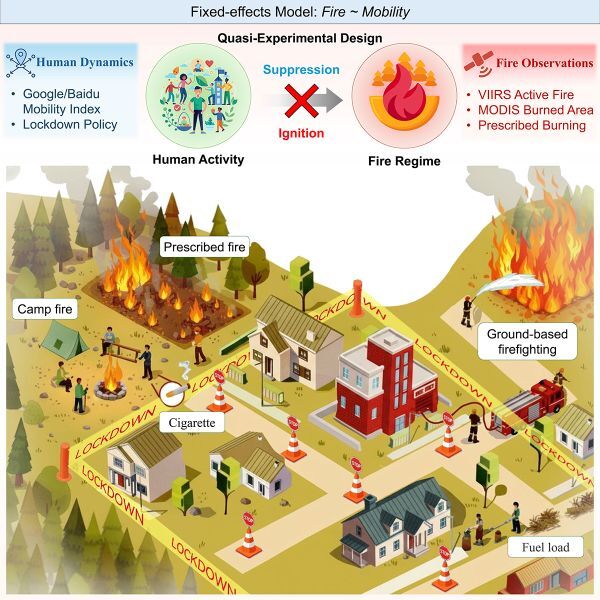
Human activity affects global fire regimes through two opposing pathways. Human can increase fire activity through accidental or intentional ignition, while reducing fires through prevention, suppression, and management. Mobility restrictions during the COVID-19 pandemic revealed strong regional differences between these effects. (Image by Prof. WANG Jianghao's group)