
Newsroom


Researchers have recently developed a new method to measure electrical transport in freestanding thin films under high pressure, opening up new possibilities for investigating the electronic properties of thin-film materials under extreme conditions.
Using the method, they found that crystal dimensionality can strongly affect the pressure response of SrIrO3: three-dimensional films undergo a pressure-driven semimetal–insulator–metal transition, while two-dimensional films remain insulating even under high pressure.
The study, published in Science China Physics, Mechanics & Astronomy, was conducted by a research team led by Prof. HAO Lin from the Hefei Institutes of Physical Science of the Chinese Academy of Sciences, in collaboration with Changzhou University and South China University of Technology.
High pressure is widely used to tune the electronic properties of materials. While it has proven particularly effective in studies of bulk materials, applying pressure to thin films remains much more challenging.
Thin films are typically grown on substrates that provide mechanical support. The enormous geometric scale mismatch between the substrate and the nanoscale film makes it difficult for external pressure to act effectively on the film. Removing the substrate can overcome this limitation, but freestanding films are mechanically fragile and difficult to integrate with electrodes for electrical measurements under high pressure.
In this study, the researchers developed a set of techniques for protecting and releasing thin films, fabricating nanoscale electrodes, and carrying out electrical transport measurements under high pressure. The resulting method works for films with different electrical properties, from metals to insulators, making it applicable to a broad range of thin-film materials.
According to the researchers, the method also holds promise for investigating other thin-film systems, including freestanding superconducting materials.
The researchers also used magnetic iridate SrIrO3 as a model system to explore the effects of pressure and dimensionality on its electronic states.
Their results showed that three-dimensional SrIrO3 films underwent a transition from a semimetal to an insulator and then to a metal as pressure increased. In contrast, SrIrO3 in the two-dimensional limit remained insulating even under high pressure.
The results show that dimensionality plays an important role in the pressure response of thin-film materials, offering a way to explore electronic states in quantum materials under extreme conditions, the researchers said.
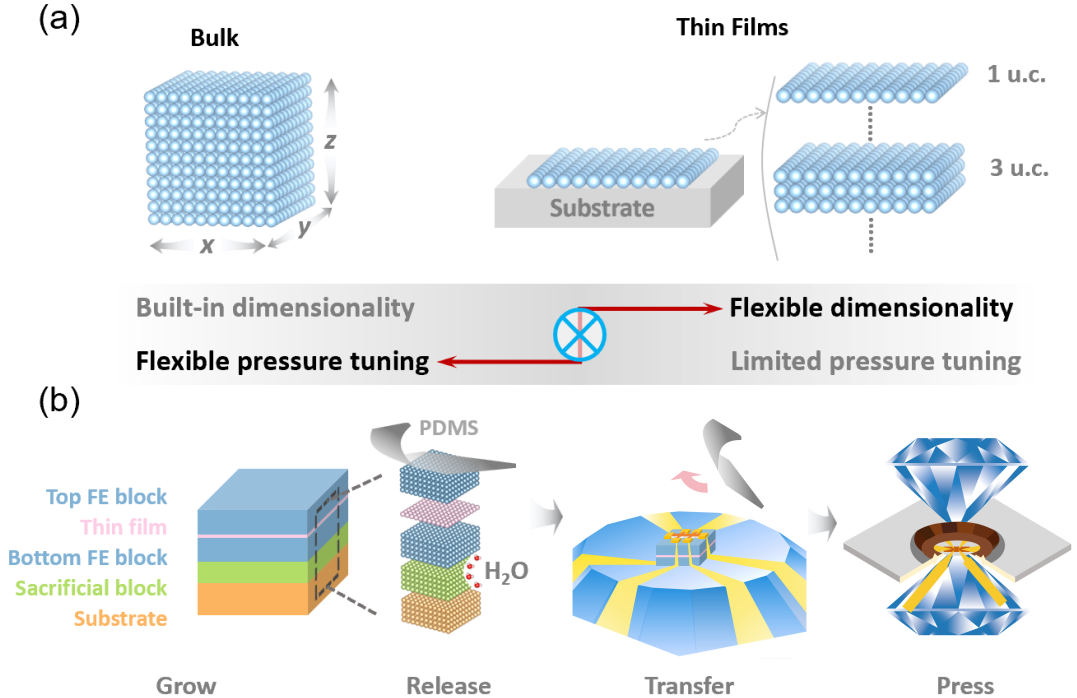
(a) In bulk materials, dimensionality is fixed by the crystal structure, whereas thin films allow flexible tuning of dimensionality through epitaxial growth. (b) Flowchart of the high-pressure strategy for freestanding films. (Image by CHEN Jingxin)
