
Newsroom


Sweet potato vines (SPV) are rich in nutrients and can serve as a feed resource for livestock, but their high moisture content makes them prone to deterioration after harvest. Ensiling, which preserves plant material through fermentation without air, offers a practical solution. Understanding how added bacteria affect both preservation and the transformation of plant material is important for improving its feeding value.
A research team led by Prof. KONG Xiangfeng from the Institute of Subtropical Agriculture (ISA) of the Chinese Academy of Sciences (CAS), in collaboration with researchers from the Institute of Microbiology of CAS, found that fermentation with a mixture of lactic acid bacteria can improve the preservation and nutritional characteristics of SPV.
The researchers also found that adding a moderate proportion of fermented SPV to pig diets can improve feed efficiency, highlighting its potential as a feed resource.
The study was recently published in Chemical Engineering Journal.
In the study, two bacterial species, Lactiplantibacillus plantarum and Pediococcus pentosaceus, were added to SPV and compared with natural fermentation over an eight-week period. Nutrient measurements, microscopy, and analyses of microbial DNA and small molecules were combined to track changes during fermentation.
The bacterial treatment consistently lowered pH and ethanol accumulation. At later stages, the treated vines had a higher crude protein concentration and lower crude fiber content than naturally fermented material. Microscopy also revealed greater disruption of plant tissues, suggesting that fermentation altered structural barriers that can restrict access to nutrients.
These changes coincided with a microbial community dominated by Lactiplantibacillus. In contrast, the predominant microorganisms varied more over time under natural fermentation. Further analyses identified associated changes in microbial genes and chemical profiles related to carbohydrate processing, amino acid metabolism, and vitamin-related pathways. Together, these observations linked improved fermentation performance with changes in plant structure and microbial activity.
To assess the practical feeding value of fermented SPV, the team conducted an eight-week trial involving 32 finishing Ningxiang pigs fed diets containing 0%, 4%, 8%, or 12% fermented SPV. At 4% inclusion, the feed-to-gain ratio fell from 4.98 to 4.21—approximately 15% less feed per unit of weight gain than in the control group.
Final body weight, average daily gain, and average daily feed intake did not differ significantly among diets. Higher inclusion levels showed no significant overall feed-to-gain advantage over the control, underscoring the importance of an appropriate dietary proportion.
Dr. HU Weidong from ISA, the first author of the study, said the findings support controlled fermentation as a promising approach to utilizing SPV in livestock feeding. Larger trials and measurements of nutrient digestibility will help establish its broader applicability.
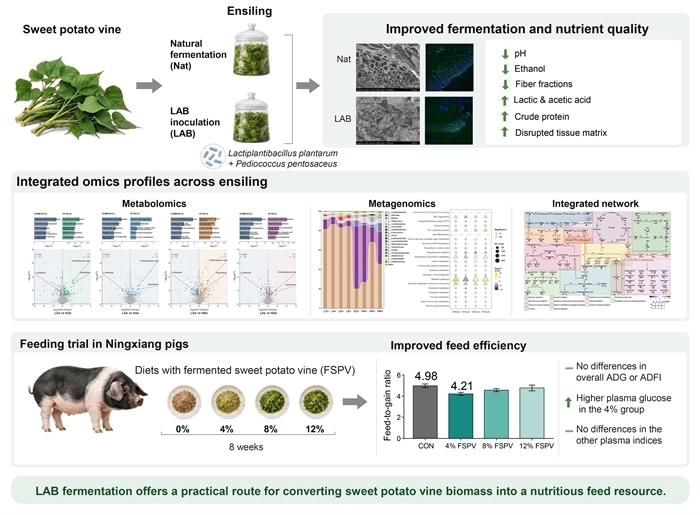
Lactic acid bacteria reshape microbial communities and metabolic processes during sweet potato vine fermentation and support its utilization as a feed resource for Ningxiang pigs. (Image by HU Weidong)
