Newsroom


A research team led by Profs. ZHANG Fan and GU Hongcang from the Hefei Institutes of Physical Science of the Chinese Academy of Sciences has developed HelixDTA, a deep learning model designed to improve drug-target affinity prediction.
"The analysis helped us understand which parts of drugs and proteins are important for their interactions," ZHANG said.
The findings were published in Journal of Chemical Information and Modeling.
Drug-target affinity prediction is an important step in AI-assisted drug discovery. It helps researchers evaluate whether a drug candidate can interact with a specific protein target. However, accurately predicting these interactions remains challenging because they are influenced by multiple factors, including molecular structures, protein sequences, and three-dimensional conformations.
In this study, the team developed HelixDTA by integrating information from drug molecules and target proteins. The model analyzes drug structures, protein sequences, and three-dimensional structural features to better understand how drugs interact with their target proteins. It then uses this information to predict the strength of the interactions.
The researchers tested HelixDTA on two widely used benchmark datasets, Davis and KIBA. The results showed that the model maintained stable prediction performance under standard evaluations.
They further evaluated its ability to handle more challenging cases, including interactions involving unfamiliar drug structures, evolutionarily distant protein sequences, and new protein structures. HelixDTA continued to provide reliable predictions in these previously unseen cases.
The researchers also analyzed the model's prediction process to better understand how different regions of drugs and proteins contribute to their interactions. The results showed that HelixDTA could identify regions associated with drug binding and protein functions.
According to the team, HelixDTA provides a computational approach for investigating potential drug-target interactions.
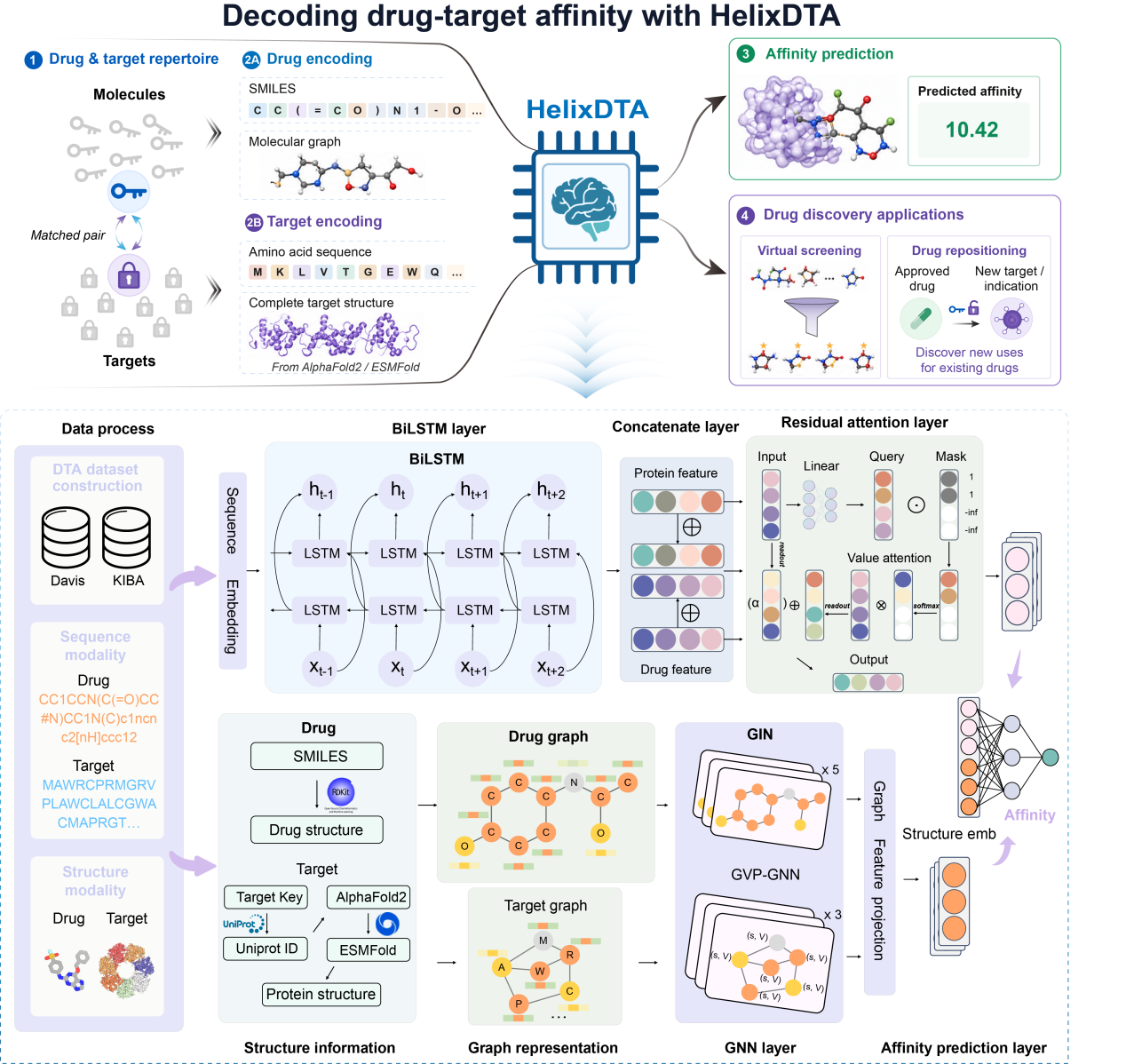
Framework of HelixDTA (Image by ZHANG Fan)