
Newsroom


Researchers from the Qingdao Institute of Bioenergy and Bioprocess Technology (QIBEBT) of the Chinese Academy of Sciences, together with Qingdao University of Science and Technology, have discovered a previously unknown marine bacterium that can both fix carbon dioxide and degrade aromatic hydrocarbons. This dual capability could make the bacterium a valuable tool for coastal carbon cycling research and pollution cleanup efforts.
The study was published in Bioresource Technology on September 9.
Ocean microbes that fix CO2 play a significant role in the planet's carbon sink. However, most of these microbes remain uncultured because they grow slowly, have complex nutritional needs, and are difficult to distinguish from the more abundant heterotrophic bacteria using standard genetic surveys.
To overcome this "culture-first, screen-second" bottleneck, the team developed an integrated workflow called scRACS-Culture. This workflow combines the use of 13C-labeled bicarbonate feeding, high-throughput Raman-activated flow cytometry, and single-cell sorting using a platform called FlowRACS. It also incorporates single-cell cultivation. By tracking shifts in the Raman signatures of carotenoid pigments induced by isotopes, the system can identify individual cells actively fixing carbon from seawater without waiting for them to become a dominant, culturable population.
When applied to Yellow Sea seawater, the approach identified and cultured six active carbon-fixing strains within seven days, as opposed to 90 days or more using conventional enrichment methods. None of the six strains were detectable by standard 16S rRNA gene sequencing, underscoring how many ecologically important, yet low-abundance, microbes are missed by routine surveys.
One isolate, Paraburkholderia aromaticivorans FR-4, stood out. Genomic and physiological analyses revealed that it is a facultative chemoautotroph that oxidizes nitrite and fixes CO2 through a complete Calvin cycle. It also carries a full aromatic-compound degradation pathway, allowing it to grow on xylene as its sole carbon source.
"This strain shows that the boundary between 'carbon fixer' and 'pollutant degrader' isn't as fixed as we assumed," said Prof. JING Xiaoyan of Qingdao University of Science and Technology, corresponding author of the study. "Its metabolic flexibility likely helps it survive in nutrient-fluctuating coastal waters, and it may also serve as a resource for the remediation of oil-contaminated marine sites."
"By linking real-time metabolic activity, genome sequence, and physiology in a single workflow, we can start recovering the kind of low-abundance functional microbes that conventional metagenomics tends to overlook," said Prof. XU Jian, co-corresponding author of the study.
The researchers plans to combine the scRACS-Culture platform with long-term ocean observation programs to better quantify the contribution of such "cryptic" carbon-fixing bacteria to marine carbon and nitrogen cycling.
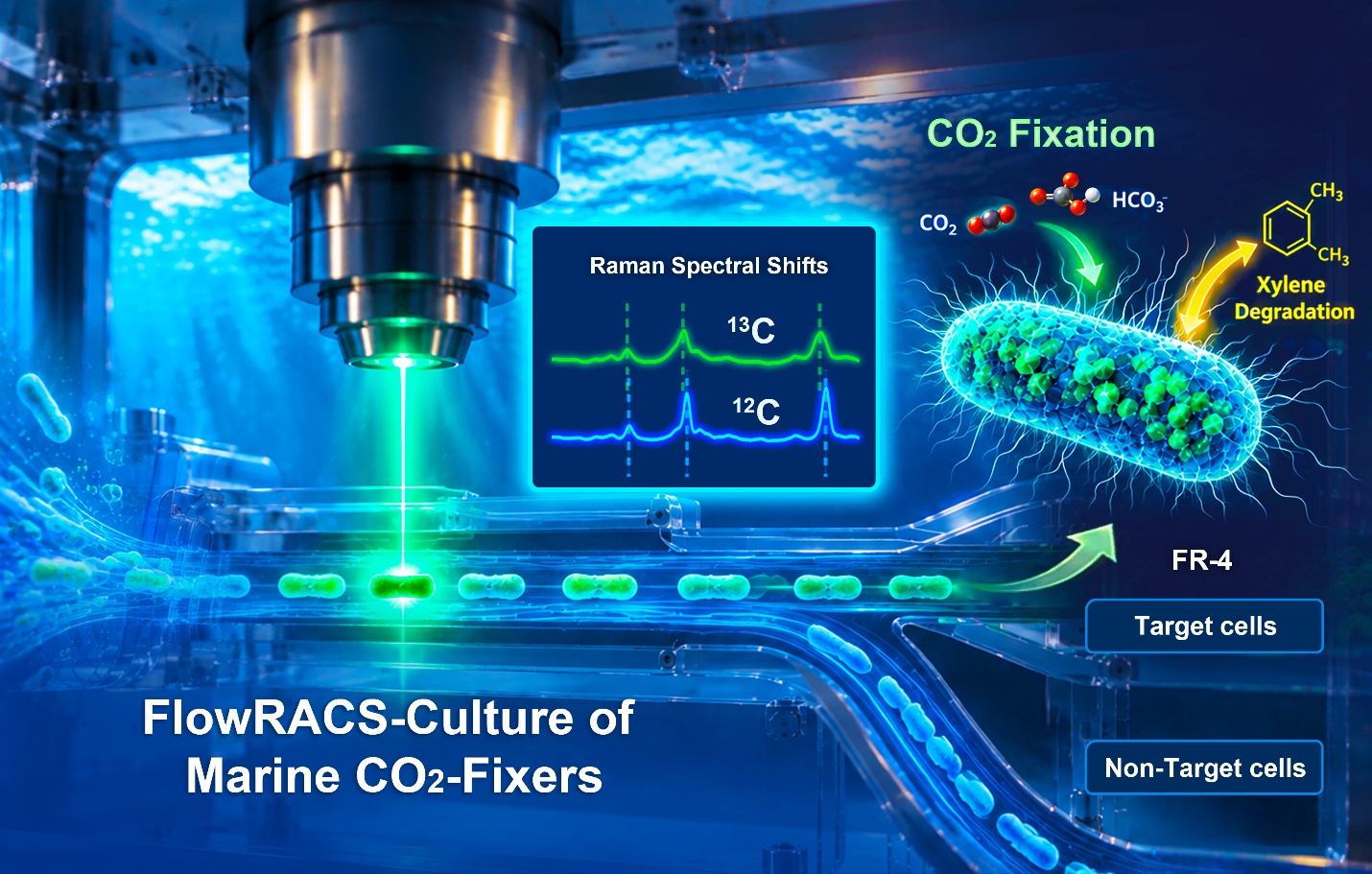
FlowRACS-based workflow for mining low-abundance functional marine microorganisms (Image by QIBEBT)
