
Newsroom


Scientists from the Institute of Metal Research (IMR) of the Chinese Academy of Sciences, in collaboration with researchers from The Hong Kong Polytechnic University, have clarified the dual regulatory role of niobium (Nb) in the microstructural stability of high-silicon austenitic stainless steel, offering a new strategy to suppress austenite decomposition during long-term service at elevated temperatures.
Their results were published in Acta Materialia on Sept. 11.
Lead-cooled fast reactors, a key reactor type in Generation IV nuclear energy systems, require structural materials that can withstand prolonged exposure to high temperatures, irradiation, and liquid lead-bismuth eutectic (LBE) corrosion. High-silicon austenitic stainless steels exhibit excellent LBE corrosion resistance, making them promising candidates for reactor vessels and internals. However, adding silicon significantly alters precipitation mechanisms and can induce austenite decomposition, which threatens long-term microstructural stability.
Building on their previous work that revealed silicon-induced austenite decomposition and associated mechanical degradation, the researchers investigated how Nb addition regulates this decomposition during thermal aging at 550 °C. They discovered that Nb plays a "dual role." On one hand, Nb preferentially forms NbC, which suppresses the precipitation of M₂₃C₆ carbides and thereby delays austenite decomposition. On the other hand, the strong interaction between Nb and Si promotes the formation of (Nb, Si)-rich clusters, which further induce a new pathway of austenite decomposition.
The study elucidated a two-stage evolution mechanism. During intermediate aging, (Nb, Si)-rich clusters act as favorable precursors for M6C carbide nucleation. The growth of M6C consumes Ni and C from the surrounding austenite, creating local Ni- and C-depleted regions that trigger the γ → α-ferrite transformation. With longer aging, these clusters further promote the nucleation of the G phase. This leads to a eutectoid transformation of γ → G phase + α-ferrite. The cooperative lamellar growth is controlled by Nb diffusion in the austenite ahead of the decomposition front.
Guided by these mechanistic insights, the team proposed a stabilization treatment at 900 °C. This treatment precipitates dispersed secondary NbC particles while reducing the solute Nb and C content in the austenite. This process synergistically suppresses both M6C carbide formation and Nb-partitioning-induced austenite decomposition. Following 3000 hours of thermal aging at 550 °C, no obvious austenite decomposition was observed after the stabilization treatment.
The findings establish a new theoretical foundation for designing the composition and controlling the microstructural stability of long-lasting, LBE-corrosion-resistant, high-silicon austenitic steels.
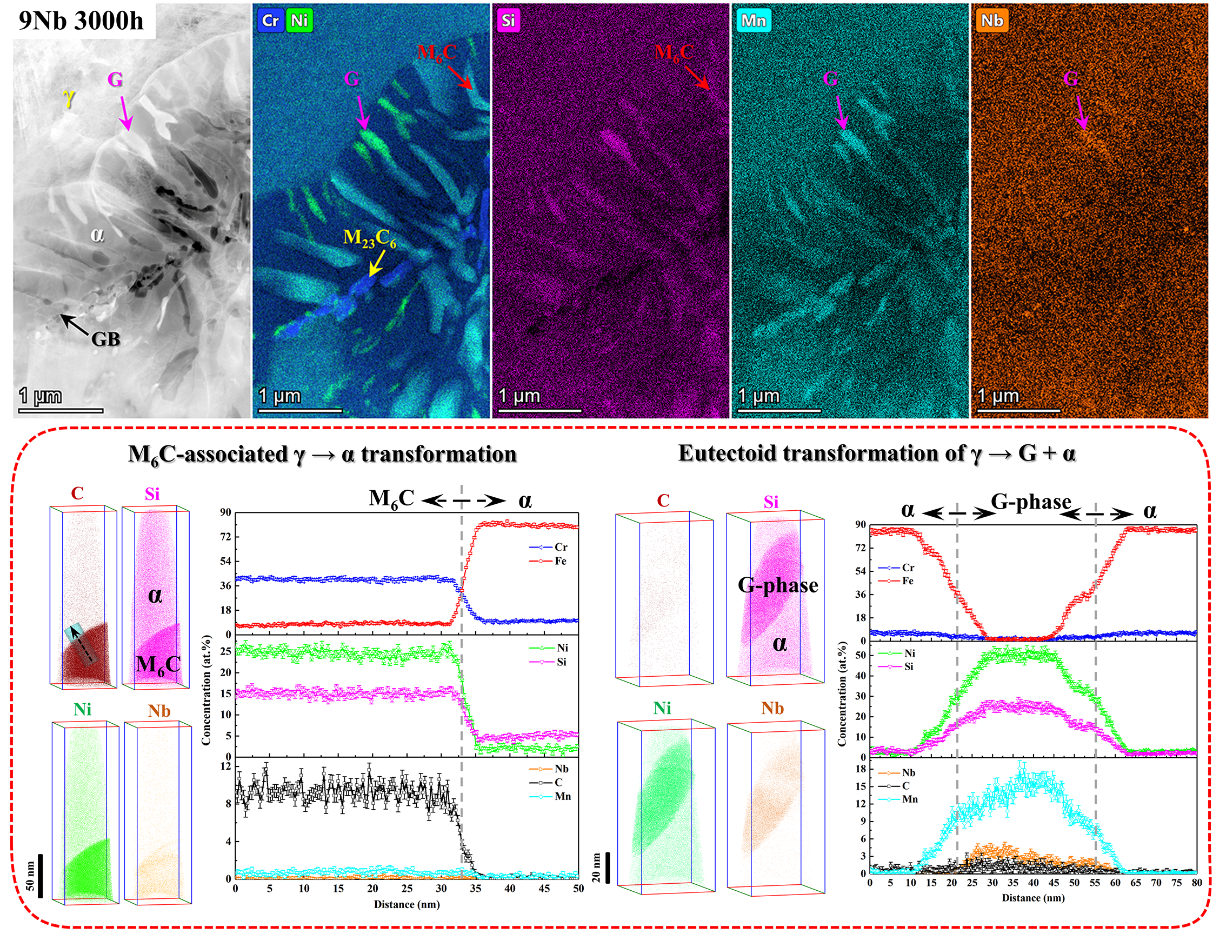
Nb partitioning-mediated austenite decomposition process. (Image by IMR)
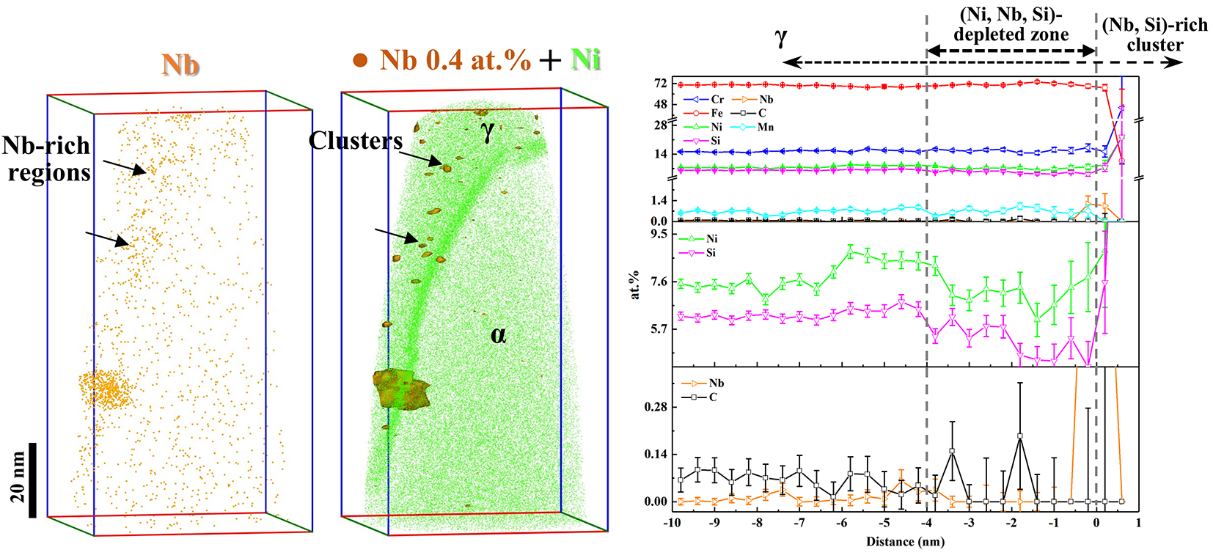
Formation of (Nb, Si)-rich clusters and composition changes in adjacent austenite. (Image by IMR)
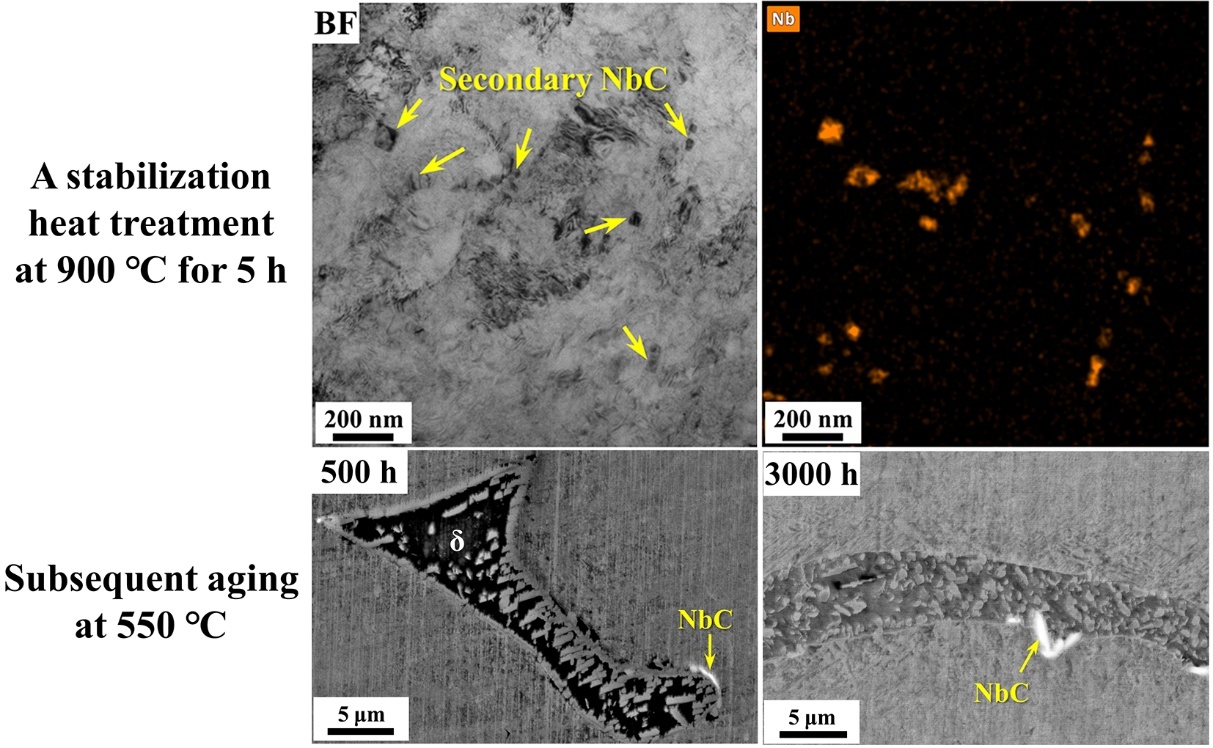
Stabilization treatment further suppresses austenite decomposition. (Image by IMR)
