
Newsroom


Zinc-ion hybrid capacitors are promising energy-storage devices, but increasing electrode thickness makes it harder for ions and electrons to move through the material, which slows charging and affects the stability of the device.
In a study published in Composites Part B: Engineering, a team led by WANG Zhenyang from the Hefei Institutes of Physical Science of the Chinese Academy of Sciences developed a thick cathode that helps zinc-ion hybrid capacitors maintain high capacity and fast charging performance.
Through a sequential laser-engineering strategy, researchers designed three functional regions within a single porous graphene electrode. They created these regions performing different roles, forming a continuous structure rather than stacking separate layers.
The inner graphene region provides pathways for electron transport, the middle region contains manganese oxide (MnOx), the main active material for energy storage, and the outer region is rich in oxygen, helping the electrolyte enter the electrode more easily.
These regions working together enables the electrode maintained continuous pathways for both electron and ion transport even at greater thickness. The electrode retained 93.6% of its capacitance after 12,000 charge-discharge cycles. A zinc-ion hybrid capacitor made with the electrode showed stable energy-storage performance.
Moreover, researchers examined the electrode structure through simulations and post-cycling analysis. They found that the oxygen-rich outer region improved the electrolyte access and might also help reduce the loss of manganese species during cycling.
The study provides a new approach for designing thick electrodes for zinc-ion hybrid capacitors.
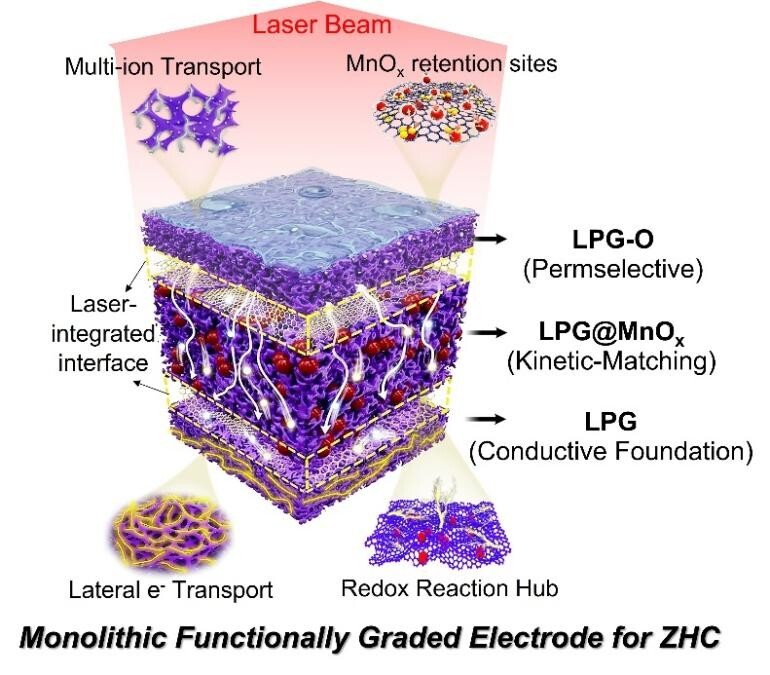
Schematic illustration of the step-wise functionally graded LPG/LPG@MnOx/LPG-O thick electrode. (Image by LI Nian)
