Newsroom


Rice leaves have waxy surfaces and complex micro/nanostructures, making them highly water-repellent. During spraying, fertilizer droplets can easily shrink, bounce off, or be removed by rainfall after deposition, reducing nutrient utilization efficiency.
In a study published in Environmental Science & Technology, a team led by Prof. WANG Guozhong and LI Wenchao from the Hefei Institutes of Physical Science of the Chinese Academy of Sciences developed a silica nanoparticle-based foliar nitrogen fertilizer that helps nanoagrochemicals better stick to rice leaves and resist being washed away by rain.
Researchers designed spiny pollen-like silica, loaded with ammonium chloride, and synergistically incorporated 0.2 wt % sodium dodecylbenzenesulfonate (SDBS) to construct a composite fertilizer system designated PSN0.2. PSN0.2 improves both the initial spreading of fertilizer droplets and their long-term retention on leaf surfaces.
When sprayed onto rice leaves, SDBS helps fertilizer droplets spread more easily, while the micro/nanostructures of rice leaves help keep them in place and prevent them from bouncing away. After drying, the rough silica nanoparticles further enhanced adhesion between the fertilizer and leaf surface.
After two simulated rainfall events, PSN0.2 retained 71.33% of its nitrogen on rice leaves, showing improved rainfastness compared with conventional foliar nitrogen fertilizer. Field experiments showed that combining soil fertilization with PSN0.2 increased rice yield by 17.5% while reducing total nitrogen input by 10%.
The study provides a simple and effective approach for developing foliar fertilizers with strong adhesion and excellent rainfastness, advancing sustainable agriculture.
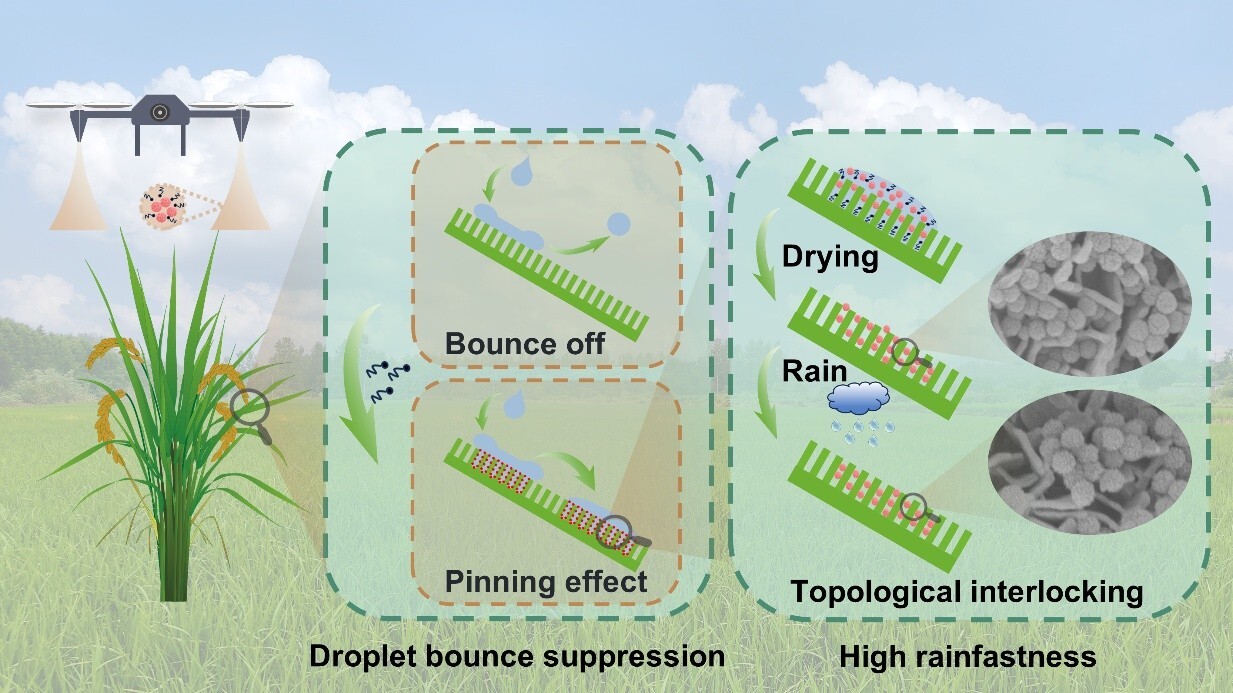
Schematic illustration of the foliar adhesion mechanism. (Image by LI Long)