
Newsroom


Atomically precise metal clusters are nanoscale molecules with well-defined structures. They have been used to construct artificial systems that mimic natural stimuli-responsive processes. Although advances have been made in understanding stimuli-responsive structural isomerization in gold and silver clusters, research on polynuclear copper clusters is underexplored.
In a study published in PNAS, a joint team led by Prof. YAN Liangliang from the Fujian Institute of Research on the Structure of Matter of the Chinese Academy of Sciences and Prof. Vivian Wing‑Wah YAM from the University of Hong Kong revealed solvent‑ and temperature‑driven reversible isomerization between two cubic octanuclear copper(I) cluster isomers, Cu8‑1 and Cu8‑2.
Researchers designed a phosphine‑alkyne bifunctional ligand, (2‑ethynylphenyl)diphenylphosphine (HL), to synthesize Cu8‑1. Single‑crystal X‑ray diffraction, high‑resolution electrospray‑ionization mass spectrometry and nuclear magnetic resonance confirmed the atomic‑level structure of Cu8‑1, among which six Cu atoms are protected by both P and C≡C donors and the other two are protected only by C≡C donors, thereby presenting accessible sites for further functional group coordination.
Furthermore, researchers revealed that the introduction of external stimuli, including varying solvent compositions or temperatures, could induce a reversible structural transformation between Cu8-1 and its isomer, Cu8-2. This transformation is achieved through the cleavage of the original Cu–P coordination bonds and the re-coordination of phosphine with exposed Cu sites. Notably, this process preserves the Cu8 kernel structure.
Accompanying this reversible structural switching, there was a luminescence color change took place. Cu8-1 emitted green light at 520 nm, while Cu8-2 produced red emission at 625 nm. Tunable emission color could be visually observed by adjusting solvent ratios under ultraviolet excitation.
This work not only provides a simple approach to achieve stimuli-induced isomerization between Cu8-1 and Cu8-2 but also offers an ideal platform for investigating their structure-property relationships.
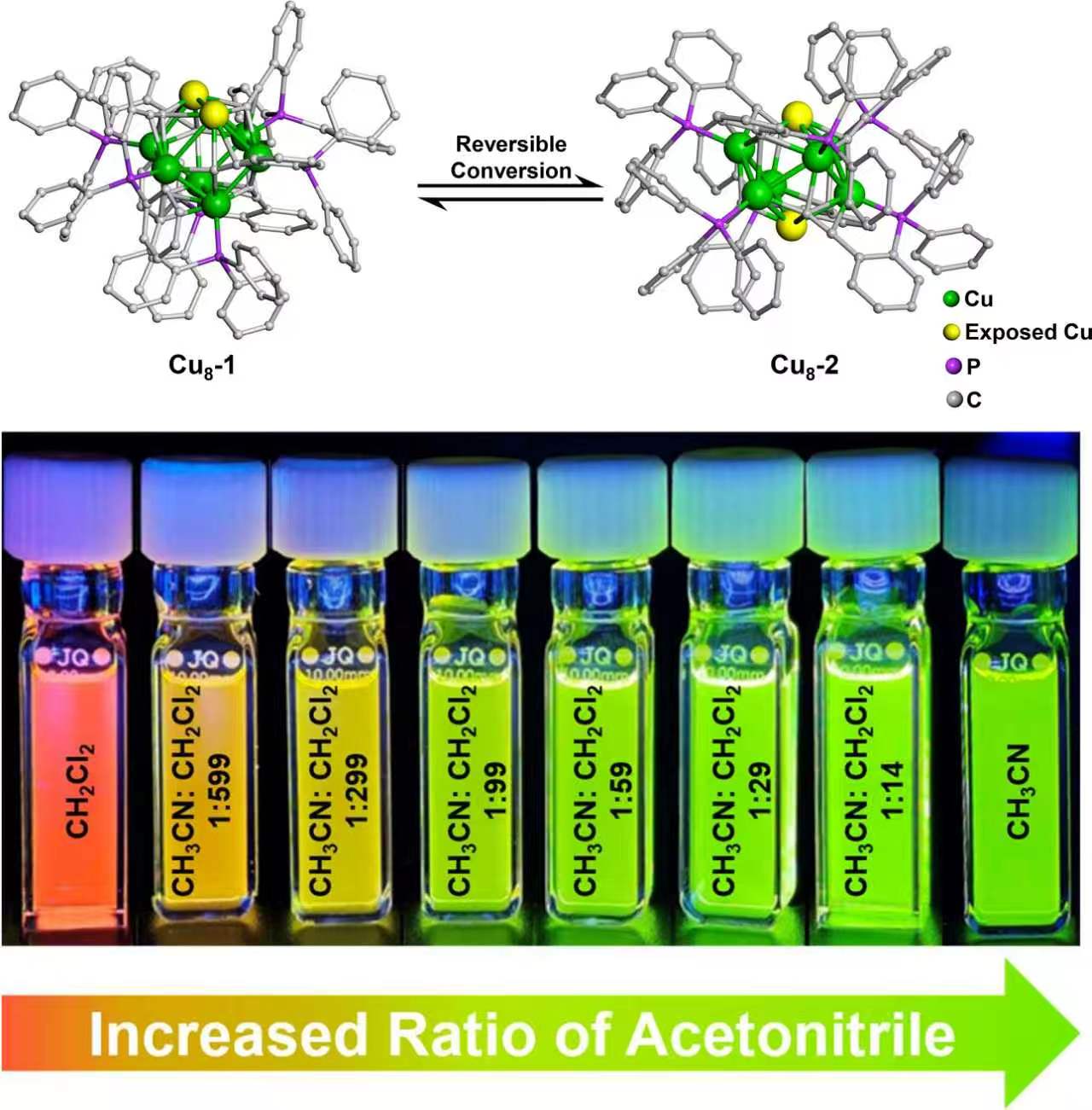
Reversible isomerization between Cu8‑1 and Cu8‑2 and their solvent‑tunable luminescence color switching. (Image by Prof. YAN's team)
