
Newsroom


A research team led by Prof. ZHOU Xuyu from the Institute of Microbiology of the Chinese Academy of Sciences (CAS), in collaboration with researchers from Beijing Ditan Hospital and Capital Medical University, has identified ANKRD11 as a key regulator that reduces the activity of CD8+ T cells during chronic hepatitis B virus (HBV) infection and cancer. The researchers found that ANKRD11 suppresses the AP-1 signaling pathway, which usually helps CD8+ T cells mount effective responses against infections and tumors.
The study was published in Nature Immunology on September 11.
HBV infects about 296 million people worldwide and is a leading cause of serious liver diseases such as cirrhosis and liver cancer. One major reason the immune system in controling chronic HBV is that CD8+ T cells, which normally attack infected cells, lose their strength and can't multiply well. The liver environment can further suppress immune responses, making some existing immune-based therapies less effective against HBV. Identifying new ways to restore T cell function is therefore an important goal in the treatment of chronic HBV infection.
Building on their previous work, the researchers had developed a mouse model that mimics key features of human immune responses to HBV and identified a major target of the antiviral immune response. In the new study, they used advanced genetic tools to look across the whole genome and identify genes that might affect how T cells respond to chronic HBV. Among the candidate genes, they focused on Ankrd11 because it was new, showed strong results, and made sense as a regulator of how genes are turned on or off in immune cells.
Deleting Ankrd11 specifically in T cells did not affect their development, but substantially enhanced their ability to fight infection. The modified T cells produced higher levels of key immune molecules and were more effective at attacking infected and cancerous cells. Further analysis showed that genes involved in T cell function were more readily activated in the absence of ANKRD11, indicating that the protein acts as a brake on T cell activity. The researchers also found that ANKRD11-deficient T cells were more resistant to signals that normally suppress immune responses.
The reserchers then tested their findings in several disease models. In mice with HBV, removing Ankrd11 from T cells led to more active immune cells in the liver, helped clear the virus, and improved disease outcomes. In another virus model and in a cancer model, T cells without Ankrd11 could better fight the virus and shrink tumors—even in cases where other treatments had failed. The researchers also found that combining this approach with existing therapies made the treatment even stronger.
The findings identify ANKRD11 as an important regulator that restrains T cell responses against chronic viral infection and cancer. Targeting ANKRD11 could provide a potential strategy for strengthening the body's own immune response to chronic HBV infection and cancer, particularly in cases where existing therapies are insufficient.
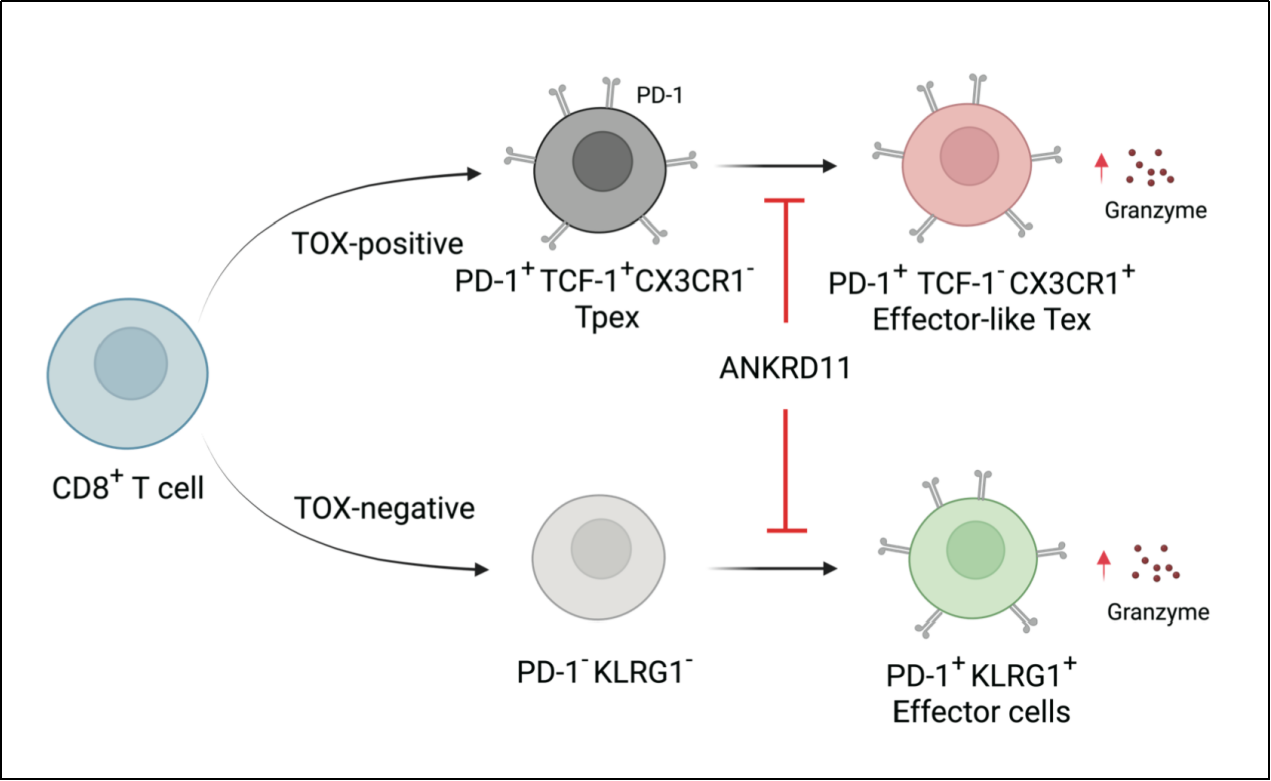
Proposed dynamics of antigen-specific CD8+ T cell populations regulated by Ankrd11 in chronic infection and cancer (Image by Prof. ZHOU Xuyu's group)
