Newsroom


Freshwater protected areas (FPAs) are widely promoted as an important conservation tool for rebuilding overexploited fish populations and protecting aquatic habitats. Yet simply banning fishing does not always guarantee ecological recovery. This is partly because non-native, stocked, and benthivorous fishes may also benefit from reduced fishing pressure.
A new study suggests that targeted fish removals (TFRs) could help address this challenge. By selectively removing certain fish groups, TFRs can complement passive protection, enhance native fish biodiversity, and improve ecosystem functions such as trophic regulation and water clarity.
The study, led by Prof. GUO Chuanbo at the Institute of Hydrobiology (IHB) of the Chinese Academy of Sciences (CAS), was published in the Journal of Applied Ecology on Aug 3.
In this study, the researchers conducted a two-year field investigation across five Chinese lakes, comparing fish community dynamics between FPAs without removals and FPAs implementing TFRs. The removal treatments selectively targeted non-native, filter-feeding, and benthivorous fishes.
The results showed that native fish biodiversity responded differently depending on whether targeted removals were implemented. In FPAs without removals, native fish taxonomic, functional, and phylogenetic diversity remained largely unchanged or declined. By contrast, TFRs significantly increased native taxonomic and functional diversity across multiple seasons.
According to the researchers, these results suggest that active, targeted management can strengthen the conservation benefits of FPAs and promote the recovery of native fish biodiversity across multiple dimensions.
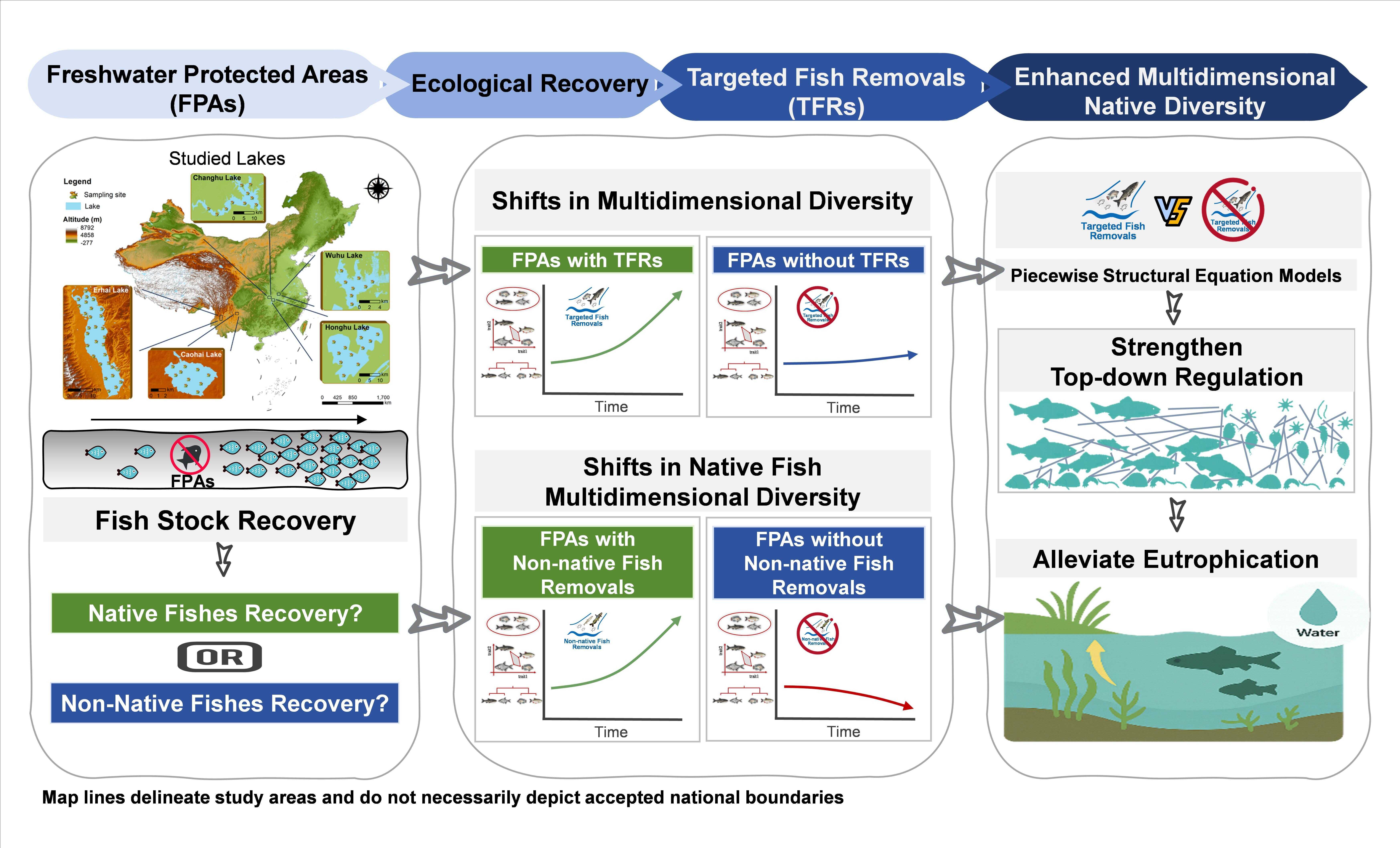
Effects of targeted fish removals on lake fish diversity recovery and ecosystem functioning. (Image by IHB)
The benefits of TFRs extended beyond fish communities. The removals altered trophic relationships among fish, zooplankton, macroinvertebrates, and phytoplankton, strengthening the regulatory role of fish communities at lower trophic levels. At the same time, phytoplankton biomass decreased and water transparency increased, suggesting that targeted fish removals can affect broader ecosystem processes as well as fish biodiversity.
The effects of TFRs, however, were strongly context-dependent. In Caohai Lake, where removals primarily targeted stocked filter-feeding fishes, non-native fish diversity increased while native functional and phylogenetic diversity declined, suggesting that removal of one fish group may generate niche opportunities for other non-native species. In contrast, in Erhai Lake, where removals primarily targeted non-native fishes, native fish abundance increased across taxonomic, functional, and phylogenetic dimensions. In addition, water-level management in Honghu Lake promoted fish emigration from protected areas, highlighting the importance of considering external environmental and management drivers when evaluating FPA outcomes.
Together, these findings highlight the need to move beyond a one-size-fits-all approach to freshwater conservation. According to the researchers, integrating targeted, context-dependent active management with freshwater protected areas could be particularly important in ecosystems affected by biological invasions, excessive stocking, or strong benthic disturbance.
Rather than relying solely on fishing bans, combining protection with the selective removal of ecologically disruptive fishes may offer a more effective strategy for restoring native biodiversity, strengthening trophic regulation, and improving ecosystem functioning.
The researchers note that the study provides important insights for improving freshwater conservation strategies and supporting the adaptive management of large-scale conservation initiatives, including the Yangtze River "10-Year Fishing Ban".