Newsroom


Solvent molecules can act as gatekeepers inside zeolite catalysts, limiting the space available for larger reactants to reach internal active sites. A recent study has shown that simply regulating where these solvent molecules reside can significantly enhance catalytic performance—without changing the catalyst's intrinsic micropore structure.
The study, led by Assoc. Prof. XING Jiacheng, Prof. XU Yunpeng and Prof. LIU Zhongmin from the Dalian Institute of Chemical Physics of the Chinese Academy of Sciences, reveals how relatively bulky molecules gain access to active sites within narrow zeolite channels. The findings were published in the Journal of the American Chemical Society on September 4.
Zeolites contain networks of nanoscale channels that regulate the adsorption and conversion of molecules. In titanium silicalite-1 (TS-1), the low activity toward cyclohexene has often been attributed to the narrow MFI channels. Efforts to improve the conversion of bulky molecules have therefore frequently focused on enlarging pores or shortening diffusion pathways.
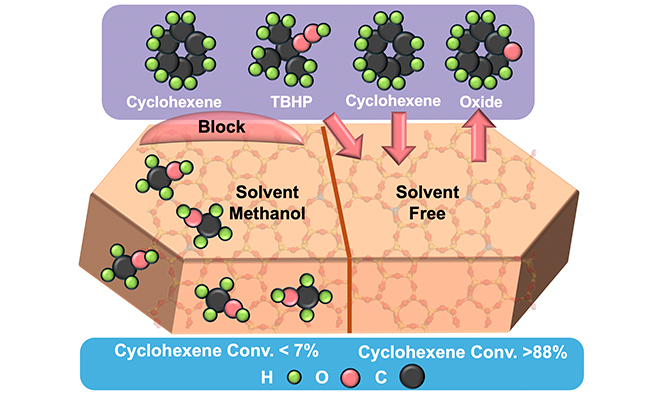
Cyclohexene conversion was below 7% in methanol but reached 88% without added reaction solvent. (Image by DICP)
However, in this study, using cyclohexene epoxidation as a model reaction, the researchers found that cyclohexene conversion was below 6.9% in methanol but reached as high as 88.8% without added reaction solvent. The selectivity toward the desired epoxide remained above 89%. This enhancement was achieved without modifying the original micropore structure of TS-1.
Furthermore, the researchers revealed the underlying mechanism. Cyclohexene can enter the MFI channels when they are empty or only weakly occupied. In contrast, methanol preferentially occupies the confined space at pore entrances and within the channels, reducing access for cyclohexene. The results show that solvent-dependent catalytic behavior is closely related to competition for limited pore space and access to titanium active sites.
The researchers describe this behavior as "solvent-gated accessibility", highlighting solvent occupancy as an additional factor governing molecular access in porous catalysts, alongside pore geometry, framework motion and molecular conformation. Similar solvent-dependent effects were observed in other titanosilicate catalysts and with larger cyclic alkenes, suggesting that this mechanism may be broadly applicable.
"Our study demonstrates a practical strategy for improving the utilization of existing microporous catalysts by regulating solvent competition within their pores," XU said. "Reducing the use of added solvent could also simplify solvent recovery and product separation, offering opportunities for more resource-efficient oxidation processes."