Newsroom


Goji berry (Lycium barbarum L.) is a perennial woody cash crop valued for its nutritional and medicinal properties and of significant industrial importance. However, its typical indeterminate growth habit has become a major bottleneck to the development of the goji berry industry.
This trait causes goji branches to continuously sprout, bloom, and bear fruit over time. Consequently, flowers and fruits at different developmental stages coexist on a single branch, making mechanized harvesting impossible. This growth pattern has severely limited the large-scale, industrialized cultivation of goji berry.
Yet a new study has shown that knocking out two conserved flowering regulatory genes, LbSP1 and LbSP5G1, can transform the indeterminate growth habit of goji branches into a compact, determinate structure, resulting in synchronized flowering and increased yield. The findings provide a molecular framework for breeding compact goji varieties suitable for mechanized harvesting and represent a significant step forward in the modernization of goji crop improvement.
The study, led by researchers from the South China Botanical Garden (SCBG) of the Chinese Academy of Sciences (CAS), was published in the Plant Biotechnology Journal.
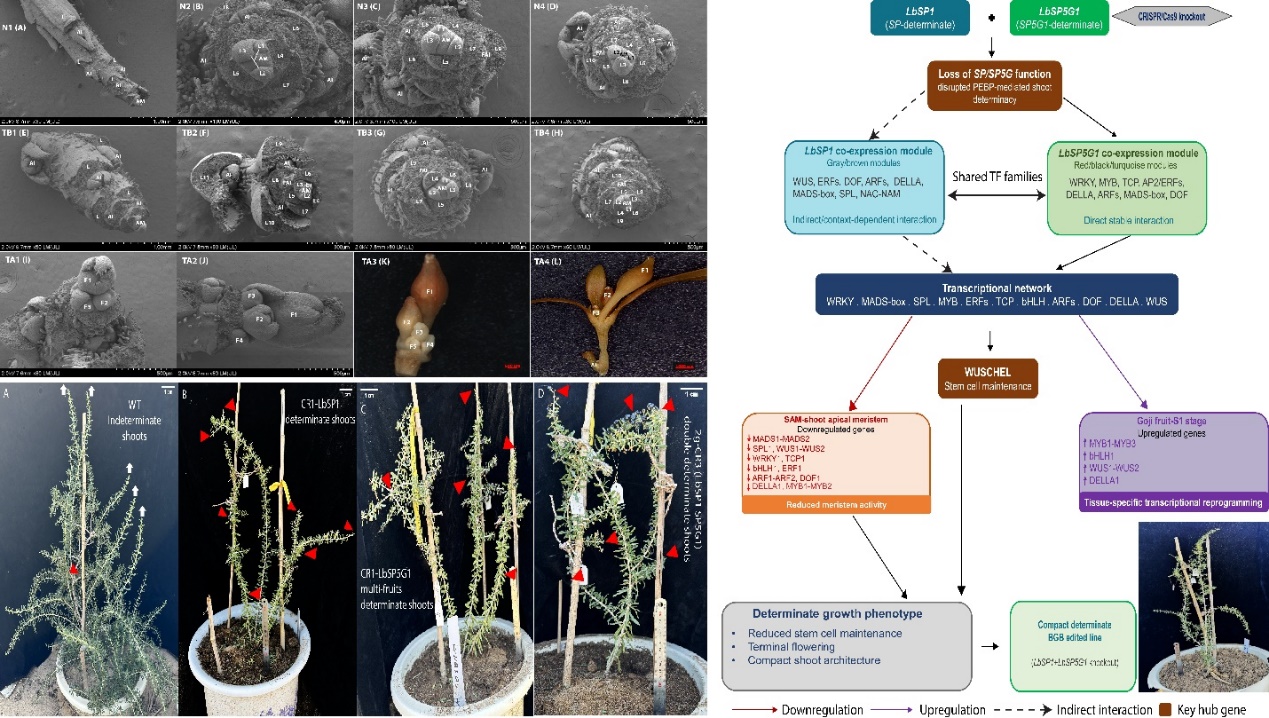
Scanning electron microscopy observations of indeterminate and determinate shoot apices, and the effects of CRISPR/Cas9-mediated knockout of LbSP1 and LbSP5G1 on shoot apical meristem development and shoot architecture reprogramming in goji berry, reveal the central PEBP regulatory network underlying determinacy and high yield. (Image by LIU Huanfang)
In the breeding of some crops, selecting determinate growth germplasm characterized by terminal flowering, synchronized flowering and fruiting, and a compact plant architecture is an effective approach to facilitating mechanized harvesting, reducing costs, and improving efficiency. However, the molecular regulatory mechanisms underlying the determinate/indeterminate growth habits in goji berry remain unclear, hindering the targeted breeding of goji varieties suitable for mechanized harvesting.
To address these industrial challenges, the plant resource research and development team at the SCBG constructed an F1 hybrid population of Lycium barbarum and selected three key types of materials for their study: the indeterminate type (N), the determinate type before terminalization (TB), and the determinate type after terminalization (TA).
Scanning electron microscopy (SEM) observations revealed significant differences in the shoot apical meristem development patterns between the two growth types. In indeterminate branches, the apex grows continuously; in contrast, in determinate branches, pre-terminal growth is similar to that of indeterminate branches, but shoot growth ceases once a terminal inflorescence meristem appears at the apex, shifting from vegetative to reproductive growth.
The research team further conducted comparative transcriptome analysis of the three experimental samples, identifying 15 candidate genes regulating flowering and shoot apical determinacy in goji berry. They focused the functional validation of the SP-like family gene LbSP1 and LbSP5G1, the goji homolog of the tomato gene SlSP5G.
Since a stable genetic transformation system for Lycium barbarum has not yet been established, the team turned to its close relative, black goji berry (Lycium ruthenicum), and used CRISPR/Cas9 gene-editing technology to obtain single-knockout and double-knockout lines.
Phenotypic analysis demonstrated that LbSP1 and LbSP5G1 regulate goji plant architecture in a functionally complementary and differentiated manner. The LbSP1 single mutant formed terminal spike-like inflorescences and exhibited compact branches. The LbSP5G1 single mutant produced multi-flowered inflorescences, increased fruit set per branch, lost photoperiod sensitivity, and displayed overall earlier flowering. The LbSP1+LbSP5G1 double mutant integrated the superior traits of both single mutants, showing more compact architecture, earlier flowering, and higher inflorescence density.
Quantitatively, the double mutant outperformed both single mutants and the wild type (WT) in all yield-related traits, achieving an average yield of 174.94 grams per plant—nearly three times that of the wild-type plants (approx. 55–65 grams)—while also possessing the highest fruit density per branch and per node. Protein interaction assays further revealed the mechanistic basis for this functional divergence, leading to the proposal of a PEBP core regulatory network: LbSP5G1 acts as a direct interaction hub, while LbSP1 serves as an environmental condition-dependent regulator, together balancing meristem maintenance and reproductive transition in goji berry.
Dr. Fazal Rehman and Assistant Researcher LIU Huanfang from the SCBG are the co-first authors of the study, with Researcher WANG Ying serving as the corresponding author.
According to the researchers, this work provides a molecular framework for developing compact goji cultivars amenable to mechanical harvesting, and constitutes a significant advance toward the modernization of goji breeding and production.