
Newsroom


Cilia and flagella are antenna‑like organelles that project from the cell surface and are widely distributed from unicellular eukaryotes to mammals. Motile cilia must beat in a coordinated manner to generate productive fluid flow and drive cell motility, which is essential for processes such as sperm propulsion, mucociliary clearance in the airways, and cerebrospinal fluid circulation.
Now, a research group led by Prof. HUANG Kaiyao from the Institute of Hydrobiology (IHB) of the Chinese Academy of Sciences (CAS) has revealed a new mechanism by which redox signals couple with calcium dynamics and coordinate flagellar beating. This study was recently published in PNAS.
Using the biflagellate green alga Chlamydomonas reinhardtii as a model, the researchers identified CYB5D1 as an evolutionarily conserved heme‑binding axonemal protein that serves as a redox‑sensitive switch. Specifically, the Asp58 residue in CYB5D1 is critical for heme binding; deletion of CYB5D1 or the Asp58Gly point mutation shifts the intraflagellar redox potential to a more reduced state and increases Ca2+ spike frequency specifically in the cis‑flagellum.
Through high‑resolution live‑cell imaging, the researchers found that oxidative treatment induces coupled Ca2+ spikes between the two flagella and restores coordinated beating, while reductive treatment uncouples these spikes and impairs coordination. This demonstrates that redox signals act upstream of Ca2+ to control flagellar dominance and waveform modification.
"We have established CYB5D1 as a critical integrator that converts redox dynamics into Ca2+‑mediated mechanical dominance switching," HUANG said. "This is the first molecular mechanism directly linking redox and Ca2+ signaling in the regulation of ciliary motility."
According to the researchers, this study not only provides a new conceptual framework for understanding ciliary coordination but also opens up avenues for mechanistic dissection and therapeutic intervention in ciliopathies, including primary ciliary dyskinesia.
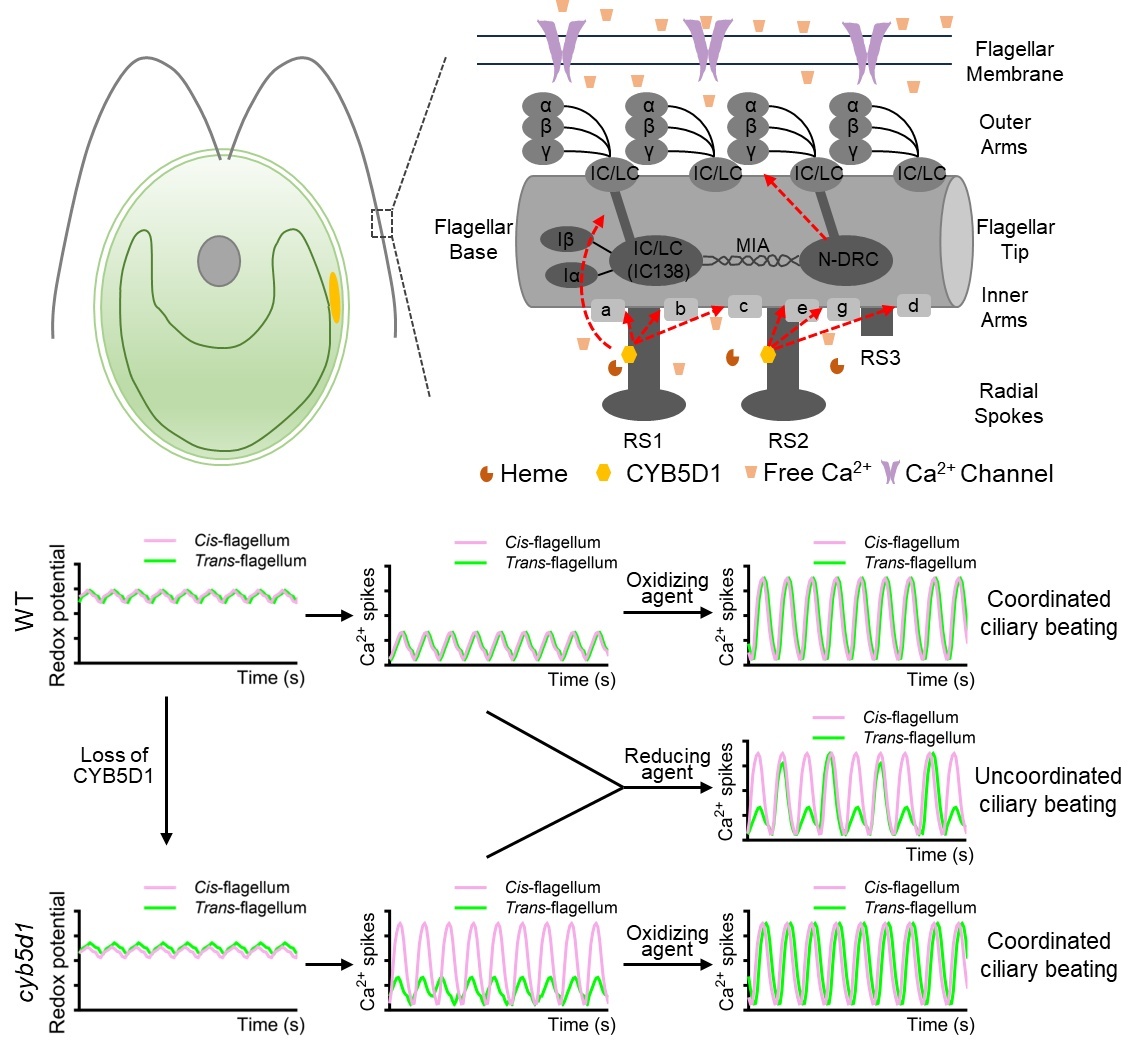
CYB5D1 integrates redox signals to control Flagellar coordination through calcium dynamics. (Image by IHB)

