
Newsroom


Establishing a quantitative structure-property relationship is essential for understanding and optimizing the performance of elastomers. In a new study published in Physical Review Letters, researchers have developed a theoretical framework that quantitatively connects the macroscopic mechanical response of unentangled elastomers to the mechanics and conformations of individual polymer strands.
The study was jointly conducted by researchers from the National Center for Nanoscience and Technology (NCNST) of the Chinese Academy of Sciences (CAS), Beijing Institute of Technology, and the Institute of Mechanics of the CAS.
Elastomers, commonly known as rubbers, are three-dimensional polymer networks formed by chemically cross-linking polymer chains. They can undergo large deformations while exhibiting highly nonlinear mechanical responses, making them indispensable in applications ranging from tires and seals to acoustic coatings for underwater vehicles and flexible electronic devices. Understanding how microscopic polymer structures give rise to macroscopic mechanical behavior is therefore important for developing elastomers with tailored properties.
Classical theories of rubber elasticity can describe the macroscopic stress-strain behavior of elastomers, but generally do not establish a direct quantitative connection between macroscopic mechanical responses and the conformations of individual network strands.
To address this challenge, the researchers first characterized the mechanical response of individual polymer chains and then developed a theoretical framework that links macroscopic stress to single-chain mechanics and the conformational statistics of network strands in unentangled elastomers.
The researchers further validated the framework using extensive molecular dynamics simulations under four representative loading modes: uniaxial compression, equibiaxial tension, pure shear, and simple shear.
The results show that, when topological constraints between network strands are absent, the theoretical predictions closely agree with the simulation results throughout deformation. When weak topological constraints are present, the framework remains accurate before the onset of damage, while deviations emerge at large deformation as the effects of topological constraints become increasingly important.
According to the researchers, the study builds a quantitative bridge between the microscopic conformations of individual polymer strands and the macroscopic mechanical response of elastomers. The findings offer fresh insight into the molecular origins of elastomer mechanics and lay a theoretical foundation for further exploring the deformation, damage, and fracture of polymer networks.
They also note that the framework may provide a basis for future efforts to incorporate topological constraints and entanglement effects in more complex elastomer systems.
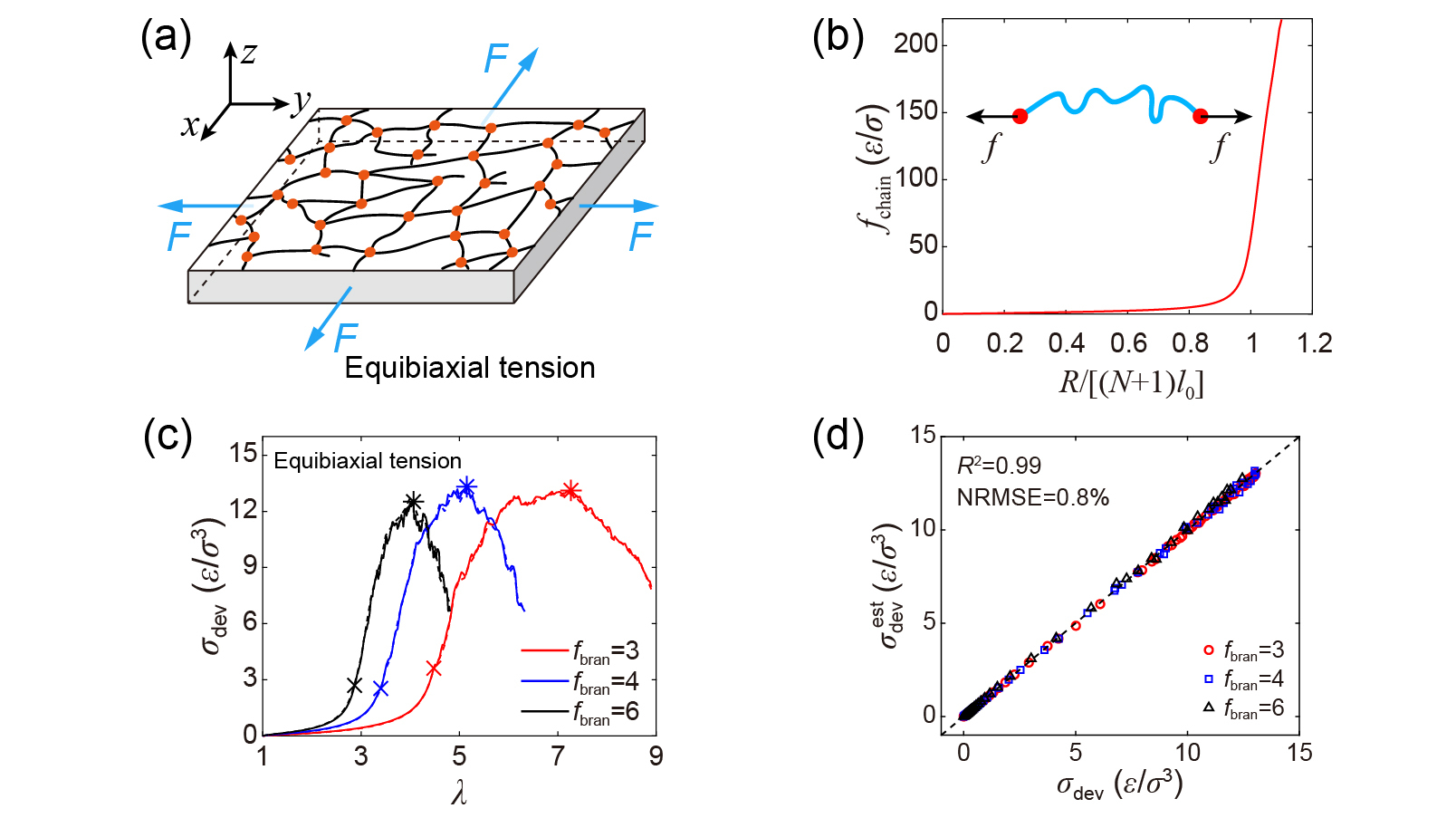
Overview of the theoretical framework for linking microscopic strand conformations to the macroscopic mechanical response of elastomers. (Image by NCNST)

