Newsroom


The genus Androsace is widely distributed across the temperate regions of the Northern Hemisphere, with notable diversity in the Alps and the Hengduan–Himalaya regions. Previous phylogenetic studies have advanced the understanding of Androsace's evolutionary history, but its biogeographic origins and diversification history remain unresolved due to limited species sampling and low statistical support.
In a new study published in Journal of Systematics and Evolution on August 13, researchers from the Xishuangbanna Tropical Botanical Garden (XTBG) of the Chinese Academy of Sciences have provided the clearest family tree yet for this group. They confirmed that several formerly recognized genera, including Douglasia, Vitaliana, and Pomatosace are actually part of Androsace, and should be treated as one broader group.
The researchers sequenced the complete chloroplast genomes and nuclear DNA of over 100 Androsace species and their close relatives. Their results showed that these flowers first appeared on the ancient Tibetan Plateau about 33 million years ago and then spread to Europe, North America, and beyond.
Using fossils and molecular clocks, the researchers calculated that the common ancestor of all living Androsace species inhabited the Pan-Tibetan Highlands (present-day Qinghai-Tibetan Plateau, Himalayas, and Hengduan Mountains) during the early Oligocene epoch. At that time, the climate was cooling, and alpine habitats were forming. Over millions of years, the plant migrated westward across Eurasia and repeatedly crossed the Bering Strait into North America. The Tibetan region remained the main source of these dispersals, sending out at least a dozen separate waves of colonization to East Asia alone.
The phylogenetic tree clearly divides Androsace into four well-supported clades. These clades correspond to different ecological niches and morphological characteristics. Clade I comprises Asian alpine perennials and cushions; Clade II comprises Asian forest-dwelling species with petiolate leaves; Clade III comprises the European-North American alpine and steppe lineage; and Clade IV comprises a small Chinese endemic group. Importantly, all formerly recognized genera are nested within Androsace, supporting a broader, unified circumscription.
Geological events (e.g., uplift of the Qinghai-Tibet Plateau), environmental changes (e.g., glacial-interglacial cycles), and morphological innovations jointly promoted differential radiation across clades. Notably, the diversification rate of Clade III increased significantly about four million years ago, which was closely associated with the origin of cushion morphology.
"Our results show that mountain biodiversity is not a product of a single historical process, but rather of region-specific interactions between geology, climate, and organismal innovation. Understanding these asynchronous histories is crucial for predicting how alpine ecosystems might respond to ongoing global change," said XING Yaowu of XTBG.
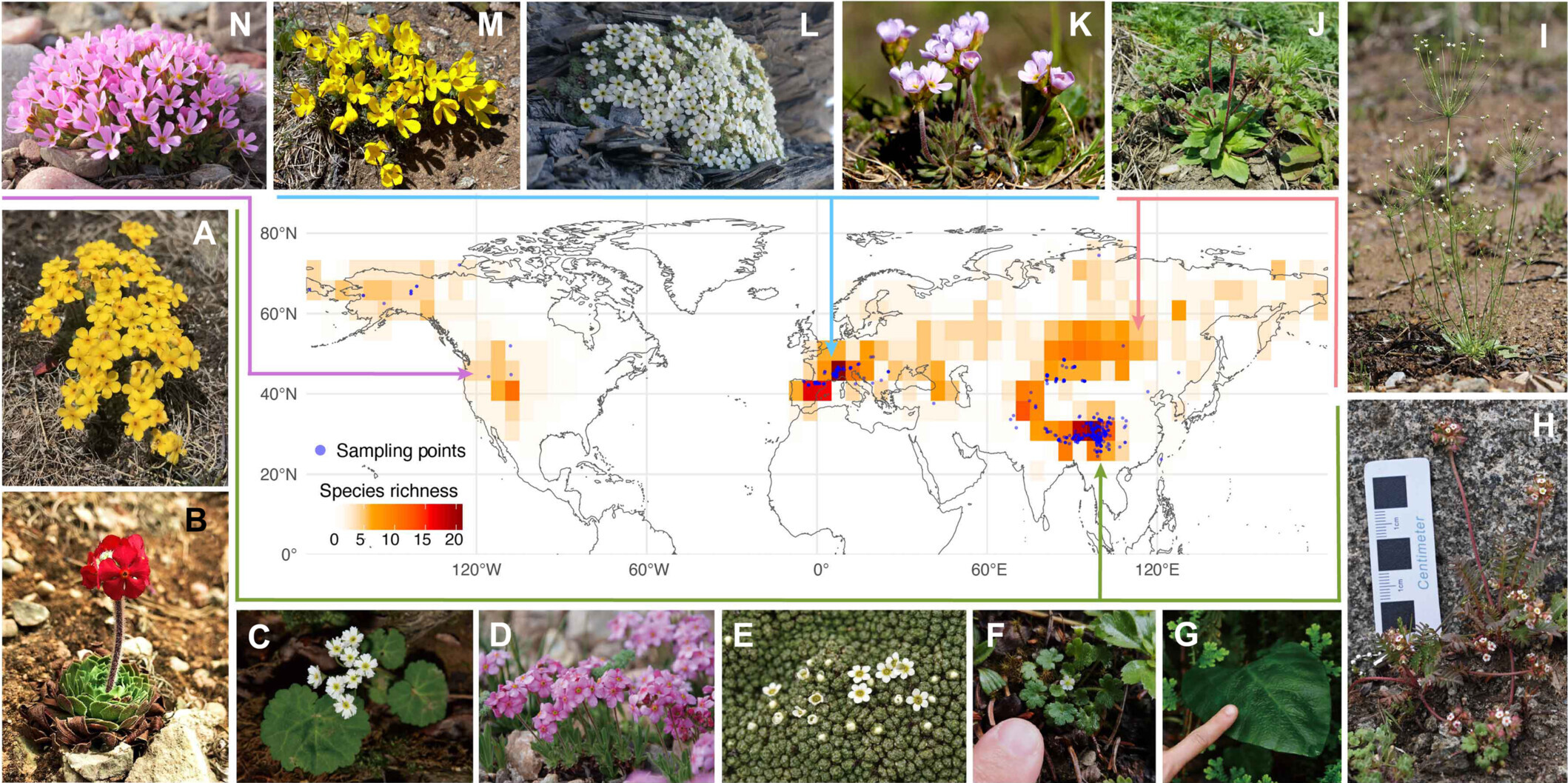
Species richness, sample distribution, and representative species of Androsace (Image by XTBG)