
Newsroom


Balsa wood is one of the world's fastest-growing and most commercially valuable tropical timber species. Renowned as the lightest commercial timber, it has experienced soaring global demand. However, traditional propagation techniques, such as tissue culture and cuttings, have proven difficult due to the species' abundant leaf hairs and mucilage secretion. This makes controlled hybridization the most practical route for cultivar improvement.
In a new study published in Industrial Crops and Products on August 21, researchers from the Xishuangbanna Tropical Botanical Garden (XTBG) of the Chinese Academy of Sciences have established a robust functional-trait framework to predict the growth performance across nine hybrid cultivars of balsa (Ochroma lagopus). This framework provides a powerful tool to accelerate breeding programs and help meet supply-chain demands in sectors such as wind energy and aerospace manufacturing.
The researchers conducted a common-garden experiment with nine hybrid balsa cultivars derived from parental trees originally introduced from Ecuador, Indonesia, and Sumatra. Over two years, the researchers monitored the growth rates of height, diameter, and biomass while measuring 22 functional traits related to photosynthesis, leaf and stem structure, biomechanics, and hydraulics.
Their results revealed significant variation among cultivars in both growth rates and functional traits. Fast-growing cultivars exhibited an "acquisitive" strategy characterized by higher photosynthetic rates, photosynthetic phosphorus use efficiency, and leaf nitrogen concentration. In contrast, slower-growing cultivars displayed a "conservative" strategy with greater structural investment (thicker leaves, higher leaf mass per area), and stronger mechanical resistance.
Strikingly, leaf traits were far better predictors of growth than stem traits. Of all 22 measured variables, only stem modulus of elasticity (a measure of stiffness) showed a significant correlation with growth rate. The researchers identified eight key traits that robustly predict growth: maximum photosynthetic rate, photosynthetic phosphorus-use efficiency, leaf nitrogen concentration, leaf thickness, leaf mass per area, leaf mechanical strength, hemicellulose concentration, and leaf water-retention capacity.
"The strong predictive power of these functional traits suggests that breeding programs can prioritize rapid measurements of these traits to screen for high-growth potential. This could dramatically accelerate selection cycles," said ZHANG Shubin of XTBG.
"This trait-based framework establishes a robust foundation for the early screening of superior balsa cultivars. By incorporating these traits into breeding programs, we can accelerate the selection of fast-growing, stress-tolerant cultivars, supporting sustainable balsa production and reducing reliance on imported raw materials," said CHEN Yajun of XTBG.
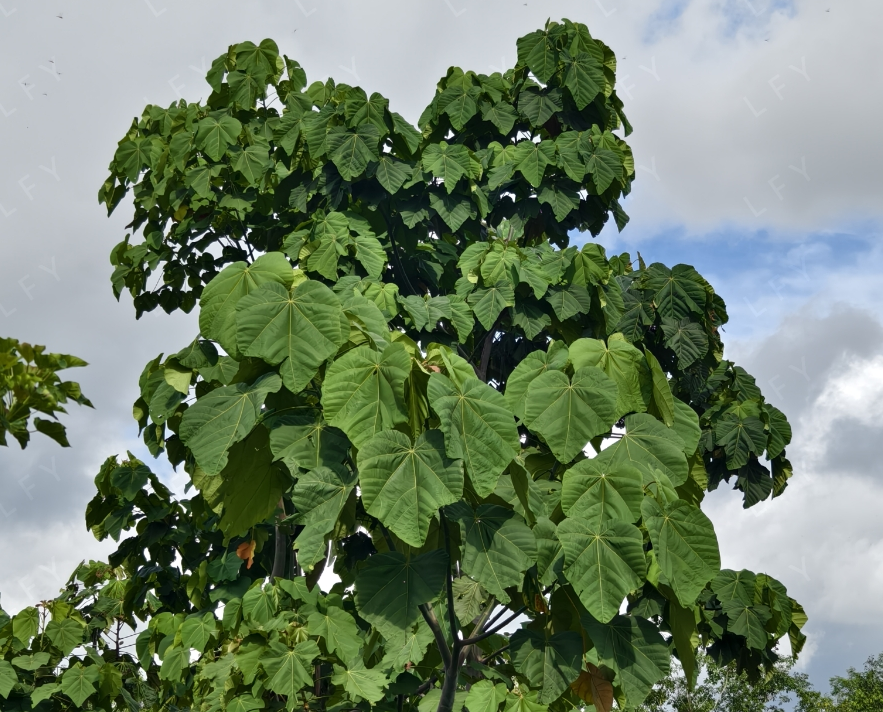
Balsa tree (Image by XTBG)

