
Newsroom


A research team has recently published a systematic reference framework for advancing Spray-Induced Gene Silencing (SIGS) from proof-of-concept toward industrialization.
Led by Prof. ZHANG Tao from the Xinjiang Institute of Ecology and Geography (XIEG) of the Chinese Academy of Sciences (CAS), in collaboration with researchers from the Institute of Germplasm Resources and Biotechnology under the Tianjin Academy of Agricultural Sciences, the study was published in Communications Biology.
Global agricultural production faces increasingly severe threats from pests and pathogens, while the ecological risks of chemical pesticides continue to grow. In this context, SIGS offers a compelling alternative: it controls these threats simply by external spraying of Double-stranded RNA (dsRNA), completely bypassing the transgenic process. This approach has shown potential as a substitute for chemical pesticides.
However, the technology still faces several critical bottlenecks including the lack of a systematic framework for rational dsRNA design, insufficient large-scale production capacity, and low delivery efficiency, which constrain its critical transition from the laboratory to field applications.
To address these challenges, the research team conducted a comprehensive review of three dimensions: rational dsRNA design, large-scale production, and nanocarrier-mediated delivery.
In terms of design, by adopting an integrated perspective spanning dsRNA design, production, and delivery, this review highlights that rational dsRNA design requires integrated consideration of five key factors. Multi-target strategies can effectively enhance silencing efficiency while reducing off-target risks. Target site accessibility exerts a greater impact on silencing efficacy than GC content, thus mRNA regions with a loose secondary structure should be prioritized as target sites.
The optimal molecular length varies by species. Loop-end-enhanced dsRNA (ledRNA) can improve dsRNA stability in the insect gut environment. Additionally, the Dicer-like (DCL) processing preferences of different species require targeted matching.
In terms of production, microbial fermentation has already reduced costs to $2-5/g, while cell-free platforms represented by Calantha®—the first EPA-approved dsRNA-based pesticide product—have achieved costs as low as $0.5-1/g. Furthermore, vector optimization strategies, including high-copy plasmids, convergent dual promoters, and non-toxic induction systems, have significantly enhanced dsRNA yields.
In terms of delivery, layered double hydroxide (LDH) nanosheets provide sustained-release protection for more than 20 days, while carriers such as chitosan and star-shaped polycations each offer distinct advantages in overcoming environmental stability and cell-penetration barriers.
The review also systematically compares differences among delivery carriers in terms of protection efficacy, environmental stability, and biocompatibility, highlighting the current lack of unified evaluation standards in the selection of SIGS technology pathways.
The research team stresses that the requirements for dsRNA length, sequence, and delivery methods vary significantly across different crop systems and target organisms, suggesting that future research should move toward a more refined technology-matching framework.
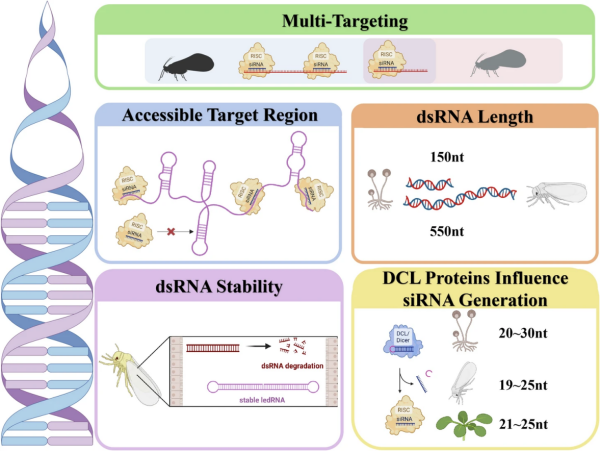
Key factors affecting dsRNA/siRNA design efficacy. (Image by XIEG)
