Newsroom


Aging varies markedly among individuals and between sexes, yet the timing of major physiological transitions and the factors driving these changes have not been well understood.
However, a new study suggests that routine clinical measurements, which are widely available and repeatedly collected, may provide a practical way to assess aging at population scale.
The study, which was published in Nature Aging on August 25, analyzed routine clinical data from 104,208 adults aged 18–98 across three centers in China. It established sex-specific clinical aging clocks based on 172 commonly measured indicators and provided a practical approach to estimating physiological aging from routine health examinations.
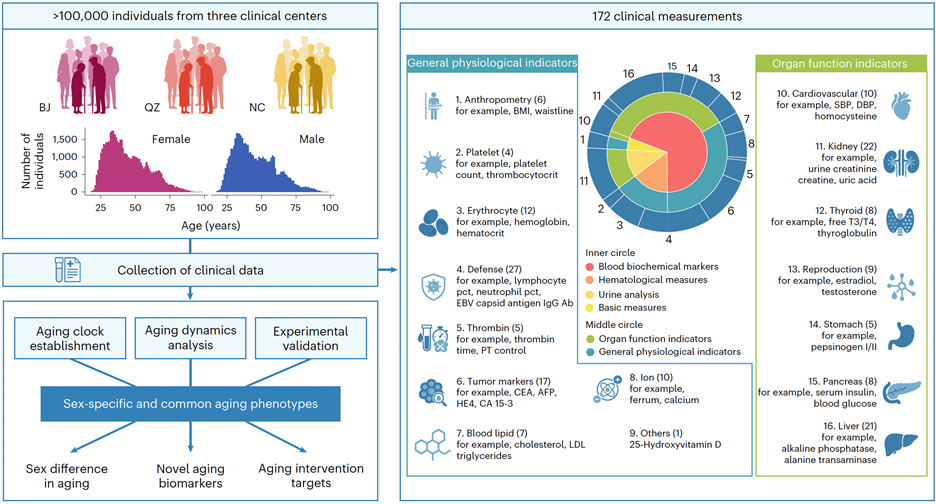
Overview of the study design and clinical measurements. (Image by CNCB)
The study revealed distinct aging transitions in men and women. Men showed a prominent metabolic transition at 35–45 years, involving changes in body mass index, triglycerides, and cholesterol. Women showed a later transition at 55–65 years, around menopause, characterized by marked endocrine changes accompanied by worsening lipid profiles. Despite these different trajectories, physiological differences between men and women generally narrowed in later life.
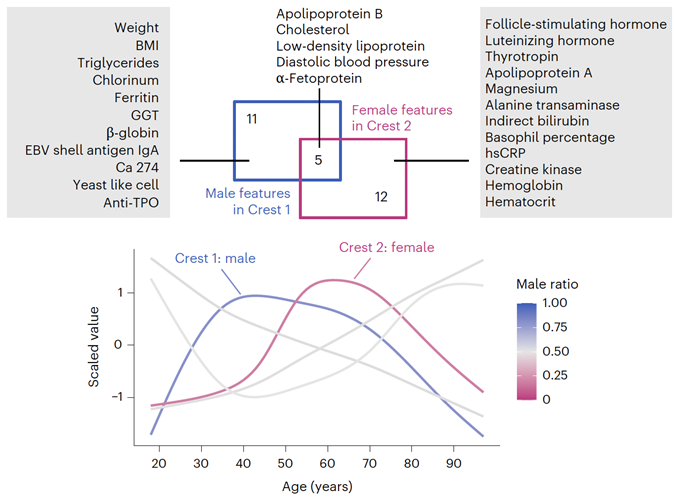
Key aging transitions and associated physiological indicators in men and women. (Image by CNCB)
The researchers also found that several metabolic factors and tumor-related markers accumulated with age and were associated with accelerated physiological aging. Cell experiments showed that elevated glucose, lipids, uric acid, CEA, and HE4 could induce aging-related changes in vascular endothelial cells, suggesting that these circulating factors may actively contribute to aging rather than merely reflect it.
Importantly, some aging-related effects were partially reversible: For example, metformin alleviated high-glucose-induced endothelial aging, and moving mice from a high-fat diet to a normal diet improved several liver aging-related features. The findings suggest that reducing the age-associated metabolic burden may represent a potential strategy for promoting healthy aging. They also highlight the importance of sex-specific assessment and intervention across the lifespan.
The study, supported by the Aging Biomarker Consortium of China, was jointly conducted by researchers from the China National Center for Bioinformation, a research center affiliated with the Chinese Academy of Sciences (CAS), the Institute of Zoology of CAS, Xuanwu Hospital of Capital Medical University, the First Affiliated Hospital of Nanchang University, the Affiliated Quzhou Hospital of Wenzhou Medical University, and West China Hospital of Sichuan University.