
Newsroom


A research team from the Shanghai Astronomical Observatory (SHAO) of the Chinese Academy of Sciences (CAS) has discovered that satellite galaxies retain a measurable "kinematic memory" of matter flowing into and along cosmic filaments.
Using a large spectroscopic sample from the Sloan Digital Sky Survey (SDSS), the team found that satellite galaxies preferentially orbit within planes that contain the axes of nearby cosmic filaments. The orbital orientations deviate from a random distribution at a statistical significance of about 12.8σ — a remarkably robust signal.
More importantly, the preferred orbital orientation changes depending on how far the host galaxy system lies from the filament axis. Outside filaments, galaxies move predominantly toward the filaments in directions roughly perpendicular to the filament axes. Once inside the filaments, their motion gradually shifts to run along the filament axes.
The study, published in The Astrophysical Journal Letters on August 24, is led by Prof. WANG Peng from SHAO as first and corresponding author, in collaboration with Shanghai Jiao Tong University, Zhejiang University, and Nanjing Normal University.
According to the researchers, this finding provides fresh observational evidence for a two-stage accretion process that had previously been predicted mainly by theoretical studies and numerical simulations: matter first falls laterally from the surrounding environment into a cosmic filament, and then flows along the filament toward galaxy groups and clusters.
"If cosmic filaments are highways that transport matter, satellite orbits are like tracks left by the traffic," WANG said. "We found evidence not only of galaxies being transported along filaments, but also of the transition from lateral infall toward filaments to motion along their axes."
WANG added that the result offers a new observational test for the two-stage accretion model, and may also provide dynamical clues about how angular momentum develops in cosmic filaments and about the physical origin of their characteristic radii.
Satellite galaxies orbit central galaxies, and their motions can preserve information about how they entered their host systems. The researchers combined the satellites' projected positions and line-of-sight velocities to determine how their orbital orientations relate to nearby cosmic filaments.
Cosmic filaments are the elongated, thread‑like structures in the cosmic web that connect galaxy groups and clusters. They are thought to continuously channel matter into these systems, but systematic observational evidence for this process has remained limited.
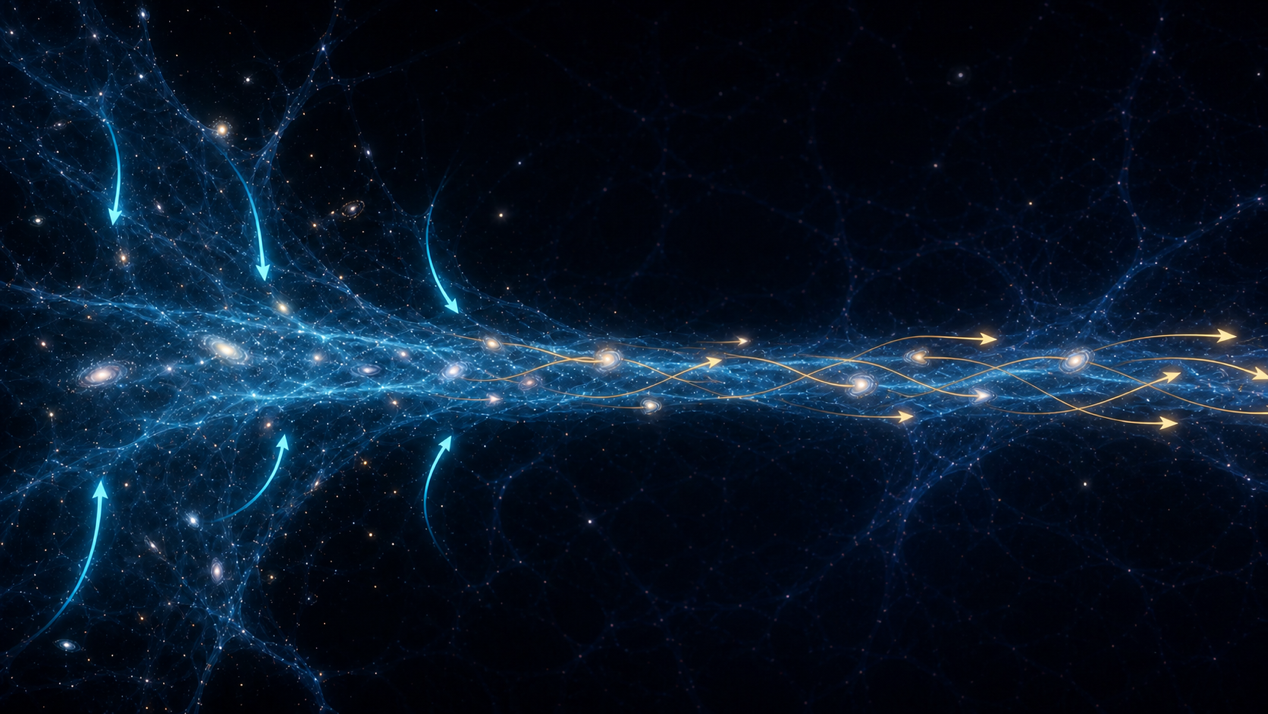
Two-stage accretion around a cosmic filament. Matter and galaxies first flow from the surrounding environment, including cosmic walls, into the filament in directions approximately perpendicular to its axis. Once inside the filament, satellite galaxies are transported toward galaxy groups or clusters through longitudinal and helical motions along the filament axis. Blue arrows indicate lateral infall, while golden arrows indicate transport along the filament. (Image by SHAO)
