
Newsroom


Inspired by the swimming mechanism of manta rays, researchers from the Shenyang Institute of Automation (SIA) of the Chinese Academy of Sciences have developed a wireless near-infrared light-controlled biosyncretic manta ray robot powered by isolated bullfrog skeletal muscle.
The study was published in Advanced Functional Materials on August 13.
Researchers have long combined biological materials with non-living electromechanical systems at the molecular, cellular, or tissue level to create biosyncretic robots that offer high energy efficiency, self-growth, self-repair, and biocompatibility. However, the use of skeletal-muscle-driven biosyncretic robots has been limited by their relatively low actuation force, restricted maneuverability, and tethered control.
The use of engineered, lab-reconstructed muscle tissues has been widely adopted in the field. To overcome the limitations of lab-reconstructed muscle tissue, the researchers employed native, isolated skeletal muscle—specifically, the Rana catesbeiana gracilis muscle—as the biological actuator. This natural tissue has a highly ordered fiber architecture and superior contractile performance compared to lab-reconstructed muscles.
By optimizing the electrical stimulation parameters to 1 Hz, 5 V, and 10 ms, the isolated muscle generated a stable contractile force of 6.5 N, with a peak force of 9.4 N under extreme conditions. In vitro culture experiments showed that the muscle retained its electrical responsiveness for up to 11 days and could power the robot reliably for seven days of continuous operation.
To enable untethered actuation, the researchers constructed an integrated driving architecture that combined near-infrared (NIR) laser irradiation, photovoltaic conversion, and neural electrical stimulation. Specifically, gallium arsenide (GaAs) solar cell modules were embedded on the robot's dorsum. Delivering time- and region-selective 808-nm laser illumination to the left and right photovoltaic panels allowed independent control of bilateral muscle contraction sequences without physical tethering. This enabled straight swimming, left/right turning, circular cruising, and U-turns. This approach requires no genetic modification of the biological tissue and significantly broadens the deployability of biosyncretic robots in aquatic environments.
Benchmark tests demonstrated multiple mobility breakthroughs. The robot achieved an average straight-line swimming speed of 0.54 body lengths per second (BL s-1, approximately 2.7 cm s-1), with an instantaneous peak speed of 2 BL s-1—the highest relative forward speed ever reported for a skeletal-muscle-driven biosyncretic robot. Its minimum turning radius was only 0.8 body lengths, with a maximum turning angular velocity of 21° s-1, enabling it to complete a full circle in only 17 seconds. Beyond underwater locomotion, the robot can surface cruise, carry underwater payloads of up to 5 g, and perform low-speed curvilinear motion across rigid ground surfaces.
The study establishes a new paradigm for next‑generation, wireless, high‑performance biosyncretic robots.
"For the first time, we have coupled native isolated skeletal muscle with a wireless optoelectronic neural stimulation system. Our work validates native muscle tissue as a high‑performance biological actuator," said Dr. ZHANG Chuang, corresponding author of the study.
He also noted that the highly maneuverable wireless biosyncretic underwater robot holds promise for applications such as shallow-water microenvironmental monitoring and low-disturbance observation of aquatic organisms.
Looking ahead, the researchers plan to optimize in vitro muscle culture strategies to extend lifespan, develop neuron-like flexible thin-film electrodes for more uniform activation, and integrate photovoltaic energy harvesting with onboard storage for self-powered operation.
In addition, the researchers suggest that the electrical stimulation parameter framework could serve as a reference for in vitro muscle repair after nerve injury and for dynamic tissue engineering culture platforms.
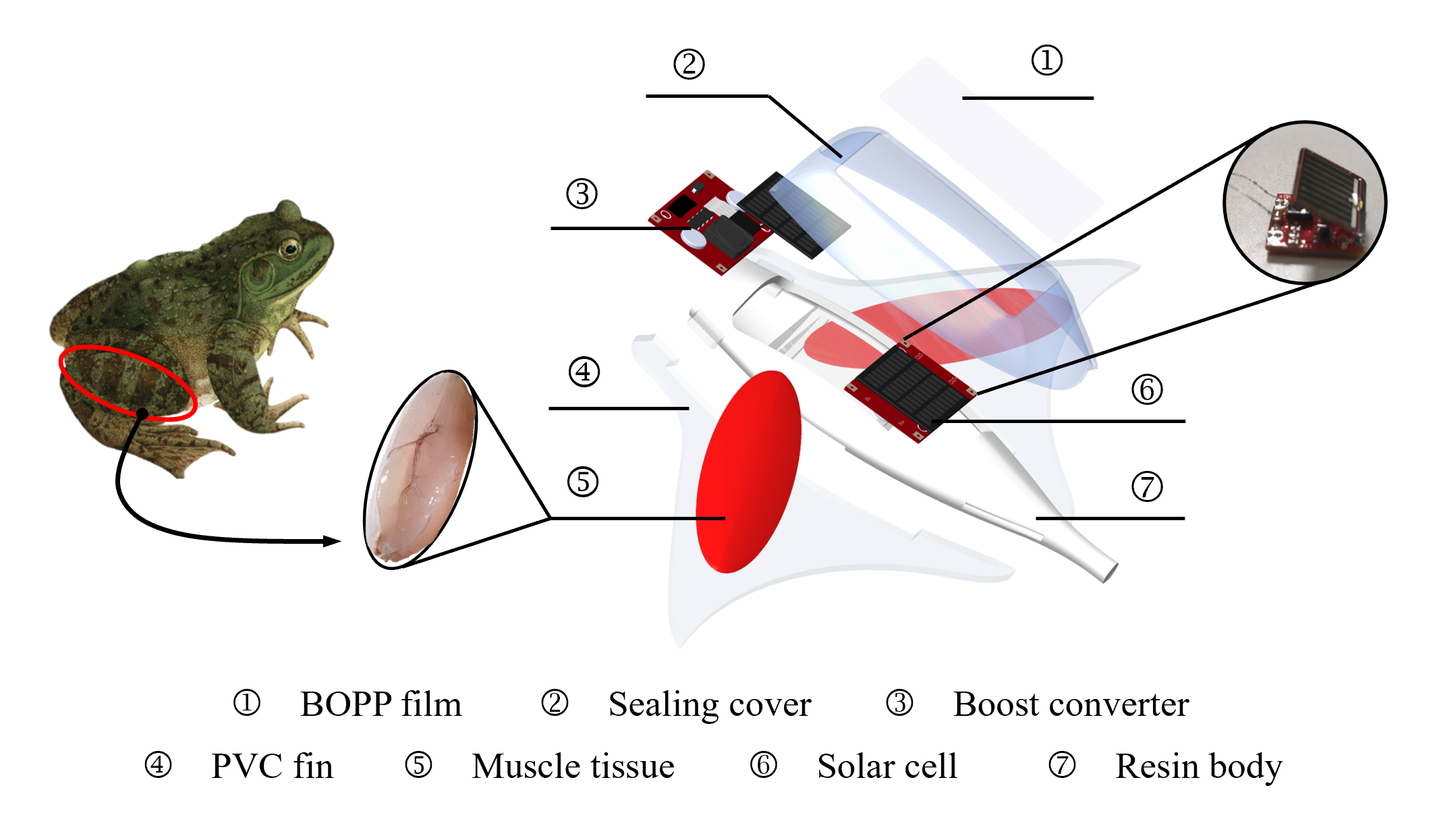
Model of the biosyncretic manta ray (Image by SIA)

Biomimetic mechanism of the biosyncretic manta ray (Image by SIA)
