Newsroom


Chinese researchers have developed a novel strategy enabling precise monovalent cation separation by taking advantage of different ions' hydration properties.
Lithium (Li) and potassium (K) both form extremely small, monovalent cations in water—ions with a single positive charge. This similarity suggests they should be difficult to separate. However, a team led by Profs. TANG Zhiyong and LI Lianshan from the National Center for Nanoscience and Technology (NCNST) of the Chinese Academy of Sciences (CAS) has discovered that the different hydration properties of Li+ and K+ result in markedly different transport behavior during membrane sieving.
The study was published in Nature Nanotechnology on Aug 17.
All ions are surrounded by a layer of water molecules that affects their transport through membrane pores. In this study, the researchers developed a new hydration-layer-mediated sieving strategy that achieves ultrahigh monovalent cation separation by leveraging dynamic angstrom-scale hydrapores constructed from monolayer covalent-organic frameworks (COFs).
According to the researchers, the strategy relies on short-range interactions mediated by water molecules, revealing a mechanism that has been largely overlooked in membrane science.
"Conventional sieving methods, which rely on size exclusion, electrostatic repulsion, or even complete dehydration energy, often struggle with the well-known trade-off between permeability and selectivity," TANG said. "In real-world conditions, ions are tightly wrapped in hydration layers. Previous studies seldom focused on the short-range interactions between these hydration layers. However, our work demonstrates that within the nanoconfinement of water molecular dimensions, these short-range interactions play a decisive role."
In this study, hydrated ions were anchored at the pore rims of a COF monolayer to construct dynamic hydrapores with an effective size of approximately 0.8 nm. The core mechanism involves "merging" and "squeezing" of hydration layers to control ion transport: K+ ions, possessing flexible hydration layers, undergo hydration-layer "merging" and experience attractive interactions, enabling near-frictionless transport; in contrast, Li+ ions, with rigid hydration layers, undergo "squeezing" and repulsion, effectively blocking their passage.
Experimental results confirmed that the activation energy for K+ transport is as low as 5.5 kcal/mol, approaching that of K+ self-diffusion in bulk solution, indicating near-frictionless transport. Under a concentration gradient, the membrane achieved an exceptional K+/Li+ selectivity of 148 and a K+ permeance of 2×10⁴ mol m-2 h-1, three orders of magnitude higher than that of state-of-the-art membranes.
"The essence of our design lies in the 'merging' and 'squeezing' of the hydration layers," said LI, co-corresponding author of this work. "Our study proves that within water-molecule-scale confinement, the traditional assumption that like-charged ions always repel each other does not hold universally. By modulating the flexibility of hydration layers, we can guide ions toward either attraction or repulsion."
Dr. YANG Jinlei, the first author of this work and currently an associate professor at the University of CAS, highlighted the broader implications: "This insight provides entirely new strategies to address the more challenging problems in nanoporous membrane-based separations, particularly the discrimination of species with similar physicochemical properties, such as precise lithium extraction from high-salinity brines and rare earth element separation."
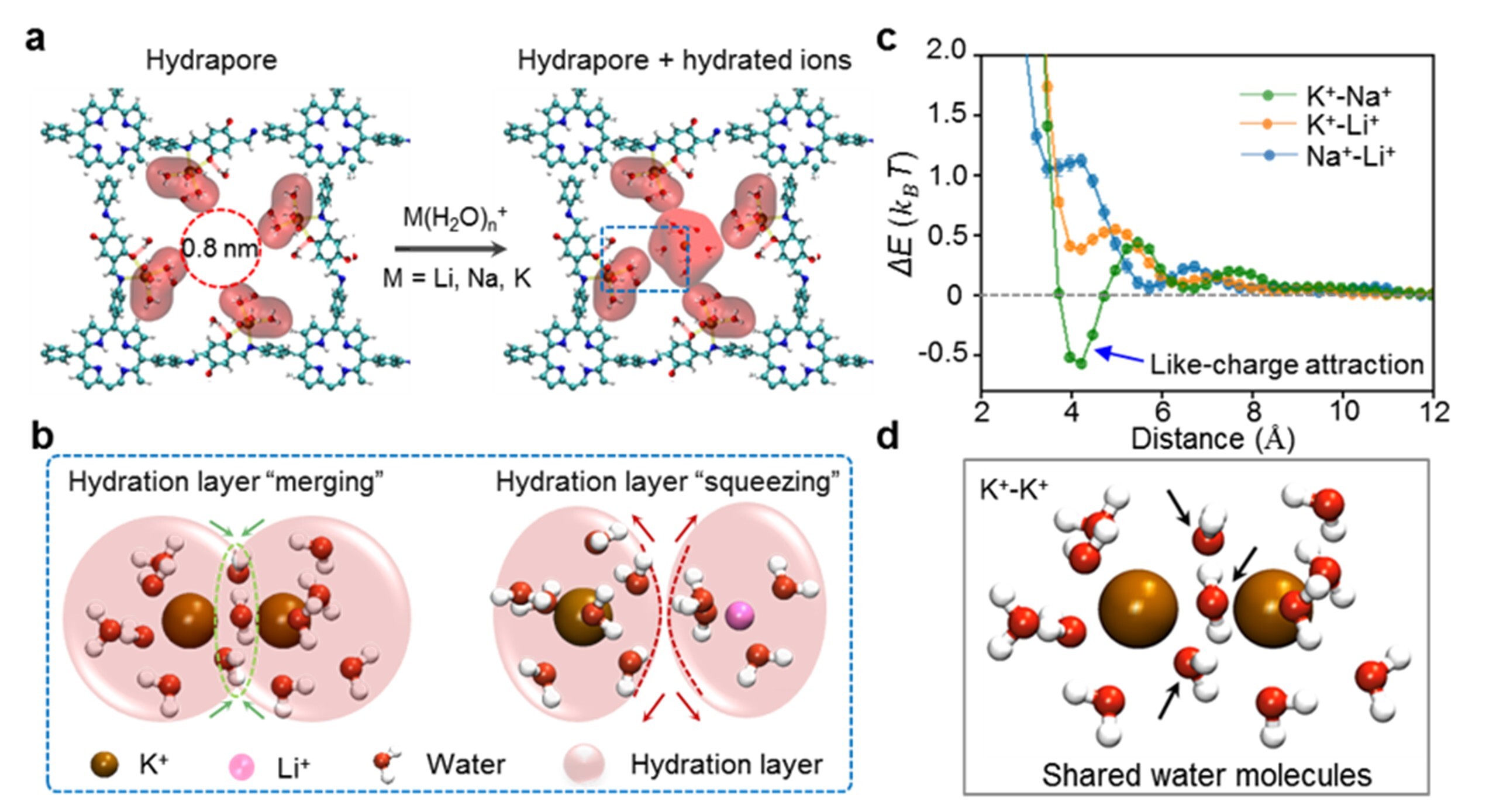
Schematic Diagram: The monovalent ion sieving through hydration layer discrimination. (Image by YANG Jinlei et al)