Newsroom


Researchers at the Institute of Oceanology of the Chinese Academy of Sciences (IOCAS) have shown how a metabolic mechanism underlying thermal tolerance in intertidal oysters sheds light on malignant proliferation in human lung adenocarcinoma.
The research, which was published in PNAS on August 18, focuses on how cells regulate glycolysis to maintain energy production under conditions of energy stress.
The IOCAS marine shellfish research team uncovered an ancient energy-sensing signaling cascade, termed the KAT2/HDACIIa–PGK–ALDO axis. The axis orchestrates a sophisticated "dual degradation inhibition" mechanism involving the key glycolytic enzymes phosphoglycerate kinase (PGK) and aldolase (ALDO). This mechanism stabilizes and hyperactivates both enzymes to meet cellular energy demands.
Integrating multi-omics data, gene editing, and biochemical functional assays, the researchers discovered that under energy stress, the balance between the acetyltransferase KAT2 and the deacetylase HDACIIa shifts to promote the acetylation of PGK. This modification shields PGK from ubiquitin–proteasomal degradation while strengthening its interaction with ALDO.
In turn, stabilized PGK exhibits a non-canonical protein kinase activity to directly phosphorylate ALDO, simultaneously boosting its catalytic efficiency and suppressing its chaperone-mediated autophagic–lysosomal degradation (CMA). By concurrently shutting down both proteasomal and CMA-mediated lysosomal degradation, this cascade achieves a potent "stabilization-plus-activation" effect, thereby amplifying glycolytic flux to ensure cell survival.
The researchers then identified a striking metabolic parallel between intertidal oysters and human tumors. Sessile intertidal oysters, which regularly endure severe heat, aerial exposure, and hypoxia, exhibit metabolic reprogramming toward aerobic glycolysis that closely mirrors the "Warburg effect" in human tumors. Building upon this evolutionary parallel, the team demonstrated that human lung cancer cells "hijack" this ancient stress-response axis—upregulating KAT2A and downregulating HDAC5 to drive persistent hyperacetylation of PGK1-K75 and hyperphosphorylation of ALDOA-S272, which directly fuels malignant proliferation and metastasis.
"The hypoxia and energy crises endured daily by intertidal oysters remarkably mirror the human tumor microenvironment," said Dr. WANG Chaogang, first author of the study. "Their extraordinary metabolic tolerance and adaptability make them a potential unconventional model organism to decipher the fundamental principles of tumor metabolism."
"Our study bridges marine evolutionary adaptation with human cancer metabolism," said Prof. LI Li, corresponding author of the study. "Hundreds of millions of years of evolution in the harsh intertidal environment have endowed oysters with an ingenious metabolic defense system."
This study not only elucidates the thermal adaptation strategies of marine invertebrates in response to climate warming from an evolutionary biology perspective, but also unveils promising therapeutic targets for the clinical diagnosis and treatment of human malignancies.
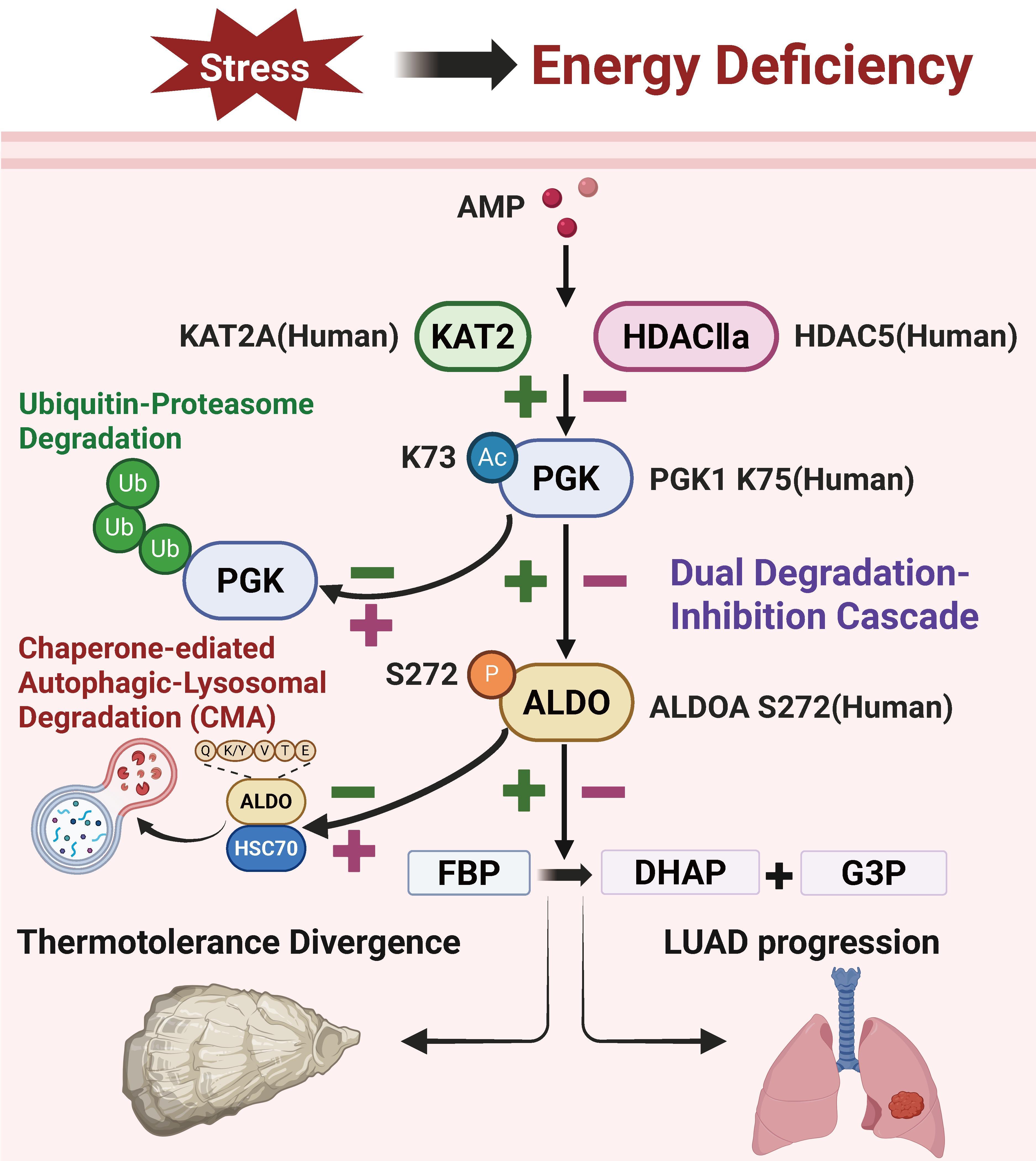
The metazoan-conserved KAT2/HDACIIa–PGK–ALDO axis inhibits dual protein degradation systems to enhance glycolysis, linking oyster thermal tolerance to cancer progression. (Image by IOCAS)