
Newsroom


Enhancers are important DNA elements that regulate gene expression. They can act across tens or even hundreds of thousands of base pairs, interacting with distant promoters via chromatin looping and activating the transcription of target genes. However, the precise manner in which enhancers transmit regulatory information to promoters and ultimately recruit RNA polymerase II (Pol II) to initiate transcription remains a major unanswered question in the field of gene regulation.
In a new study published in Nature Genetics on August 12, researchers led by Prof. XUE Yuanchao at the Institute of Biophysics of the Chinese Academy of Sciences have revealed a new molecular mechanism through which the RNA-binding protein hnRNPK mediates enhancer-promoter interactions and facilitates the directed recruitment of Pol II.
Using a combination of advanced approaches such as RIC-seq, HiChIP, CUT&Tag, and live-cell super-resolution imaging, the researchers examined how hnRNPK coordinates enhancer-promoter communication with Pol II recruitment.
They found that hnRNPK broadly binds to nascent RNAs transcribed from enhancer and promoter regions and promotes long-range enhancer-promoter chromatin looping across the genome in an RNA-dependent manner. Loss of hnRNPK substantially weakened a large number of enhancer-promoter interactions, resulting in widespread transcriptional downregulation. These findings establish hnRNPK as an important structural regulator that maintains enhancer-promoter communication and gene activation.
Moreover, the researchers discovered that hnRNPK undergoes liquid-liquid phase separation, self-assembling into a unique type of condensate with internal cavities. By directly interacting with the RPB3 subunit of Pol II, hnRNPK encapsulates Pol II within these condensates.
Further experiments showed that paired interacting enhancer RNAs (eRNAs) and upstream antisense RNAs (uaRNAs) promote the enrichment of Pol II within hnRNPK condensates and guide hnRNPK to recruit Pol II to promoter regions through dimerization, thereby enabling efficient transcriptional activation.
Based on these findings, the researchers proposed a new model of "RNA-guided Pol II recruitment." In this model, RNA serves as both a carrier of genetic information and a spatial organizing factor. By driving the assembly of phase-separated condensates and directing Pol II transport, RNA enables precise regulatory information transmission from enhancers to promoters, ultimately activating gene expression.
The researchers also generated a mouse model carrying an hnRNPK mutation associated with Au-Kline syndrome. They found that the mutant hnRNPK formed abnormal gel-like structures, leading to impaired enhancer-promoter communication, reduced efficiency of Pol II recruitment, and widespread dysregulation of developmental genes. The mutant mice exhibited characteristic disease phenotypes, including growth retardation and craniofacial abnormalities. These findings suggest that dysfunction of RNA-guided phase-separated condensates may represent an important pathogenic mechanism underlying Au-Kline syndrome and other developmental disorders.
This study, for the first time, integrates RNA, RNA-binding proteins, three-dimensional chromatin architecture, and Pol II recruitment into a unified regulatory framework. It proposes that RNA-guided phase-separated condensates serve as an important bridge between the three-dimensional organization of the genome and transcriptional output
The findings provide new insights into the mechanisms governing gene expression and a theoretical basis for understanding and potentially targeting developmental disorders and related genetic diseases.
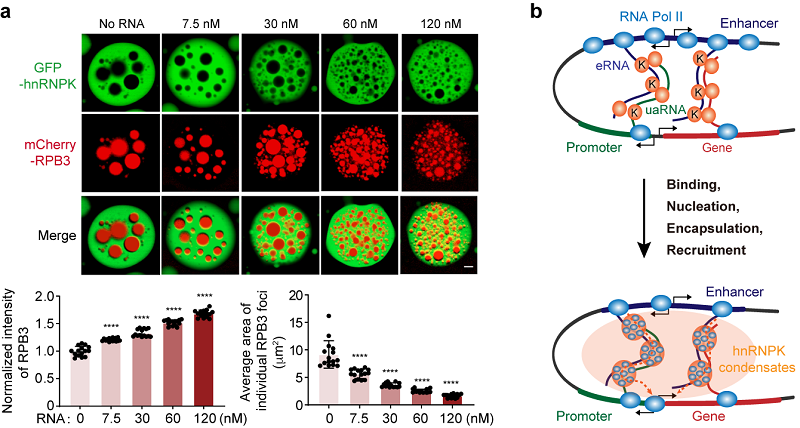
HnRNPK condensates promote enhancer-promoter looping and Pol II recruitment. a. Pooled eRNAs and uaRNAs enhance the encapsulation of RPB3 within hnRNPK phase-separated cavity-containing condensates; b. Schematic model illustrating hnRNPK-mediated transcriptional regulation. (Image by XUE Yuanchao's group)
