Newsroom


The Large High Altitude Air Shower Observatory (LHAASO) revealed that the peculiar binary system Cygnus X-3 in the constellation Cygnus is the highest energy gamma-ray source known to date. The temporal variability and spectral characteristics measured by LHAASO confirmed this object as the source of cosmic rays, with particle energies reaching at least 30 PeV (1PeV=1015eV), far exceeding current theoretical expectations for Galactic accelerators.
The study, published in National Science Review, was conducted by researchers from the Institute of High Energy Physics (IHEP) of the Chinese Academy of Sciences (CAS), the Tsung-Dao Lee Institute at Shanghai Jiao Tong University, the Shanghai Astronomical Observatory of CAS, and other research institutions.
In this study, LHAASO detected flaring activity in ultra-high-energy (>1014eV) gamma rays, which showed a clear temporal correlation with observations at the GeV (1GeV=109eV) band, one million times lower in energy.
During the GeV flaring periods, the Fermi satellite detector and the LHAASO simultaneously detected highly significant signals, while no signals were observed during GeV quiescent periods for LHAASO. The signal exhibited a 4.8-hour periodicity in both GeV and ultra-high-energy gamma rays, reflecting the orbital modulation of the binary system. This allowed the accelerator to be localized within a region roughly three times the size of the Sun—the highest-precision localization ever achieved for an ultra-high-energy particle accelerator in the Universe.
This study confirms Cygnus X-3 as the first ultra-high-energy gamma-ray source with temporal variability, providing a new frontier for ultra-high-energy time-domain astronomy and a new way to study physical processes near compact objects such as black holes. As an extreme cosmic ray accelerator, Cygnus X-3 has important implication for future multi-messenger astronomy research.
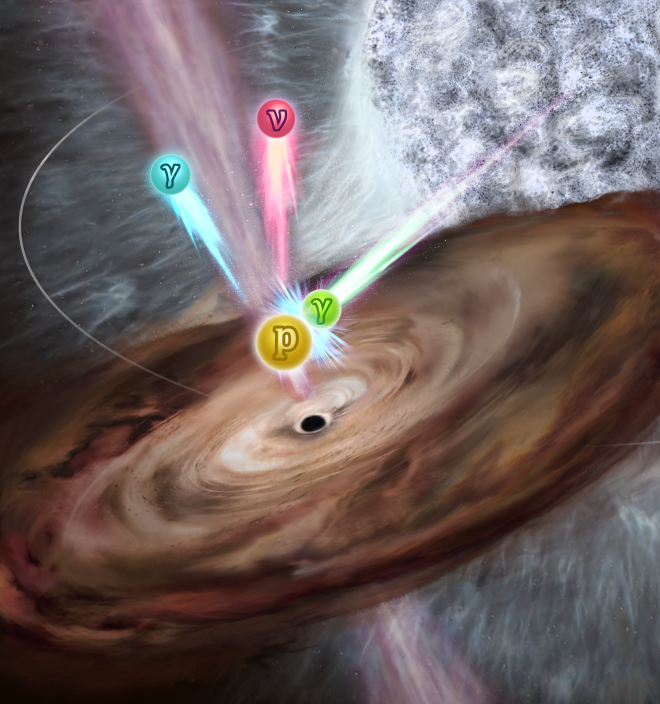
Schematic diagram of high-energy photons and neutrinos produced by interactions between protons from the base of the Cygnus X-3 jet and ultraviolet photons from the companion star. (Credit: LHAASO Collaboration)