
Newsroom


A research team led by Professor YAO Le from the Nanjing Institute of Geology and Paleontology of the Chinese Academy of Sciences (NIGPAS), in collaboration with researchers from institutions in China and abroad, has reconstructed the process and mechanism of a major warming event that occurred about 300 million years ago during the Earth's penultimate icehouse, known as the Late Paleozoic Ice Age (LPIA).
The study, published in PNAS on August 11, shows that the Earth experienced a transient global warming event triggered by volcanic activity and orbital pacing during an icehouse climate state. This event was characterized by a ~7.5 ℃ rise in global mean surface temperature (GMST) and an increase in atmospheric CO2 concentrations (pCO2) from ~300 to ~700 ppm.
The modern world is experiencing unprecedented warming during an icehouse climate state, resulting in ocean acidification, deoxygenation, and the deterioration of marine ecosystems. Throughout geologic time, multiple hyperthermal events have occurred; however, reported hyperthermals during greenhouse climate states are inadequate analogues for modern climate warming due to their dissimilar boundary conditions (i.e., they occurred during a greenhouse climate state instead of an icehouse climate state).
The LPIA is the only deep-time icehouse interval known to have atmospheric pCO2 levels comparable to those of the Quaternary (∼300 ppm). Conodont and brachiopod oxygen isotope (δ18O) records from North America and the Donets Basin indicate climate warming near the Kasimovian-Gzhelian boundary (KGB) during the LPIA. However, due to the low resolution of the available datasets, the magnitude and temporal expression of these δ18O excursions are inconsistent.
To investigate this event further, the researchers conducted a secondary ion mass spectrometry (SIMS) oxygen isotope analysis (δ18Oapatite) of conodonts from the Naqing and Narao sections in South China and the Usolka section in the southern Urals of Russia. Large negative δ18Oapatite shifts at the KGB indicate a pronounced warming event, referred to as the Kasimovian-Gzhelian Thermal Maximum (KGTM).
The KGTM consists of two warming phases, an initial phase and a main warming phase. These phases were characterized by rises in sea-surface temperature (SST) of ~2.0 ℃ and ~3.5 ℃, respectively. Cyclostratigraphy at Naqing constrains the duration of the initial and main phases to ~60 kyr and ~35 kyr, respectively. Comparison of SSTs from Usolka with Community Earth System Model (CESM) simulations of pCO2 indicates a rise in atmospheric pCO2 from ~300 to ~700 ppm. These results reveal that atmospheric pCO2 during the KGTM encompasses the modern range (~300 to ~400 ppm), although present-day rates of temperature rise are far higher (~10–15 ℃/kyr) than estimates for the KGTM (~0.04 to ~0.10 ℃/kyr).
Mercury isotope records (∆199Hg and δ202Hg) indicate the development of photic-zone euxinia (PZE) during the main phase of the KGTM. Marine ecosystems changed at that time, as reflected by decreases in conodont size and diversity, as well as shifts from metazoan to macroalgal reef ecosystems. The coherence of ∆199Hg values (0 to +0.04‰) during the initial phase of the KGTM across South China and the southern Urals indicates a contemporaneous increase in local to regional volcanic activity, which triggered the initial climatic warming. On the other hand, a distinct negative shift in ∆199Hg values during the main phase suggests that the volcanic activity did not continue during that period.
The KGB was marked by coupled and rhythmic variations in the δ18Oapatite and Δ13C (=δ13Ccarb–δ13Corg) records of the Naqing section that conform to 405-kyr long-eccentricity cycles, supporting regulation of atmospheric pCO2 by orbital forcing. During the KGTM event, the initial and main warming phases coincided with maxima of the 100-kyr short-eccentricity cycle and high values of the 405-kyr long-eccentricity cycle.
In conclusion, YAO and his colleagues inferred that the KGTM was initiated by volcanic activity and amplified by superimposed orbital forcing, leading to increased carbon emissions and rapid warming. Based on atmospheric CO2 accumulation during the initial phase, sustained orbital forcing is inferred to have triggered positive climate-carbon cycle feedbacks across a critical climatic tipping point, leading to massive carbon release and abrupt large-scale warming during the main phase of the KGTM.
A major implication of this study is that even modest warming events during the modern icehouse climate warrant humanity's attention, as these events have the potential to lead to the accelerated melting of high-latitude ice sheets and the release of carbon from permafrost. Through positive climate-carbon cycle feedbacks, the Earth system could cross a climatic tipping point and trigger massive carbon release and abrupt large-scale warming. This could lead to a major expansion of oceanic anoxia and biodiversity collapse.
This study was funded by the National Natural Science Foundation of China, the Youth Innovation Promotion Association of CAS, and the State Key Laboratory of Paleobiology and Stratigraphy of NIGPAS.
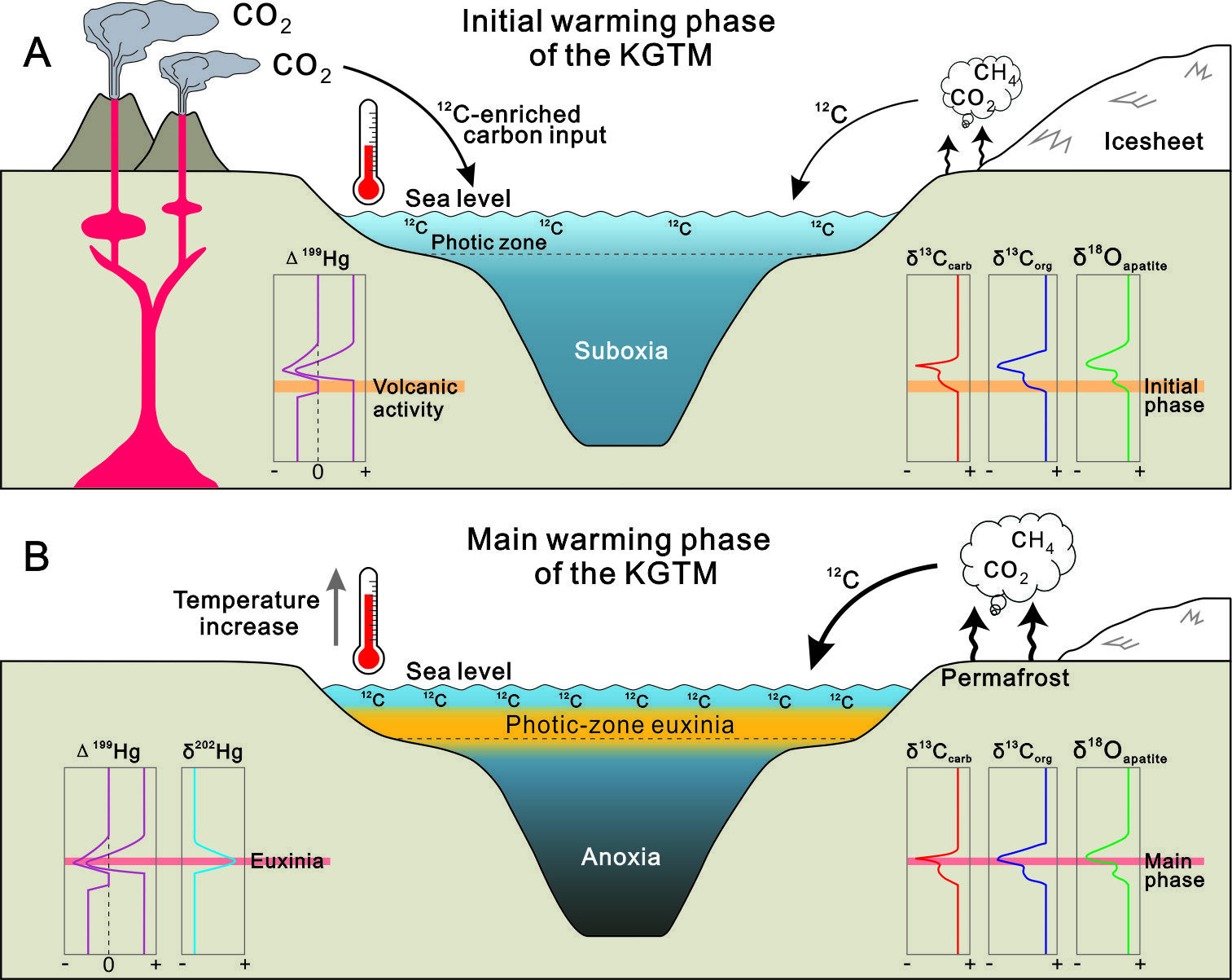
Schematic diagram shows the process and mechanism of the Kasimovian-Gzhelian Thermal Maximum event during the Pennsylvanian Subperiod. (Image by NIGPAS)
